Publié par
Photo d'un membre de l'équipecurve whitecurve white
Charlotte Nowak
Content Manager
Blog
/
Paid
/
A/B Testing: Optimize Your Marketing Campaigns

A/B Testing: Optimize Your Marketing Campaigns

Want to improve your marketing campaign performance? Discover how A/B testing can optimize your conversions and drive better marketing results.

This method lets you compare different versions of a web page or email to identify the variant that generates the best response or sales rate. With A/B testing, base your marketing decisions on data analysis rather than gut instinct. 

Dernière mise à jour :
05
/
06
/
2026

What Is A/B Testing?

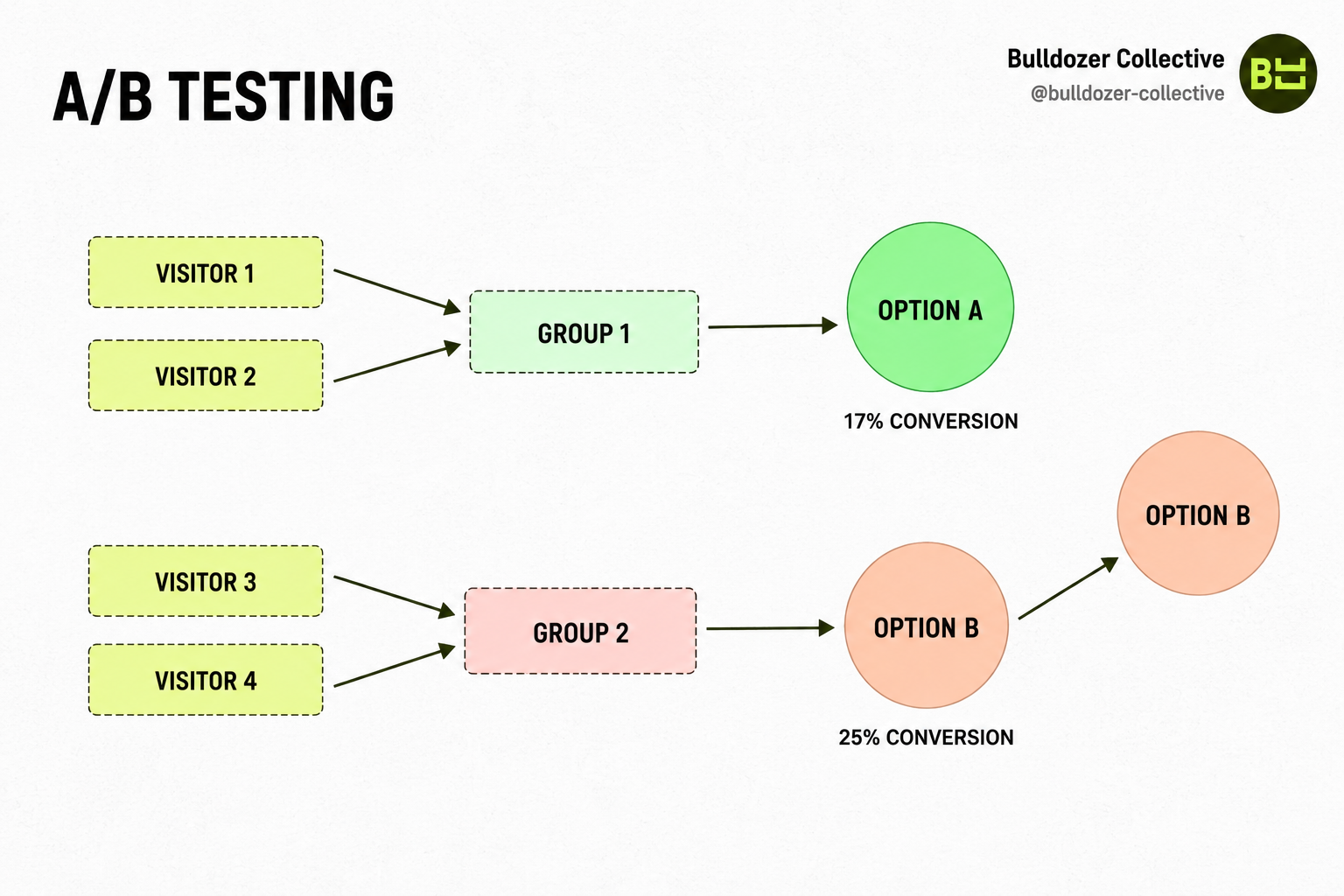
A/B testing, also known as split testing or A/B experimentation, is a scientific method applied to digital marketing. It involves comparing two versions of an element (A and B) to determine which performs better with your audience. 

Have you ever wondered why some companies always seem to have an edge in marketing effectiveness? A/B testing allows you to measure the impact of a change on a variable, evaluating its influence on reaching a specific goal — whether that's a click, a form submission, or a conversion.

This method is an indispensable tool for staying competitive. It helps companies: 

  • optimize their marketing efforts;
  • improve the user experience
  • increase conversion rates

For example, HubSpot reports that one company increased its conversion rate by 49% simply by changing the text of its call to action (CTA) following an A/B test.

How Does A/B Testing Work?

The fundamental principle of A/B testing is straightforward: you create two versions of a marketing element, present them to distinct groups within your audience, then measure which performs better against predefined criteria. 

To run an A/B test, follow these steps:

  1. Define an objective: identify what you want to improve or test. For example, increasing the click-through rate on a sign-up button.

  2. Choose the element to test: select a specific element you want to gather data on. This could be an image, a headline, a CTA button, or even a page layout. For instance, you might want to test two button versions: one red, one blue — to see which drives more clicks.

  3. Create two versions (A and B): develop two variants of the same element. Version A is typically the current version (control), and version B is the new version being tested (variant).

  4. Split your audience randomly: use a tool or software to divide your audience fairly and randomly, ensuring each subgroup is statistically similar.

  5. Run both versions simultaneously: launch both versions at the same time to avoid bias from potential time-based variations.

  6. Analyze the results: use analytics tools to measure each version's performance against your initial objective. Review data such as click-through rates or other relevant performance indicators.

  7. Implement the winning version: choose the version that performed best and deploy it to your entire audience. 

Variables to test can include headlines, CTAs, visuals, layouts, forms, and any other type of content you want to optimize.

Which Tools Should You Use for A/B Testing?

Among the many A/B testing tools on the market, the most popular and well-regarded are:

Note that Google Optimize, Google's free tool, has been discontinued since 2023. 

The effectiveness of your A/B testing can be amplified by integrating it with other marketing tools. For example, platforms like Salesforce Marketing Cloud offer built-in A/B testing features within their full marketing suites.

Want to learn more about your paid advertising potential? 

Demander un audit gratuit
Carte ou profil utilisateur central mis en évidence, entouré d’autres profils en arrière-plan, suggérant une sélection ou une mise en avant d’un utilisateur.
bulldozer

What Are the Best A/B Testing Strategies?

Top A/B Testing Strategies


If you're not sure where to start, here are some commonly run A/B tests:

  • Testing different headlines to improve click-through rates.
  • Comparing various CTA colors or copy to increase conversions.
  • Experimenting with different visuals to boost engagement.

Best Practices for Effective Testing

Also keep the following best practices in mind:

  • test only one element at a time;
  • ensure the sample size is statistically significant;
  • run tests for a sufficient duration;
  • document all tests and their results.

Even small changes can have a significant impact on results. Outcomes can sometimes be surprising, which requires staying open-minded and adaptable. It's also worth noting that A/B testing applies to all industries and company sizes.

Analyzing Results

Analyzing results is key to measuring the success of your A/B testing strategy. 

  1. Verify the statistical significance of your results.
  2. Avoid drawing hasty conclusions based on limited data.
  3. Use results to inform your future hypotheses and tests.
  4. Iterate constantly for continuous improvement.

Have you thought about how you could apply these practices to your own marketing strategy?

Real-World A/B Testing Success Stories

Several companies have achieved impressive results through A/B testing. 

For example, First Midwest Bank increased its overall conversions by 195% through creative A/B testing strategies — experimenting with photos of people on their landing pages and challenging traditional rules by placing key elements at the bottom of the page.

Electronic Arts achieved a 40% increase in SimCity 5 sales by testing a direct purchase option against a discounted offer. The test revealed that customers preferred a simple transaction with no pre-order incentive.

Finally, Gousto, a meal kit delivery brand, increased post-order sales by 20% by replacing its confirmation screen with a step-based screen that encouraged customers to add more products to their cart.

Key Takeaways from These Examples

The main lessons from these success stories are:

  • even small changes can have a significant impact;
  • A/B testing should be a continuous process, not a one-off action;
  • results can sometimes be surprising;
  • A/B testing applies to all industries and company sizes.

A/B testing is an essential tool for optimizing your marketing campaigns and maximizing conversion rates. By systematically testing different elements of your marketing assets, you can make informed decisions based on concrete data rather than assumptions. This allows you to fine-tune your strategies precisely and achieve real results.

Feel free to explore more resources on our site to deepen your knowledge of marketing and conversion optimization. And if you'd like personalized guidance, the Bulldozer Collective team is ready to guide you. Contact us to turn your ambitions into results!

FAQ

L'A/B testing (également appelé split testing) est une méthode scientifique de marketing numérique qui consiste à comparer deux versions différentes (A et B) d'une page de destination, d'un courriel ou d'une application pour déterminer quelle version génère le meilleur taux de conversion. Cette technique permet d'évaluer l'efficacité d'un changement spécifique sur le comportement des visiteurs et d'améliorer l'expérience utilisateur de manière fiable.

L'A/B testing permet de prendre des décisions basées sur des données réelles plutôt que sur l'intuition. Cette approche aide à optimiser le taux de conversion, réduire le taux de rebond, améliorer le retour sur investissement des campagnes marketing et mieux comprendre le comportement des clients. En effectuant des tests réguliers, vous pouvez identifier les facteurs qui influencent positivement l'action souhaitée par vos internautes.

Pour réaliser des tests A/B performants, définissez d'abord une hypothèse claire sur le changement à apporter. Choisissez un seul aspect à tester (texte d'appel à l'action, design de page produit, emplacement d'un bouton). Assurez-vous d'avoir un grand nombre de visiteurs pour obtenir des résultats statistiquement significatifs. Exécutez le test sur une période suffisante pour collecter assez d'informations et éviter les faux positifs ou faux négatifs.

Outre l'AB testing classique, il existe le test multivarié (MVT) qui permet de tester plusieurs variables simultanément sur une même page. Le split URL testing compare deux pages complètement différentes en dirigeant le trafic vers des URL distinctes. Chaque type de test a ses avantages selon l'objectif défini et le niveau de complexité souhaité pour votre site internet.

Pour valider efficacement les résultats, vérifiez la signification statistique en utilisant soit l'approche fréquentiste traditionnelle, soit la méthode bayésienne plus moderne. Analysez non seulement le taux de conversion principal, mais aussi les métriques secondaires comme le temps passé sur la page, le nombre de pages consultées, et les sessions par utilisateur. Documentez chaque insight obtenu pour développer de nouveaux tests et assurer une amélioration continue.

Testez un seul élément à la fois pour des résultats clairs et fiables. Assurez-vous d'avoir un échantillon large pour éviter toute erreur de type I ou II. Exécutez les tests sur une durée suffisante, en général plusieurs semaines selon votre trafic. Formulez des hypothèses précises avant chaque phase de test, et intégrez cette technique dans votre processus marketing quotidien pour une optimisation constante de votre entonnoir de conversion.

L'A/B testing peut être appliqué sur tous les canaux du marketing numérique : pages web de votre site internet, landing pages, courriels marketing, publicités sur les réseaux sociaux, applications mobiles, et même messages SMS. Chaque canal offre des possibilités différentes de personnalisation et de testing, permettant d'optimiser l'expérience utilisateur à chaque point de contact avec votre marque.

Les problèmes les plus fréquents incluent un trafic insuffisant, l'interprétation erronée des données, et les tests multiples simultanés qui peuvent fausser les résultats. Pour les éviter, assurez-vous d'avoir une base statistique solide, formez-vous aux principes scientifiques du testing, priorisez vos tests selon leur impact potentiel sur votre business, et maintenez une sélection aléatoire des destinataires pour éviter tout biais de sélection.

Le test multivarié permet de tester plusieurs éléments simultanément (titre, image, call-to-action, navigation) pour identifier la combinaison la plus performante. Cette approche est particulièrement utile lors d'une refonte complète de page ou pour optimiser plusieurs aspects de l'expérience utilisateur en une seule phase. Cependant, elle nécessite un volume de trafic plus important qu'un simple split test pour obtenir des résultats statistiquement fiables.

Pour aller plus loin

Which Google Ads Agency in Toulouse for Your B2B Growth?

Paid
Charlotte Nowak
agence Google Ads Paris

Top Google Ads Agency in Paris: Who to Choose to Maximise Your ROI?

Paid
SEA
Charlotte Nowak

Effective Strategies to Improve Your Facebook Ads Conversion Rate

Brand Strategy
Growth
Paid
Killian Drecq

Let's talk.

Full-funnel
500+ clients
300+ membres
Prendre un rdv stratégique