Publié par
Photo d'un membre de l'équipecurve whitecurve white
Charlotte Nowak
Content Manager
Blog
/
Content Marketing
/
Your Guide to an Effective Content Strategy

Your Guide to an Effective Content Strategy

Is your content strategy hitting its goals? In today's digital landscape, a well-defined content strategy is an essential element of any business's success.

It attracts and engages your target audience while strengthening your online presence and SEO. Ultimately, well-crafted content enables you to drive your growth.

Let's explore together how to define a strong content strategy and what levers you can pull to deploy it.  

Dernière mise à jour :
16
/
06
/
2026

What Exactly Is a Content Strategy?

A content strategy is a guide that details the creation, publication, and management of your company's content. It encompasses all content types and defines how that content will serve your objectives. 

A complete content strategy covers different points:

  • Identifying your target audience and their needs
  • Identifying the most relevant content types for that audience
  • Planning distribution methods (channels, format)
  • Defining metrics to measure success

In today's digital era, a well-thought-out content strategy is indispensable for several reasons:

  1. Online visibility: Quality content improves your organic search ranking.
  2. Audience engagement: Relevant content attracts and retains your target audience.
  3. Authority and credibility: Sharing your expertise reinforces your expert positioning.
  4. Lead generation: Targeted content attracts qualified prospects.
  5. Differentiation: Unique content sets you apart from the competition.

The impact of a content strategy on growth can be significant. According to a recent study, companies that adopt a strategic approach to content marketing generate on average 67% more leads than those that don't.

Defining Your Content Strategy Objectives

Defining clear, measurable objectives is crucial in building an effective content strategy. These objectives will guide your efforts and allow you to evaluate your strategy's success. To be effective, your objectives must follow the SMART model:

  • Specific
  • Measurable
  • Achievable
  • Relevant
  • Time-bound

Concretely, here is what SMART objectives for a content strategy might look like:

  1. Traffic increase: "Increase website organic traffic by 30% over the next 6 months by publishing 2 SEO-optimized blog posts per week."
  2. Engagement improvement: "Increase social media engagement rate by 20% over the next 3 months by sharing interactive content daily."
  3. Lead generation: "Generate 100 new qualified leads per month through downloadable content over the next 4 months."

Identifying your objectives is the first step in building a relevant content strategy. Don't skip this step, or you risk spending time and resources producing content that has no impact.

Analyzing Your Audience and Market

An effective content strategy is built on a deep understanding of your audience and your market. This analysis allows you to create content that resonates with your target audience. Here are some effective methods to better understand your audience:

  1. Creating personas: Develop detailed profiles of your ideal customers.
  2. Data analysis: Use web analytics tools to understand your visitors' behavior.
  3. Surveys and polls: Query your audience directly.
  4. Social media analysis: Study your audience's interactions on social media.
  5. Customer feedback: Analyze comments and frequently asked questions.

Using data is essential to refine your content strategy. It allows you to:

  • identify popular topics;
  • optimize content formats;
  • personalize your approach;
  • continuously improve your strategy.

Creating and Managing Your Content: Keys to Success

Once your objectives are defined and your audience analyzed, the next step is to set up an efficient system to create and manage your content.

Content Planning

Effective planning is the secret to a successful content strategy. Essential elements include:

  • a detailed editorial calendar;
  • identification of main themes and topics;
  • consideration of seasonality;
  • a balance between different content types.

Content Types to Prioritize

The choice of content types and distribution channels depends on your audience and your objectives. Here are some popular formats:

  1. Blog posts (e.g. for SEO) 
  2. Educational videos, webinars, interviews, immersive content…
  3. Educational or entertaining infographics
  4. Podcasts on current events, societal topics, or niche subjects depending on your audience
  5. Case studies to help your audience project themselves
  6. User-generated content such as social media comments

Effective Management of Your Editorial Calendar

For effective management of your editorial calendar:

  • Use project management tools
  • Define clear roles and governance within your team
  • Establish creation and review processes
  • Plan content in advance
  • Maintain flexibility to react to current events

To get the most out of your editorial calendar, it's essential to make it a collaborative tool where everyone feels invested. The calendar creates a form of consistency and structure in content production: two essential concepts if you hope to generate engagement.

Want to learn more about your content potential? 

Demander un audit gratuit
Carte ou profil utilisateur central mis en évidence, entouré d’autres profils en arrière-plan, suggérant une sélection ou une mise en avant d’un utilisateur.
bulldozer

How to Optimize Your Content Strategy?

Once your content is created and published, you can optimize it, collect performance data, and continue to improve it. 

Tools and Techniques to Optimize Content

Here are some essential tools and techniques to boost the effectiveness of your content:
  1. SEO: Use tools like SEMrush or Ahrefs to optimize your content for search engines.
  2. Content analysis: Tools like Clearscope can help you optimize your content based on SEO best practices.
  3. A/B testing: Test different versions of your headlines, images, or calls to action to select the most effective ones.
  4. Social media optimization: Use tools like Hootsuite to schedule and optimize your posts.
  5. Page speed optimization: Improve your page load speed with tools like Google PageSpeed Insights.

Measuring Performance and Adjusting Your Strategy

__wf_reserved_inherit

To build a continuous improvement dynamic, you must adopt a data-driven approach. 5 key steps can help you structure your data analysis.

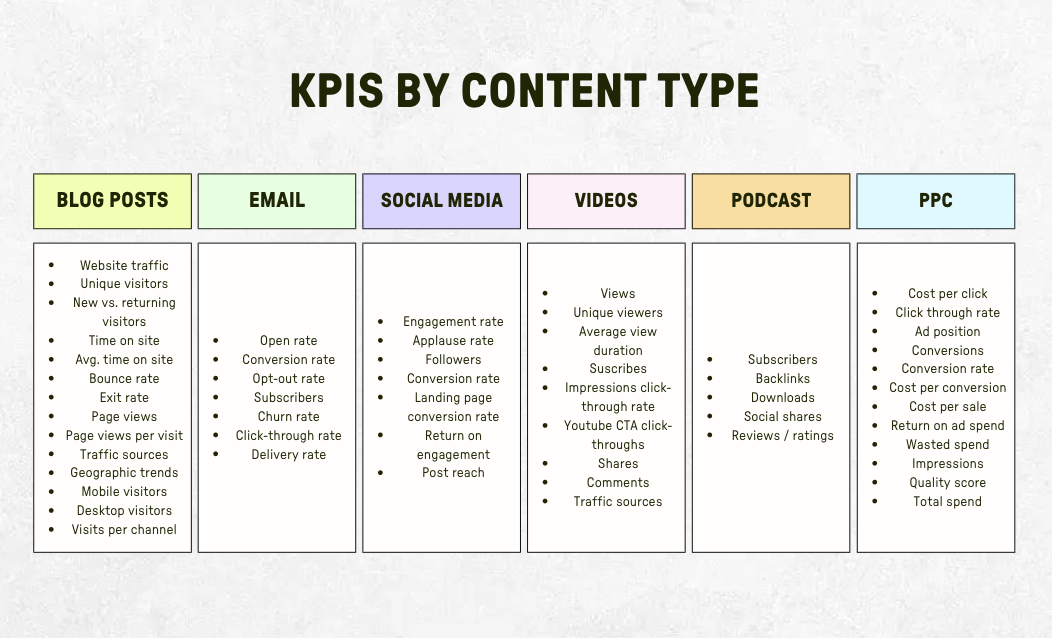
  1. Define your KPIs, the priority metrics to track for evaluating your strategy's performance.
  2. Use analytics tools like Google Analytics to understand your audience's behavior.
  3. Establish a data analysis routine with the right team members. 
  4. Identify trends and patterns that work in your competitive landscape.
  5. Adjust your strategy based on collected data and your objectives. 

Through thorough data analysis, you can significantly improve your marketing processes and make more effective strategic decisions.

Successful Content Strategies: Case Studies

Data Analysis and Strategic Optimization: The Aircall Case

Aircall, a cloud telephony solution, implemented a comprehensive content strategy to improve visibility and generate leads. Their strategy includes:

  • a competitor audit and benchmark;
  • a detailed SEO roadmap;
  • advertising campaigns across various platforms;
  • analysis and optimization of existing campaigns.

Results: Fast, relevant insights, improved processes, and a clear roadmap for future growth.

Real Estate Tokenization Campaign: The Atoa Case

Atoa launched a content campaign to attract investors and build an engaged community. The French startup activated several levers to achieve its objectives:

  1. Ad campaigns across various platforms to reach its audience.
  2. Lead nurturing campaigns to qualify prospects.
  3. Creation of organic content to gain visibility at lower cost.

Results: 1,119 leads generated, 28% reduction in cost per lead, and 100% of the operation funded. Mission accomplished for the pioneer of real estate tokenization.

In conclusion, a well-thought-out and well-executed content strategy is a central element of modern digital marketing. It allows you to communicate effectively with your audience and drive your company's growth.

By defining clear objectives and adopting a continuous improvement approach, you'll be able to develop an effective content strategy that propels your business toward success.

FAQ

Une stratégie de content marketing efficace repose sur plusieurs éléments clés. Commencez par définir des objectifs SMART (spécifiques, mesurables, atteignables, pertinents, temporels) pour votre marketing de contenu. Identifiez votre client idéal et créez des personas détaillés pour adapter votre ligne éditoriale. Élaborez ensuite un planning éditorial cohérent qui intègre différents types de contenus (articles de blog, vidéos, infographies) sur vos canaux de diffusion (site internet, médias sociaux, LinkedIn, Instagram). Cette approche permet de renforcer votre présence en ligne et d'établir votre expertise dans votre domaine d'activité.

Pour évaluer l'efficacité de votre stratégie de création de contenus, surveillez plusieurs métriques importantes : le taux de conversion qui mesure l'impact sur vos ventes, le taux de rebond de votre site internet, le nombre de visiteurs et leur temps passé sur vos pages. Analysez également l'engagement sur vos médias sociaux (partages, commentaires), la génération de leads qualifiés, et l'amélioration de votre positionnement dans les moteurs de recherche. Ces indicateurs vous permettront d'ajuster votre stratégie digitale et d'optimiser votre système de gestion de contenu pour maximiser la conversion et l'expérience utilisateur.

Pour créer un contenu qui capte l'attention et répond aux attentes de votre audience, concentrez-vous sur l'information utile et pertinente pour votre secteur. Utilisez diverses méthodes de création : articles de blog optimisés pour les moteurs de recherche, vidéos éducatives, livres blancs, études de cas. Votre contenu doit informer, inspirer et convaincre tout en restant cohérent avec votre message de marque. Adaptez le format selon le canal de diffusion (texte long pour le blog, contenu visuel pour Instagram) et maintenez une approche d'inbound marketing qui attire naturellement vos prospects vers vos produits ou services.

La mise en place d'une stratégie de communication efficace nécessite une approche structurée. Commencez par déterminer les canaux les plus adaptés à votre cible (site web, social media, mail, LinkedIn). Créez une ligne éditoriale spécifique à chaque plateforme tout en maintenant une cohérence globale de votre brand content. Utilisez un planning éditorial pour organiser vos publications et assurer une présence régulière. Intégrez du contenu gratuit à forte valeur ajoutée pour attirer l'attention, puis guidez vos prospects vers vos offres commerciales grâce à des liens stratégiques et des call-to-action bien positionnés.

Le brand content est essentiel pour créer une stratégie de contenus engageante sur les réseaux sociaux. Partagez votre expertise à travers des contenus éducatifs qui positionnent votre marque comme experte dans son domaine. Variez les formats selon les plateformes : vidéos courtes pour Instagram, articles professionnels pour LinkedIn, infographies pour le partage. Créez des contenus qui encouragent l'interaction et le partage, utilisez des mots-clés pertinents pour améliorer votre visibilité, et intégrez des éléments de promotion subtile de vos services. Cette approche de social media marketing permet de construire une communauté engagée tout en générant des opportunités commerciales.

Pour créer une stratégie de contenus optimisée pour les moteurs de recherche, effectuez d'abord une recherche approfondie des mots-clés pertinents pour votre thématique. Organisez votre contenu autour de ces termes en créant des pages spécifiques pour chaque sujet important. Adoptez une approche de création régulière avec un calendrier éditorial qui maintient la fraîcheur de votre site. Optimisez chaque page avec des titres accrocheurs, des méta-descriptions pertinentes, et une structure claire. Intégrez des liens internes pour améliorer la navigation et créez du contenu long et détaillé qui répond aux questions de vos internautes. Cette méthode améliore votre positionnement sur Google tout en offrant une expérience utilisateur de qualité.

Pour aller plus loin

Comment utiliser le snack content pour engager votre audience B2B

How to Use Snack Content to Engage Your B2B Audience?

Content Marketing
B2B
Killian Drecq
Web-to-Store

Web-to-Store: Turn Your Visitors into Physical Customers

Brand Strategy
Content Marketing
Killian Drecq
organique-linkedin

The End of Free LinkedIn Reach: The Playbook to Keep Your Impact

SEA
Content Marketing
Sébastien Castelli

Let's talk.

Full-funnel
500+ clients
300+ membres
Prendre un rdv stratégique