
Publié par
Photo d'un membre de l'équipecurve whitecurve white
Charlotte Nowak
Content Manager
Blog
/
Growth
/
A Guide to Optimizing Your B2B Lead Generation

A Guide to Optimizing Your B2B Lead Generation

Want to turn anonymous visitors into won clients? Discover how an effective B2B lead generation strategy can become your greatest ally for driving sales growth. 

Apply our methods to capture more prospects and optimize your sales process, so every click on your site truly counts. Dive into the world of B2B opportunities and start seeing results now.

Dernière mise à jour :
05
/
06
/
2026

What Is B2B Lead Generation?

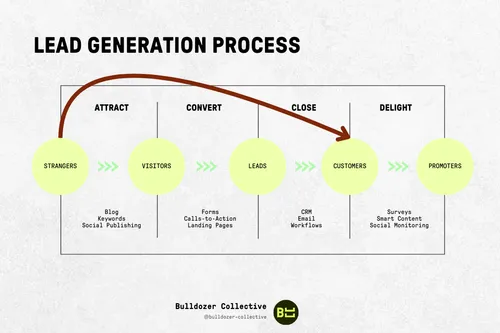
B2B lead generation is an essential strategic process aimed at identifying, attracting, and converting qualified prospects for businesses operating in a business-to-business context. It plays a crucial role in the sales cycle by ensuring a steady flow of potential clients and driving revenue growth. Key benefits include:

  • Building a solid pipeline, guaranteeing a constant flow of commercial opportunities.
  • Increasing sales and revenue through precise targeting of highly qualified prospects.
  • Strengthening brand awareness within your sector.
  • Better understanding of the needs and expectations of your potential clients.
  • Optimizing marketing ROI by focusing on prospects most likely to convert.

B2B vs. B2C Lead Generation: Key Differences

You may wonder how B2B prospecting differs from B2C lead generation. Here are the main differences:

  • Longer sales cycles, as purchase decisions in B2B typically involve multiple stakeholders.
  • More complex purchasing decisions, as financial stakes are generally higher.
  • Greater need for informative content and proof of solution effectiveness.
  • Greater importance of relationships, particularly long-term ones.
  • More precise targeting, as the B2B market is often more niche.

Analyzing and Measuring Your Current Efforts

Before implementing new strategies, it's essential to evaluate the effectiveness of your current efforts to determine what's working and what needs improvement.

The following metrics will help you understand your current lead generation performance:

  • Your visitor-to-lead conversion rate — the percentage of website visitors who complete a form, sign up for a newsletter, etc. 
  • Your top-performing traffic sources — the channels generating the most traffic to your site.
  • Time on site and bounce rate — indicators of visitor engagement with your content.
  • The user journey on your site — understanding how visitors interact with your content.
  • The performance of landing pages — analyzing page elements like headlines, copywriting, images, sign-up forms, and calls to action. 

Understanding these metrics lets you identify strengths and weaknesses in your strategy, and ask these essential questions: 

  • Which channels generate the most qualified leads?
  • Which content types drive the most engagement?
  • What is the cost of acquisition per lead for each channel?
  • What is the quality of leads generated by each campaign?
  • How do your campaigns compare to those of your competitors?

The Best B2B Lead Generation Techniques

__wf_reserved_inherit

Let's now look at the best strategies to complement and strengthen your B2B lead generation approach.

Content Marketing and SEO

Content marketing — creating quality content — can position your company as an expert in your field and attract qualified leads.

A corporate communications strategy implemented by Seer Interactive demonstrated a 150% increase in lead conversion rate. This was achieved by optimizing landing pages, improving call-to-action visibility, and streamlining content to better engage visitors.

The most effective content formats in B2B are:

  • Blog articles on expertise topics;
  • Case studies detailing solutions to specific problems;
  • Webinars and explainer videos;
  • Infographics summarizing complex data;
  • Podcasts featuring industry experts.

Paid Advertising (PPC)

Paid advertising, for example via Google Ads, can be a fast way to generate B2B leads. Use relevant, high-intent keywords to target potential clients. Also consider:

  • Using dedicated landing pages for each campaign;
  • Testing different ad variants (A/B testing);
  • Leveraging ad extensions to maximize visibility;
  • Targeting keywords with B2B purchase intent;
  • Using remarketing to re-engage visitors who have already shown interest.

Want to find out more about your growth potential? 

Demander un audit gratuit
Carte ou profil utilisateur central mis en évidence, entouré d’autres profils en arrière-plan, suggérant une sélection ou une mise en avant d’un utilisateur.
bulldozer

Professional Social Networks

In the professional social network category, LinkedIn is essential. It's highly effective for targeting prospects through its advanced targeting capabilities and B2B-specific advertising tools

With LinkedIn, you can:

Marketing Automation

Using platforms such as Webmecanik or Blacksales, you can automate your lead nurturing campaigns, send personalized emails, and track prospect engagement throughout the buying journey.

Marketing automation allows you to:

  • Personalize communications at scale;
  • Segment your database;
  • Track prospect behavior;
  • Integrate with your CRM for end-to-end tracking.

Using a CRM

A customer relationship management (CRM) system lets you centralize prospect information, track interactions, and optimize your sales process. Popular options include Salesforce and HubSpot CRM.

Key features to look for in a B2B CRM:

  • Detailed tracking of interaction history with each lead.
  • Ability to assign lead scores.
  • Integration with your marketing automation tools.
  • Advanced reporting to analyze the performance of your sales efforts.
  • Collaboration features to align marketing and sales teams.

Lead Scoring

Lead scoring allows you to qualify and prioritize leads based on their purchase potential. Tools such as HubSpot, Marketo, and Salesforce Pardot use artificial intelligence to analyze prospect behavior and predict purchase propensity, offering significant improvements in the precision and efficiency of prospect qualification.

A good lead scoring system takes into account:

  1. Demographic and firmographic data — age, gender, job title, company size, industry, etc.
  2. Online behavior — pages visited, document downloads, and time spent on the site.
  3. Engagement with your emails and content — open rates, click rates, and conversion rates from email campaigns and shared content.
  4. Interactions with your sales team — direct communications, meetings, calls, and responses to commercial proposals.
  5. Match with your ideal customer profile.

Tracking Your Results

To understand the impact of your new strategies, analyze the performance of each channel, the conversion rate of different content types, and prospect behavior at each stage of the sales funnel. 

Build custom dashboards to track your most important KPIs, such as:

  • The conversion rate by channel and campaign;
  • The cost per acquired lead;
  • The lead qualification rate;
  • The length of the sales cycle;
  • The average value of signed contracts.

Finally, measure ROI using analytics tools to track the complete journey of your leads. When calculating ROI, account for:

  • The total costs of your lead generation campaigns;
  • The long-term value of acquired clients (LTV — Lifetime Value);
  • Client retention rate;
  • Impact on brand awareness and market positioning;
  • The effectiveness of alignment between marketing and sales teams.

An effective B2B lead generation strategy is indispensable for any company looking to improve its commercial performance and drive growth.

Ready to transform your B2B lead generation approach? Put the advice in this article into practice. And if you want to go further in optimizing your strategy, the Bulldozer Collective team is here to support you. Contact us to discover how we can help you maximize your commercial opportunities!

FAQ

B2B lead generation is the process of identifying, attracting, and converting potential prospects for companies that sell to other companies, with the goal of turning them into loyal customers. This digital strategy involves building a connection with decision-makers who have shown interest in your product or service, by offering relevant resources such as a white paper or high-quality content on your website.

To obtain qualified leads and grow your business-to-business, the first step is to define your targets and understand their needs. A comprehensive inbound strategy combines organic search (SEO) on Google and other search engines, the creation of valuable content including white papers and specialized resources, optimizing your landing page with effective calls to action, participating in professional events and trade shows, using social networks and social media, sending targeted emails, and analyzing interest signals in real time.

The best lead generation techniques include content marketing to offer relevant resources and engage the target audience, an inbound strategy to naturally attract prospects through SEO and content, using social networks like LinkedIn to interact with decision-makers, digital marketing with targeted campaigns and an optimized budget, marketing automation via specialized software to manage leads and track performance, integrating live chat to improve the customer experience on your website, and participating in events or running webinars.

The main objective is to build a solid sales pipeline that makes it possible to convert anonymous visitors into new customers. This approach helps build a sustainable marketing strategy, increase the ROI of your marketing investment, improve your understanding of your target audience's needs, develop strong added value for your company, and optimize the effectiveness of your sales campaigns.

The essential tools for an effective lead strategy include generation platforms such as HubSpot, Marketo, or Pardot, lead generation software and CRMs like Salesforce for lead management, working with a marketing agency specialized in B2B lead generation, analytics tools such as Google Analytics for performance tracking, integrating a customer service solution with live chat and a call center, as well as automation solutions for sending contact details and nurturing.

To evaluate your lead generation process, you should analyze the conversion rate from the website to prospect contact details, the cost per lead acquisition by channel, lead qualification and their progression through the sales pipeline, customer reviews and feedback on the user experience, the effectiveness of campaigns by channel - whether SEO, social, or email - as well as the analysis and planning of performance in real time.

Every company must adapt its strategy according to its business model. The technology sector requires frequent updates to code and features, B2B services call for a focus on expertise and customer testimonials, high-priced products involve a longer qualification process, niche markets demand a personalized approach with a dedicated person, while digital solutions benefit from demos and free trials.

Generally, you can start to see an improvement in the quality and quantity of your leads after 3 to 6 months of consistent implementation. The investment varies depending on the complexity of your offer and target market, the many phases of the sales process, the choice between a specialized agency or in-house management, the scope of your digital strategy including SEO and social selling, as well as the raw material of content already available.

To optimize your calls to action and conversion, you need to refine your homepage with an attractive design and a clear message, use engaging visuals to capture attention, simplify the forms for entering contact details, smooth out the customer journey at each lead generation stage, adapt the content to the specific target audience, and run A/B tests to compare different versions and optimize performance. This holistic approach helps build a robust lead generation strategy, tailored to the specifics of the B2B market and the expectations of modern decision-makers.

Pour aller plus loin

Defining Your ICP When You Don't Know Where to Start: The Bulldozer GTM Framework

Brand Strategy
Bulldozer
Growth
Charlotte Nowak
Tunnel de conversion : les meilleures pratiques pour convertir vos leads

Conversion Funnel: Best Practices to Convert Your Leads

Growth
Killian Drecq
buyer persona

From Buyer Persona to Sales: The Marketing Journey in 4 Steps

Growth
Charlotte Nowak

Let's talk.

Full-funnel
500+ clients
300+ membres
Prendre un rdv stratégique