
If you spend any time in the world of digital marketing, you've heard the term growth hacking. A core concept of growth piracy? Yes. An empty buzzword? Absolutely not. Behind this intriguing expression lies a radically different marketing approach — built for those who want to grow fast, strong, and smart.
Growth hacking is the art of subverting conventional methods to generate growth at record speed. Unlike traditional marketing, which relies on established playbooks and sizeable budgets, growth hacking is built on agile experimentation, relentless testing, and surgical optimization — all within a resolutely data-driven mindset.
An approach built for speed and efficiency 🚀
Growth hacking is a collection of unconventional marketing techniques designed to rapidly accelerate a company's growth. The objective? Maximize prospect-to-customer conversion, extend customer lifetime value, and multiply digital impact with minimum resources.
Rather than waiting months for a traditional campaign to deliver results, growth hacking relies on an iterative, scientific approach:
It's a discipline powered by experimentation, driven by growth hackers obsessed with performance and data, and guided by a customer-centric strategy.
The term "growth hacking" was coined in 2010 by Sean Ellis, who was searching for an expert capable of propelling startups like Dropbox in record time. Since then, giants like Airbnb, PayPal, and TikTok have built their success on growth hacking strategies for startups — combining smart traffic acquisition, viral loops, and optimized conversion funnels.
Unlike classical marketing, which follows long-term plans, growth hacking focuses on rapid optimization and constant testing. It's not simply SEO or advertising: it's creative, automated execution, often driven by specialized growth hacker tools, enabling exponential results within a growth-oriented digital marketing mindset.
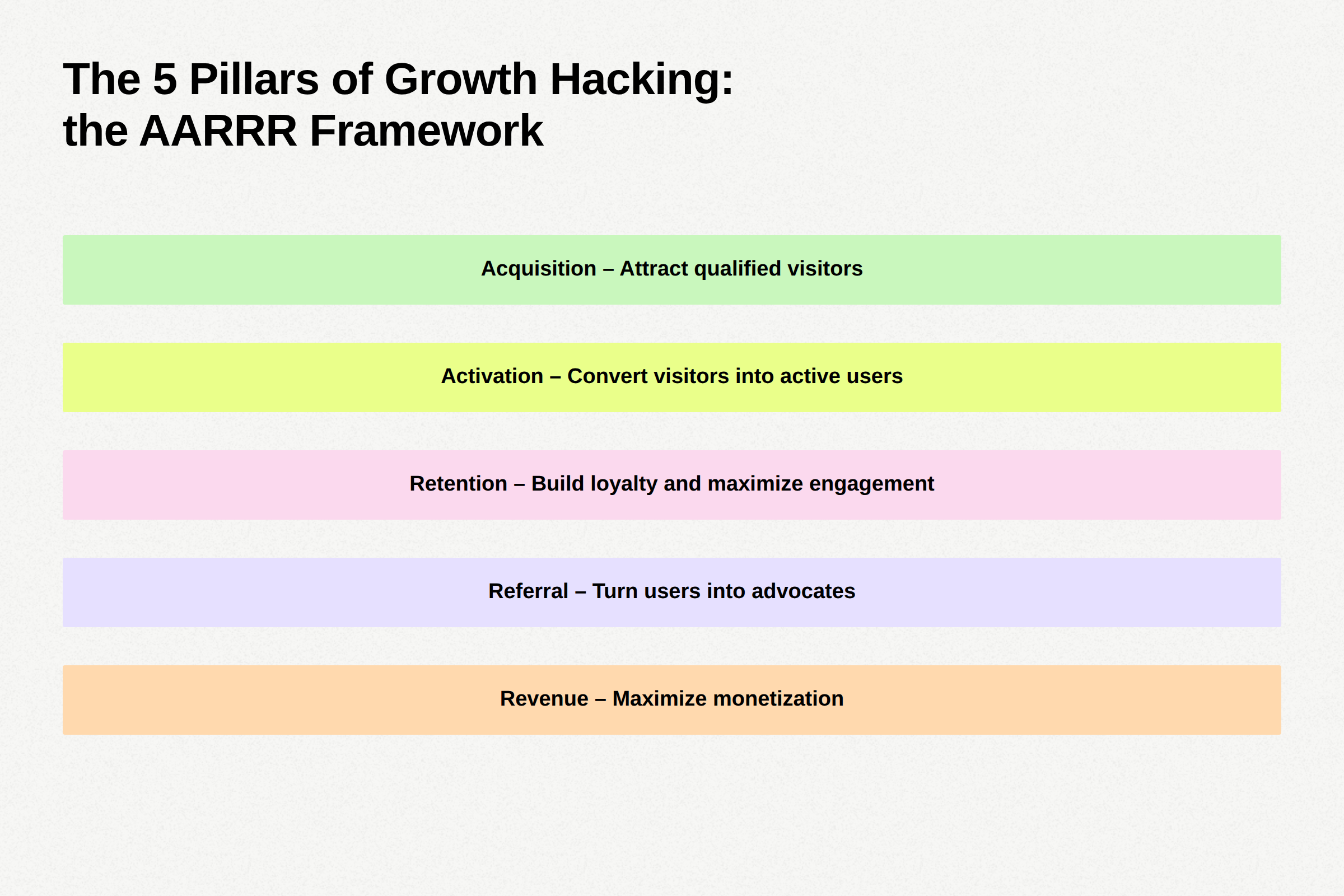
The AARRR framework, created by Dave McClure, is the reference model for growth hacking. It structures the customer lifecycle into five key stages — from entering the conversion funnel to monetization, via activation, retention, and referral. Each phase relies on specific digital strategies that enable rapid, efficient growth.
Growth hacking goes far beyond SEO or advertising. What makes the difference is agile execution, creativity, and continuous optimization — all 100% data-driven.
The goal is to bring the maximum number of potential customers to an offer using diverse digital levers:
Growth hack examples:
Activation means optimizing the experience from the very first interaction to minimize drop-off and maximize engagement.
Techniques used by top growth hackers:
Converting a contact into a customer is good. Getting them to come back is even better. Retention relies on actions that strengthen the relationship and encourage regular product usage.
Growth hack examples:
A satisfied customer can become a powerful growth lever. Encouraging referrals unlocks lasting viral momentum and reduces the costs of traffic acquisition.
Examples of digital strategies deployed by growth hackers:
The objective is to optimize lead-to-paying customer conversion and increase long-term customer lifetime value.
Examples of growth hacking techniques:
[rta-block=folder-cta][rta-title=h3]Want to explore your growth potential?[rta-title=h3][rta-btn=regular href="/prendre-rendez-vous-typeform" target=_blank]Get a free audit[rta-btn=regular][rta-block=folder-cta]
Growth hacking has been a digital accelerator for many companies that knew how to leverage existing platforms, repurpose established behaviors, and maximize virality. These growth hacking strategies for startups and scale-ups — often ingenious and low-cost — enabled them to build brand awareness, expand their customer base, and establish themselves at scale.
From day one, Dropbox bet on an incentive-based referral program by offering extra storage space to users who invited contacts to sign up. This approach harnessed the natural virality of word-of-mouth, dramatically reducing digital marketing costs while delivering rapid growth.
👉 Why it works:
Airbnb used an ingenious hack by enabling users to automatically post their listings on Craigslist, the ultra-popular classified ads site in the US. This bridge between two platforms allowed Airbnb to channel qualified traffic directly from Craigslist, targeting prospects already interested in short-term rentals.
👉 Why it works:
At launch, PayPal deployed a bold strategy: offering $10 to new users and their referrers alike. This approach rapidly accelerated acquisition by creating immediate interest in the service and motivating users to invite their network.
👉 Why it works:
Spotify leveraged social networks from its earliest days by enabling playlist sharing and Facebook integration. By displaying what users were listening to in real time, Spotify transformed music listening into a social experience — reinforcing retention and powering organic discovery through digital word-of-mouth.
👉 Why it works:
Growth hacking runs on innovative, automated techniques that maximize acquisition, engagement, and retention. Here are concrete strategies any company can test to accelerate growth.
The freemium model attracts new users at scale, but the real optimization lies in converting them to paid. By limiting access to certain features or introducing a time-restricted trial, you create a sense of urgency that accelerates the purchase decision.
Trade shows and professional events are expensive. So make every square foot of your booth count. A simple but powerful digital growth hacking technique: scrape the attendee list (via platforms like Eventbrite or the event's LinkedIn page), then reach out before or on the day with a personalized LinkedIn message.
👉 Result:
A clever strategy for generating qualified traffic without blowing your ad budget.
Some real estate agencies have fully cracked growth hacking. Instead of relying solely on traditional viewings, they place QR codes on "For Sale" signs outside properties. Scanning the code gives instant access to a virtual tour, a detailed listing, or a contact form — no need to enter the building.
👉 Why it's clever:
A great example of growth hacker tools integrated into the real world.
Companies like Notion and Superhuman used gamified waitlists to build demand before their product even launched. The principle is simple: early access is offered to users who share their referral link, creating scarcity and organic word-of-mouth at zero cost.
Generic pop-ups can feel intrusive — but when triggered intelligently, they boost conversions without hurting the user experience. A message that appears just before a visitor leaves, offering an exclusive deal or promo code, can significantly reduce abandonment rates.
Generic emails have weak open and click rates. By using behavioral analytics, you can send ultra-targeted recommendations based on user actions (pages visited, products viewed, purchase history). This level of personalization significantly increases engagement and conversions.
Transforming the user experience into a game — with rewards, levels, or badges — stimulates interaction and retention. This technique is especially effective for SaaS, mobile apps, and e-commerce platforms, where a points program or VIP status encourages users to return regularly.
Growth hacking is neither a magic formula nor a simple list of tricks. It's an approach built on rapid experimentation, continuous optimization, and intelligent exploitation of digital levers. By combining creativity, data analysis, and automation, it's possible to generate exponential growth — even with limited resources.
Every company needs to test, measure, and refine its strategies to find what works best in its context. The key is to adopt an agile, results-oriented mindset. You now have the tools — time to take action.
Lorem ipsum
.jpeg)
Writer at Bulldozer, he covers web scraping, UGC and no-code, mixing data, storytelling and SEO.
Can't find what you're looking for ? Contact us here
jordan@bulldozer-collective.comGet access to playbooks and feedback from those who are shaping the next wave of marketing and AI.




 ChatGPT
  Perplexity
  Claude