
Publié par
Photo d'un membre de l'équipecurve whitecurve white
Charlotte Nowak
Content Manager
Blog
/
Growth
/
From Buyer Persona to Sales: The Marketing Journey in 4 Steps

From Buyer Persona to Sales: The Marketing Journey in 4 Steps

A buyer persona is a detailed ideal customer profile that describes your typical buyer — their role, goals, frustrations, purchasing behaviors, acquisition channels, and decision criteria — in order to guide your digital marketing (SEO, acquisition) and sales efforts. When built properly, your messages, content, and campaigns become more targeted and effective, with a direct impact on traffic and lead generation (website, email, social media).

If you're searching "buyer persona example," you're not looking for theory — you want a clear, reusable model, maybe a buyer persona template, to structure your profile without spending weeks on it.

In this article, we'll do exactly that: clarify the difference between target market, ICP, and marketing persona; break down the anatomy of a high-performing buyer persona; walk you through a concrete example — and then give you a simple method for building an actionable buyer persona you can put to work in your next content campaign.

Ressource en lien
4 Growth Loop Models
Dernière mise à jour :
05
/
06
/
2026

Buyer persona, customer avatar, target market: setting the record straight

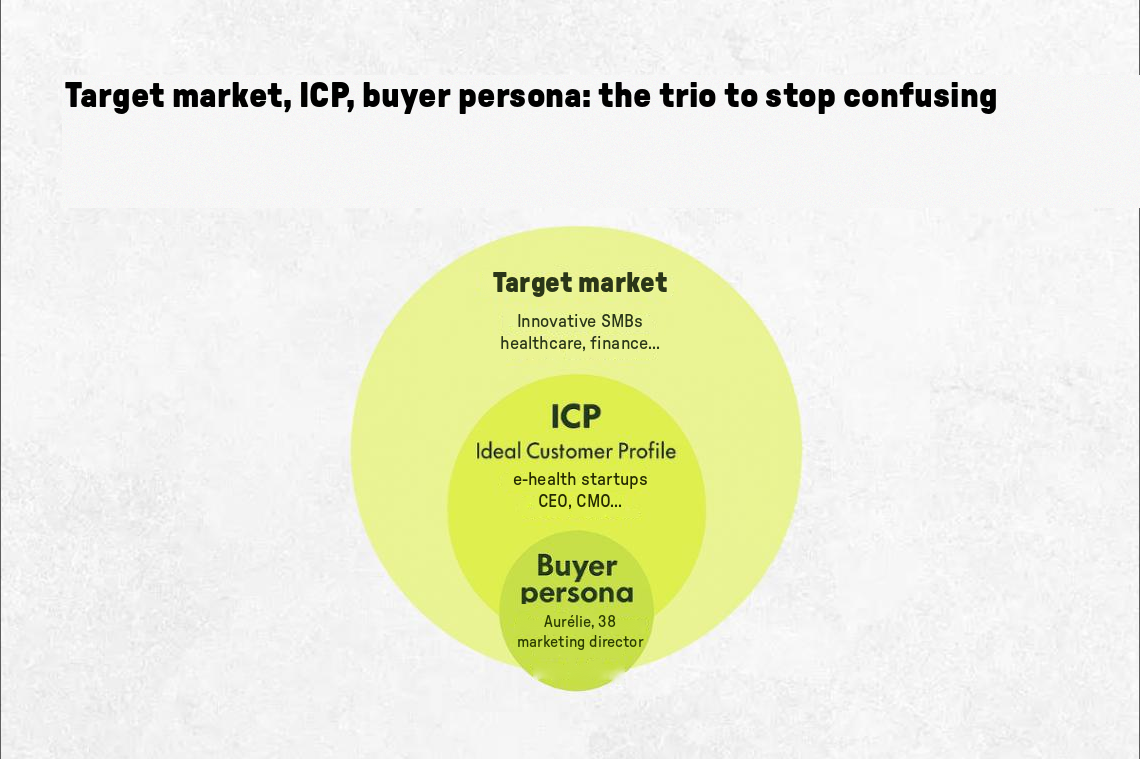
Target market, ICP, buyer persona: the trio you need to stop conflating

Many teams think they "know their customer" — when all they really know is their market segment.

Target market, ICP, user persona, buyer profile — the terms get blurred, and the message gets diluted.

Let's clear it up:

  • The target market is the broad universe.
  • Example: "B2B SMBs with 10–200 employees in SaaS, across English-speaking markets."
  • We're talking volume, segments, geographies.
  • The ICP (Ideal Customer Profile) is the ideal company type within that market.
  • Example: "Subscription-based B2B SaaS, between $2M and $20M ARR, marketing team of 5 or fewer, under strong lead generation pressure."
  • We're talking company type, business model, digital maturity, and return on investment.
  • The buyer persona is the concrete individual inside that ICP.
  • Example: "Claire, CMO, 36, running a small marketing team, caught between the board and operational reality."
  • We're talking goals, pain points, useful demographic data, purchasing behaviors, and decision criteria (often tied to brand perception).

In other words:

  • target market = "where we play";
  • ICP = "which types of companies we actually want to work with";
  • buyer persona = "who we're talking to inside those companies".

When you describe "the mid-market industrial segment," you're still at the market level.

When you describe "Julien, an operations director who needs to digitize his processes without disrupting production," you're starting to build a real customer avatar.

buyer persona

What a strong buyer persona does for your digital strategy

A well-built buyer persona isn't just another deliverable — it's a filter for every decision you make across digital marketing, prospecting, and content.

  • For content strategy, a clear persona lets you choose genuinely useful topics, the right level of depth, and the right formats (articles, case studies, comparisons, webinars, email sequences) — all in the language your customer actually uses: their words, their fears, their goals.
  • For acquisition and the conversion funnel, it helps you prioritize channels (SEO, SEA, LinkedIn, email, events), understand what your prospects are actually searching for, and tailor your CTAs accordingly: demo, audit, template, trial, meeting booking.
  • On the sales side, it aligns marketing and sales around the same vision of the buyer profile, feeds qualification scripts, prepares responses to objections, and gives customer success the early warning signals to watch for.

If your buyer persona doesn't change how you write an email, a landing page, a LinkedIn post, or a sales pitch — it's not a persona. It's a decorative document.

When should you create or revisit your buyer personas?

There are three key moments when working on buyer personas isn't optional.

  1. At launch or repositioning
  2. When launching an offer, a new vertical, or an inbound marketing strategy, you need one very sharp ideal customer profile — not five fuzzy personas.
  3. That profile drives your website messaging, your first acquisition campaigns, and your pillar content.
  4. When your market reality has shifted
  5. If your sales team is saying "our customers have changed" or "the decision-makers aren't who they used to be," it's time to revisit: longer sales cycles, new roles (CFO, CTO, Legal), new budget or compliance constraints.
  6. Outdated personas become dangerous if they no longer reflect actual purchasing behavior.
  7. On a regular maintenance schedule
  8. A buyer persona is never set in stone. Schedule a review every 6 to 12 months: revisit CRM data and won/lost deals, gather sales and support feedback, run a few targeted customer interviews.
  9. The goal isn't to rebuild everything — just to update friction points, triggers, channels, and vocabulary.

Good instinct: whenever your content underperforms, your campaigns stall, or your leads no longer look like your ideal customer — start by revisiting your buyer personas before changing your tools or channels.

Anatomy of a high-performing buyer persona (the full profile)

A useful buyer persona is not "Male, 35–45, high earner, likes innovation."

It's a precise buyer persona sheet that the whole team can use day-to-day.

The essential building blocks of your buyer persona profile

To build a solid marketing persona, start with a structure that's simple but complete:

  • Identity and professional context
  • Job title, level of seniority, company type (SaaS, manufacturing, professional services, e-commerce…), company and team size, country/region, working language. This is the backdrop against which the person makes decisions.
  • Goals, priorities, KPIs
  • Business goals for the next 6–12 months (growth, leads, retention, cost reduction), the metrics they're tracked on (MQL, pipeline, CAC, NRR, churn), and the pressure coming from leadership or the board. A strong buyer profile is defined by what they're measured on.
  • Frustrations, fears, constraints
  • Not enough time, gaps in internal expertise, tight budgets, fear of choosing the wrong tool or vendor, past failures ("we tried this before and it didn't work"). This is where you build your messaging, your content, and your proof points.
  • Digital behavior and research journey
  • Where they go to learn (LinkedIn, newsletters, podcasts, blogs, events, webinars), what they search for, and what content they consume (research reports, comparisons, tutorials, case studies). A customer avatar without an online behavior profile is an incomplete persona.
  • Role in the buying process
  • Final decision-maker, influencer, end user, internal champion; other personas involved (CEO, CFO, IT, operations); key stages of the sales cycle (discovery, evaluation, shortlist, negotiation, signature). This connects your target profile to the reality of B2B decision-making.
  • Messages, proof, and objections
  • Promises that resonate, the types of proof they expect (case studies, quantified ROI, POC, peer recommendations), and recurring objections with their rebuttals. This block connects the buyer persona sheet directly to your sales pages, scripts, and landing pages.

Add one often-overlooked element: 1–3 verbatim quotes from customer interviews or discovery calls. They give texture and authenticity to your persona model and help teams speak the actual language of your target customer.

Concrete buyer persona example: "Claire, B2B SaaS CMO"

Time for the real thing. Here's a B2B marketing buyer persona example you can use as a starting point.

Who is Claire?

Claire is 36. She's CMO at a B2B SaaS scale-up doing around $8M ARR.

She runs a small marketing team (3 people) and works closely with the Head of Sales.

Context:

  • the company is in hypergrowth mode, with high expectations on pipeline;
  • the board wants more qualified, predictable leads;
  • the website drives traffic, but few leads that sales can actually work with.

Claire is the primary marketing decision-maker: she chooses tools, agencies, and budgets — but gets sign-off from the CEO and CFO on major projects.

Her goals, challenges, and frustrations

Primary goals:

  • increase qualified MQL volume by 50% in 6–9 months;
  • build a real inbound marketing strategy;
  • reduce dependence on paid channels to feed the pipeline.

Her frustrations:

  • the feeling of talking "to everyone" on the website and in campaigns;
  • content that's too generic, not grounded in the real pain points of decision-makers;
  • a team that's perpetually reactive, with no editorial framework or consistent calendar.

What Claire searches for: "B2B buyer persona example," "SaaS persona template," "CMO marketing persona example" — but also "SaaS lead gen strategy" or "structure B2B conversion funnel." She follows a few CMOs on LinkedIn, some growth agencies, B2B newsletters, and tool benchmarks — though she rarely has time to read everything.

Her decision-making process

When Claire evaluates a vendor or methodology:

  • she reads a few in-depth articles and at least one solid case study;
  • she quickly loops in the CEO;
  • she books a demo or diagnostic call if she senses a genuine understanding of her challenges.

Too much buzzword-speak drives her away; a clear, structured approach — "we start from your buyer personas, rebuild your messaging, then connect it to your conversion funnel" — builds confidence.

This buyer persona example shows what a usable buyer profile looks like: grounded, situated in a real company, with a clear purchase journey. It's not an abstract psychological portrait — it's a tool for writing better messages and prioritizing your actions.

Want to know more about your growth potential? 

Demander un audit gratuit
Carte ou profil utilisateur central mis en évidence, entouré d’autres profils en arrière-plan, suggérant une sélection ou une mise en avant d’un utilisateur.
bulldozer

The Bulldozer method for building your buyer persona

Let's get practical: how to build a marketing persona that actually holds up — without getting lost in a never-ending branding exercise.

Step 1: mine your existing data

Before inventing anything, dig into what you already have: CRM (won accounts, size, sector, roles involved), analytics (page views, content that converts, funnel drop-off points), forms (filled fields, open-text responses), support/CS (recurring questions, irritants, friction moments).

Goal: identify patterns in company types, roles, challenges, and recurring objections — not write the perfect profile yet.

Step 2: talk to real customers and prospects

No persona model holds up without real conversations. Run 5 to 10 interviews with satisfied customers, average-fit customers, and lost deals — using simple questions:

  • What triggered the search for a solution?
  • What was your biggest source of stress around this project?
  • What gave you confidence in us?
  • What would make you leave?

These interviews surface the actual words your target customers use, the triggers in their purchase journey, and the blockers that kill deals. A persona built without interviews is just internal projection.

Step 3: synthesize into 1–3 coherent personas

Once the data is gathered, group the common threads.

Goal:

  • 1 primary persona (your priority ideal customer profile);
  • optionally 1–2 secondary personas (end user, internal champion, financial decision-maker).

For each persona, describe the company context, their role in the buying decision, 3 major goals, 3 core frustrations, 3 project triggers. One crystal-clear persona model beats a collection of fuzzy profiles every time.

Step 4: formalize and share the buyer persona sheet

Final step: make your buyer personas visible and actionable.

Build a simple profile in Notion, Google Docs, or your CRM — using the same structure for all (identity, goals, frustrations, journey, objections, verbatims) — and share it with marketing, sales, CS, and product.

You can embed a summary in your sales playbooks, create an empathy map per persona for workshops, and link each persona to their key content in your editorial calendar. From that point on, your buyer personas become the reference point for every email, every landing page, every campaign, and every pitch.

Putting your buyer persona to work in your campaigns

A buyer persona only has value if it shapes your daily actions. Here's how to plug it into your marketing and sales.

Adapt content and campaigns to each persona

For each target profile, ask yourself:

  • what do they need at the awareness stage (educational articles, definitions, comparisons)?
  • what do they need at the evaluation stage (case studies, benchmarks, peer reviews, webinars)?
  • what do they need at the decision stage (ROI, social proof, objection responses, demo, trial)?

Map your existing content onto these customer journey stages, spot the gaps by persona, then adjust your offers and messages by channel (SEO, LinkedIn, email, nurturing). You're building an editorial funnel for each priority customer avatar.

A clear marketing persona directly influences your audiences (LinkedIn Ads targeting, CRM segments), your hooks and CTAs, and your offers (audit, template, diagnostic, training, guided demo). The goal: make your persona think "this is literally made for me."

Align marketing, sales, and CS around the same customer avatar

Share your buyer persona profiles in campaign kickoffs, new sales hire onboarding, and regular alignment sessions between marketing, sales, and customer success.

In practice, you can:

  • enrich qualification scripts with questions drawn from customer interviews;
  • adapt pitch decks based on the buyer profile you're facing;
  • prioritize which features to highlight based on the persona's primary goals.

This is how you shift from a product-centric company to a customer-centric one — and the impact shows up in your conversion rates.

Common mistakes and best practices

Mistake 1: personas too vague to be useful

"SMB owner, 30–60, likes innovation" is not a buyer persona — it's a blurry sketch.

A strong buyer profile:

  • is grounded in a specific business reality;
  • describes concrete challenges, not buzzwords;
  • is detailed enough to inspire an email, a pitch, or a call script.

If a sales rep reads it and asks "OK, but what do I actually say to them?" — your persona needs work.

Mistake 2: creating too many personas instead of prioritizing

Building 7 or 8 profiles for one marketer to manage guarantees you'll target no one.

Instead, aim for:

  • 1 primary persona you know inside out;
  • 1–2 secondary personas;
  • a roadmap like "Q1: persona A, Q2: persona B."

Focus does more for your pipeline than collecting profiles.

Mistake 3: building personas without field input

A persona invented in a meeting room — without customers or sales input — is almost always biased.

Avoid:

  • personas built by marketing alone;
  • zero real verbatims;
  • no validation from CRM data or won/lost deals.

Do instead:

  • co-build with at least one sales rep and one CS team member;
  • pressure-test each assumption: "have we actually heard this on a call?";
  • update the profiles after a few months of use.

Mistake 4: never updating them

A persona that goes untouched for 3 years becomes fiction.

From the start, set:

  • a review cadence (every 6–12 months);
  • a few alert signals (conversion drop, new objections, new decision-makers);
  • a clear owner for updates (marketing, RevOps, or a marketing/sales pairing).

Your simple action plan from here:

  1. List your 10 best current customers.
  2. Identify the ideal customer profile among them.
  3. Schedule 3–5 interviews.
  4. Write a first actionable buyer persona sheet.
  5. Test it in an email, a landing page, or a LinkedIn campaign.

Only then should you start building out additional personas — but on solid foundations.

FAQ

En marketing digitale, la définition du buyer persona est simple : un buyer persona (ou personas marketing) est une représentation fictive – parfois décrite comme une représentation semifictive ou une représentation semi imaginaire – de votre profil type de client. Historiquement popularisé par Alan Cooper, le buyer persona est un portrait robot de vos clients idéaux : on lui donne un prénom, une tranche d’âge, un sexe, un niveau d’éducation, une situation familiale et professionnelle, des données démographiques plus fines, des caractéristiques psychologiques, des besoins et intérêts, des habitudes de consommation et des motivations claires. Autrement dit, le marketing est une représentation : le buyer persona met un visage humain au groupe de personnes visées, un humain au groupe cible, pour mieux cibler client idéal. Cette description structurée sert à résumer les principaux éléments d’un buyer persona : contexte d’activité et de management, canaux d’information, type de contenu préféré (article, vidéo, mail, média social…), point de douleur, problème ou défi principal, habitudes d’utilisation d’un produit ou service, critères de choix, objections. On parle souvent d’avatar client, de “profil client idéal” ou de représentation fictive du groupe cible ; le but reste le même : segmenter la clientèle, collecter des données et les transformer en outil concret pour votre stratégie marketing et votre expérience client. Concrètement, un buyer persona aide un marketing manager à améliorer marketing et stratégie de contenu : SEO, content de marque, campagnes de marketing direct ou de marketing automation, gestion de contenu sur les sites web et réseaux sociaux. Il incarne l’importance du buyer persona dans la génération de leads, la satisfaction et la personnalisation de la communication digitale, bien au-delà d’un simple “article très complet” théorique ou d’une “réponse Danilo Duchesnes, merci pour cet article”.

Le marché cible, c’est le décor général : une activité (“logiciels B2B”), une taille d’entreprise, une zone géographique, parfois un niveau d’investissement moyen. C’est ce que vous obtenez souvent après une étude de marché et une première phase de recherche. Il sert à définir sur quel groupe d’entreprises vous concentrez vos actions marketing et votre processus de vente. L’ICP (Ideal Customer Profile) est un cran en dessous : il décrit le type d’organisation le plus rentable pour vous, celui où votre product or service ou produit ou service apporte le plus de valeur et le meilleur retour sur investissement. On parle ici de modèle économique, de niveau de digitalisation, d’équipe, de maturité SEO et internet, de fréquence de consommation de vos services, bref de caractéristiques qui permettent d’identifier les comptes prioritaires. Le persona marketing, lui, ne parle plus d’entreprise mais de personne. Il zoom sur l’individu concret vis à vis de votre offre : rôle, responsabilités, tâches quotidiennes, défi principal, point de douleur, habitudes d’interaction avec vos contenus, canaux sociaux préférés. Là où le marché cible reste macro, le persona résume la façon dont une personne va interagir avec votre site internet, vos réseaux sociaux, vos campagnes de publicité Facebook ou vos emails de marketing direct. C’est ce niveau individuel qui permet ensuite de définir vos buyer personas et de relier chaque profil à un projet de création d’offres et d’actions marketing plus fines.

Créer un buyer persona ne consiste pas à inventer un personnage totalement imaginaire, mais à recueillir et collecter des données. La base, c’est l’analyse de vos sites web, de votre site web principal, de votre site internet, de votre CRM et de vos outils de logiciel de marketing : trafic entrant, canaux d’acquisition, génération de leads, formulaires, sondage, enquête de satisfaction, tickets de service client. Vous voulez mesurer réellement ce qui se passe : qui vient, par où, avec quels besoins et intérêts. En pratique, vous pouvez utiliser des outils ou logiciel dédiés pour collecter des données et les structurer : HubSpot, avec son outil Make My Persona ou un template de buyer persona, d’autres générateur de buyer, ou n’importe quel outil de création de persona et logiciel de marketing qui vous aide à optimiser la conception et la description de vos personas marketing. Ces données sont souvent basées sur les requêtes SEO qui amènent du trafic, mais aussi sur les interactions sociales : clics sur une publicité Facebook, engagement sur vos réseaux sociaux, réponses aux mails ou aux séquences d’actions marketing automatisées. La partie la plus riche reste l’information qualitative : entretiens, sondage email, questionnaires courts, appels au service client. On cherche à obtenir un retour direct sur les habitudes de consommation, la situation vécue, les problèmes, les défis et les motivations ; on peut même intégrer une citation forte d’un client, qui deviendra la phrase-clé du persona. L’objectif n’est pas seulement de décrire une tranche d’âge ou un niveau d’éducation, mais de comprendre pourquoi la personne avance dans le processus de vente et ce qui bloque, pour ensuite améliorer et optimiser vos actions marketing.

Pour une petite équipe, définir dix buyers personas n’a aucun sens. En général, commencer par un ou deux profil type bien construits suffit largement. Ces personas se basent sur quelques données démographiques simples (par exemple une tranche d’âge, un sexe, une situation familiale, un niveau d’éducation) mais surtout sur les besoins et intérêts et les habitudes de consommation qui distinguent réellement vos clients idéaux. L’idée n’est pas de multiplier les personnages pour chaque groupe de votre base, mais de créer des représentations suffisamment différentes pour segmenter la clientèle et adresser des messages plus pertinents. Un persona peut par exemple représenter un décideur senior, très orienté investissement et retour sur investissement, et un autre un utilisateur opérationnel, focalisé sur la facilité d’utilisation et sur la réduction de certaines tâches répétitives. Au lieu de vous perdre dans quinze variantes, mieux vaut un noyau de personas qui reflètent clairement vos principaux segments et qui aident votre équipe à se concentrer sur les actions marketing les plus utiles.

Dans un cycle de vente complexe, les décisions sont prises par un groupe : CEO, CMO, DAF, équipes opérationnelles, parfois juridique ou achats. Chacun a ses habitudes, ses points de douleur, ses motivation propres, et ne lit pas le même type de contenu. Le CEO cherche une vision globale et un retour sur investissement clair ; la DAF se concentre sur la mesure des coûts, l’investissement et la réduction du risque ; l’utilisateur final regarde d’abord comment le produit ou service va l’aider à résoudre son problème concret ou son challenge du quotidien. Avoir un persona par rôle n’est pas obligatoire, mais créer quelques personas complémentaires vous permet de personnaliser votre communication : type de contenu préféré, canal social préféré, niveau de détail, angle d’engagement. C’est ce travail qui vous aide à adresser le bon message à la bonne personne, plutôt qu’un discours générique qui ne parle à personne. L’important est que chaque persona reste suffisamment simple pour être utilisé réellement par marketing, sales et service client.

Vos personas ne sont pas figés : ils évoluent en même temps que votre marché, vos sites web, votre marque et vos actions marketing. Les canaux changent, les réseaux sociaux montent ou descendent, les usages d’internet et de la consommation digitale bougent, de nouvelles habitudes apparaissent. Mettre à jour vos personas régulièrement est indispensable pour améliorer marketing, maintenir la pertinence de vos messages et optimiser votre expérience client. Une bonne pratique consiste à faire une analyse simple tous les 6 à 12 mois : regarder l’engagement sur vos contenus, les taux de clic sur vos mails, la génération de leads, les retours du service client et des commerciaux. Si la satisfaction baisse, si les leads n’entrent plus dans le processus de vente comme avant ou si votre marketing automation ne performe plus, c’est souvent le signe que vos personas sont à réviser. Le but n’est pas de tout réécrire à chaque fois, mais d’améliorer votre description, d’ajuster certaines caractéristiques et d’aligner vos personas sur les projets de création et les priorités actuelles de l’entreprise.

Pour documenter vos personas, vous pouvez partir d’un simple document ou d’un template de buyer persona maison, puis évoluer vers des outil de création de persona plus avancés. Des solutions comme HubSpot proposent des assistants du type Make My Persona ou create a buyer qui vous guident pas à pas. D’autres logiciel de marketing intégrés à votre CRM combinent marketing automation, gestion de contenu et suivi des actions marketing sur votre site web, vos sites web annexes, vos réseaux et vos réseaux sociaux. L’important est de choisir un outil qui s’intègre bien à votre écosystème : suivi des emails, tableaux de mesure, liens avec vos campagnes de publicité Facebook, reporting sur le trafic et la génération de leads. Que vous utilisiez un simple Google Docs, un Notion, un logiciel spécialisé ou un logiciel de marketing plus complet, l’essentiel est que vos personas restent accessibles aux équipes marketing, sales, service client et management, pour qu’ils puissent s’y référer dans leurs tâches quotidiennes.

L’intelligence artificielle ne remplace pas la méthode des personas, mais elle peut la rendre beaucoup plus opérationnelle. Une fois que vous avez une bonne définition du buyer persona, vous pouvez fournir cette description détaillée à un outil d’IA pour l’aider à générer des emails, des scénarios de nurturing, des scripts de marketing direct, des pages de vente ou même un article très complet sur un projet de création de produit ou service. L’IA peut proposer des idées de formats, de type de contenu et de messages adaptés à chaque persona, voire tester plusieurs variantes pour mesurer quel message crée le plus d’engagement et de satisfaction. Dans ce cadre, le buyer persona devient une sorte de cahier des charges pour l’IA : conception de nouvelles campagnes, rédaction de textes, amélioration de la communication et de la personnalisation “à grande échelle”. Vous pouvez par exemple demander à un outil d’IA : “génère un email basé sur ce persona, avec un ton social mais professionnel, puis donne-moi une conclusion courte et une citation percutante”. Et, en retour, certains lecteurs vous répondront peut-être “merci pour cet article” ou “min merci” parce que le message est vraiment aligné sur leurs points de douleur. L’essentiel reste de garder la main sur la mesure : suivre les résultats, mesurer réellement l’impact sur la génération de leads, la satisfaction et la performance globale de vos campagnes.

Pour aller plus loin

Defining Your ICP When You Don't Know Where to Start: The Bulldozer GTM Framework

Brand Strategy
Bulldozer
Growth
Charlotte Nowak
Tunnel de conversion : les meilleures pratiques pour convertir vos leads

Conversion Funnel: Best Practices to Convert Your Leads

Growth
Killian Drecq
IA marketing

AI Marketing: How to Transform Your B2B Strategy (Without Losing Control)

IA
B2B
Growth
Killian Drecq

Let's talk.

Full-funnel
500+ clients
300+ membres
Prendre un rdv stratégique