Voir nos cas clients
Allez plus loin avec nos ressources gratuites
La newsletter de Bulldozer
Êtes-vous prêt à accélérer ?


AI Marketing: How to Transform Your B2B Strategy (Without Losing Control)
Everyone talks about "AI marketing." Few teams actually know what to do with it.
Between the promises of marketing AI, the demos of the latest tools, and the pressure to digitally transform everything, a B2B CMO is mainly wondering: how do I connect AI to my marketing stack without losing control of the brand or the data?
The question is no longer "should we test a chatbot." It's how to build AI-augmented marketing: better leveraging data, automating what can be automated, sharpening targeting, feeding lead nurturing, optimizing campaigns, and improving ROI across the entire customer journey.
In this article, we clarify what AI marketing actually means (generative, predictive, automation), walk through 8 concrete use cases for a B2B marketing team, and give you a simple framework to decide where and how to start.
The goal: move from "we're testing marketing technologies" to "smart marketing that actually moves the business."

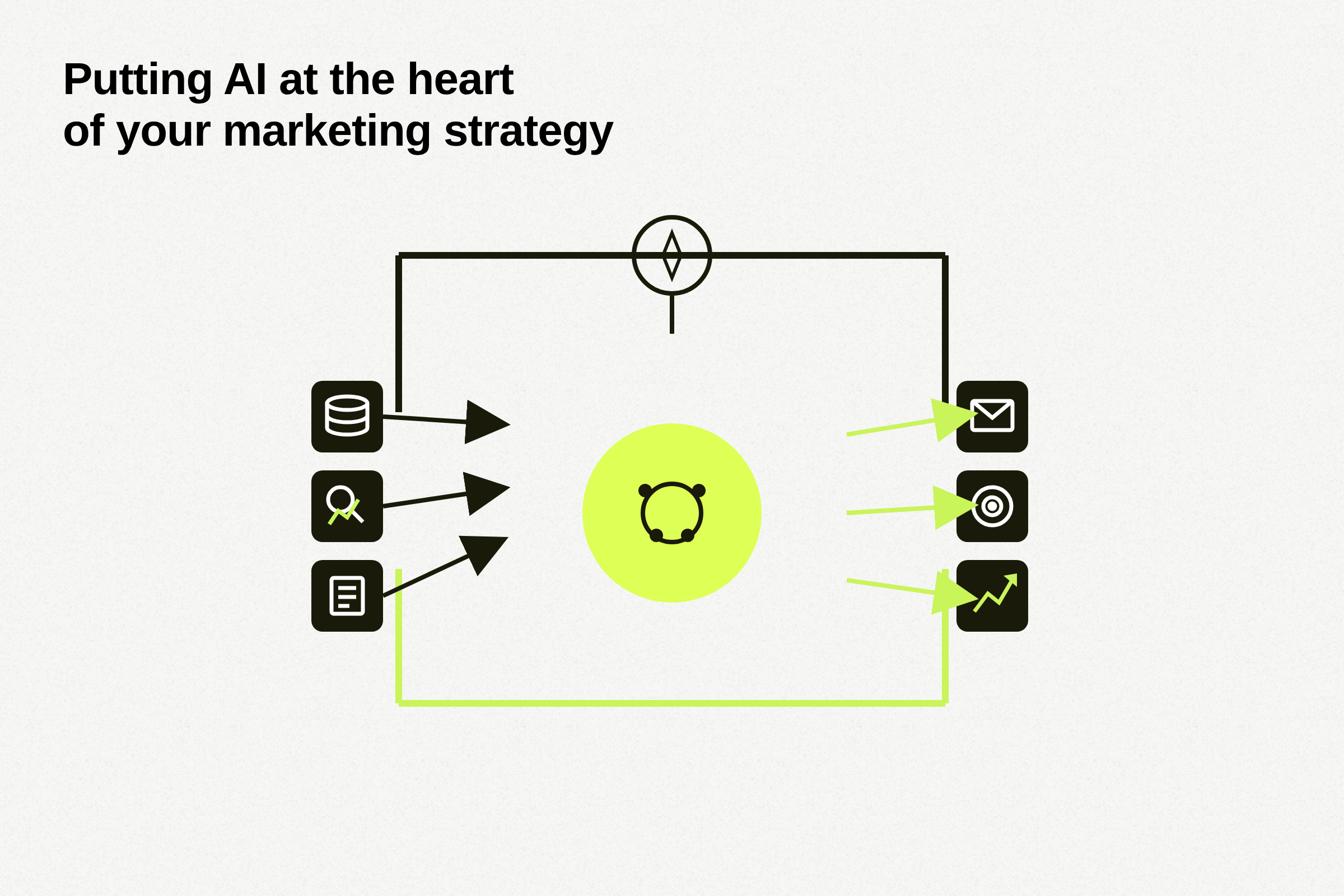
Putting AI at the Core of Your Marketing Strategy
AI marketing: what you need to understand before deciding
What does AI applied to marketing actually mean?
Broadly, marketing AI rests on three building blocks: generative AI (models that produce text, images, and video for your content, emails, and campaign visuals), predictive AI / predictive marketing (algorithms that anticipate behavior: conversion probability, churn risk, optimal send time), and marketing automation (workflows that automatically trigger emails, CRM updates, notifications, and tasks).
Marketing AI becomes genuinely useful when these building blocks are connected to your data (CRM, analytics, campaign history) and your existing stack (HubSpot, Salesforce, email tools, website). Without that integration, it stays a novelty.
It's also worth distinguishing strategic AI — which helps you decide where to focus (segments, content, channels, offers) through analytics and customer journey modeling — from operational AI, which accelerates execution (content generation, campaign optimization, segmentation, targeting). A B2B CMO needs to manage both.
Why AI has exploded in marketing teams since 2023
Since 2023, generative AI tools have become simple and powerful enough to integrate everywhere. Teams use them to draft articles, web pages, emails, and LinkedIn posts faster, generate variants for A/B testing, leverage CRM data more effectively for segmentation and scoring, and analyze performance without spending hours in analytics dashboards.
The result: greater operational efficiency (less time on repetitive tasks), better optimization (more targeted campaigns, more relevant messages), and often a stronger ROI on media and content budgets — provided there's a minimum of method behind it.
The limitations you need to accept upfront
Marketing AI is neither magic nor neutral. Models learn from your data — if that data is biased, so will your segmentation and targeting. A generative model can hallucinate figures or produce off-brand content, with real brand risk if you publish on autopilot. Over-reliance on a marketing automation tool you don't fully understand limits your ability to challenge the outputs. And every time you feed customer data or CRM records into an external service, GDPR compliance and data governance need to be front of mind.
The basic rule fits in one sentence: AI should remain a co-pilot. It proposes, you decide; it suggests, you validate; it automates, you stay in control.
8 AI Use Cases That Actually Change a Marketing Team
In a B2B marketing team, AI becomes interesting when it connects to your real pain points: not enough time, difficulty prioritizing, heavy content investment, incomplete CRM follow-up. Here are 8 use cases you can activate quickly.
1. Content generation and optimization
Generative AI is perfect for accelerating content production — as long as you stay in charge of the substance.
Concretely, you can use it to:
- draft SEO articles, web pages, video scripts, social media posts;
- rework and enrich existing content;
- adapt the same core message to different segments or channels.
Try this tomorrow: pick a key page (conversion landing page, service page) and use an AI tool to generate 3 alternative copy versions, then A/B test which performs best.
2. Customer segmentation, scoring, and lead nurturing
Where a human drowns in CRM data, AI thrives.
By connecting your behavioral data (visits, opens, clicks, trials) and your business data (MQL, SQL, closed deals), predictive marketing lets you:
- build segmentation more granular than "prospects / customers / inactive";
- assign dynamic scores to leads based on conversion probability;
- prioritize Sales efforts on the hottest accounts.
From there, you can automate lead nurturing: email and content sequences tailored to each segment, triggered automatically. This is where marketing automation earns its value.
Try this tomorrow: analyze your last won deals to identify 3 weak signals (pages viewed, content consumed, time between actions) and test a simple AI-enriched scoring model.
3. Campaign personalization and customer journey
Personalization no longer stops at the first name in an email subject line.
With the right data, AI marketing can help you:
- serve different content based on segment, funnel maturity, or account size;
- dynamically recommend content, webinars, or case studies in real time;
- adjust marketing pressure (email frequency, retargeting) based on behavior.
In a post-cookie world, AI-powered marketing technologies also enable smarter targeting by relying on contextual signals and the first-party data you already own.
Try this tomorrow: define 2 or 3 message and content variants for the same email based on customer journey stage, and use an AI tool to automatically route the right version.
4. Sentiment analysis and competitive intelligence
Reading every review, comment, LinkedIn post, and competitor article manually is impossible. AI loves exactly that kind of work.
Analytics and sentiment analysis tools let you:
- surface recurring themes in customer feedback;
- identify the most common frustrations by segment;
- track competitor messaging (new content, angles, offers).
Try this tomorrow: collect the last 50 customer reviews (or sales verbatim) in an AI tool and ask it to summarize the 5 most common frustrations and 5 most common positives. You'll have an immediate foundation to orient your next content and offer decisions.
5. Visual and creative asset generation
AI image generation isn't there to replace art direction — it's there to accelerate testing.
You can use it to:
- prototype visual concepts for ad campaigns;
- create variations for A/B tests;
- produce blog or social media visuals faster.
Again, brand guidelines matter: colors, tone, style. AI provides the raw material; you make the editorial calls.
Try this tomorrow: take an existing campaign and generate 5 visual variations around the same key message, then test performance.
6. AI-driven persona creation and updates
Personas shouldn't be static posters hanging in a conference room.
With AI marketing, you can:
- enrich personas using CRM data, site behavior, and sales verbatim;
- regularly update persona profiles with fresh insights;
- tie each persona to specific content and messaging.
Try this tomorrow: export an anonymized sample of customer data, run it through an AI tool, and ask it to propose 3 archetypal profiles with motivations, objections, and buying criteria. Compare against your current personas, refine with Sales, validate.
7. CRM automation and marketing reporting
A significant amount of wasted time in marketing teams comes from CRM tasks and reporting.
Connected to your CRM, AI can:
- automatically update certain fields (industry, company size, role) from public data;
- suggest tasks for a sales rep when a lead crosses a score threshold;
- generate performance reports (campaigns, channels, content) in plain language.
You move from reporting as a burden to smart marketing where analytics are readable and actionable, and where automation saves time across the board.
Try this tomorrow: identify a recurring report that eats your time (e.g., monthly acquisition summary) and test an AI tool to generate the write-up from your data exports.
8. Sales team enablement
Finally, AI marketing only delivers its full value when it creates genuine bridges with Sales.
For example, you can use it to:
- generate prospecting sequence drafts based on a persona and offer;
- summarize an account's full history ahead of a meeting;
- propose call scripts or standard responses to the most frequent objections.
Try this tomorrow: take a priority segment, formulate a clear value proposition, and ask an AI tool to generate 5 different prospecting emails. Sales tests them, you analyze the results together.
With these 8 use cases, you have a concrete picture of the potential of AI marketing in a B2B context. The logical next step: decide where you start, how you frame AI usage in your team — and how you do all this without turning your stack into an over-engineered mess.


Which AI Marketing Tools Belong in Your Stack?
The classic mistake with marketing AI is accumulating tools without a real strategy. The right approach: build a lean, use-case-driven stack, connected to your data and your CRM.
The "content and strategy" layer
You need a generative AI generalist tool for content creation, briefs, and campaign structuring.
Tools like ChatGPT, Jasper, or Frase can help you:
- prepare SEO article outlines and draft web pages;
- adapt the same message across channels (email, LinkedIn, landing page);
- challenge your angles and enrich content with new arguments.
The gain isn't only time — it's also a better capacity to test variants and optimize continuously.
Try this tomorrow: choose a single content generation tool, connect it to your editorial calendar, and use it to produce all first drafts for one month. The team rewrites, densifies, and validates.
The "visual creation" layer
For visuals, add a dedicated image generation layer to your stack.
Tools like Midjourney and other image generators let you:
- quickly produce visuals for articles, ebooks, and social posts;
- create variations for ad campaigns and A/B tests;
- illustrate complex concepts more clearly.
Try this tomorrow: take an existing campaign, write a precise prompt (persona, style, context) and generate 5 to 10 visuals to test on your social channels or sales pages.
The "CRM and marketing automation" layer
This is where AI marketing gets genuinely interesting for B2B.
Combining CRM and marketing automation, you can:
- set up intelligent lead nurturing, connected to real lead behavior;
- automate low-value tasks (data enrichment, basic follow-ups, field updates);
- activate predictive marketing to prioritize which accounts to reach out to.
HubSpot AI, Salesforce, and their extension ecosystems let you orchestrate this automated marketing close to the ground level, with a direct link between marketing and sales.
Try this tomorrow: list the 5 most repetitive CRM tasks for your team, and check whether your current tool already offers ready-to-use AI automations.
The "analytics, intelligence, and prediction" layer
The final layer of your stack: tools that turn your data into decisions.
This type of AI marketing tool can:
- analyze your analytics to identify the most profitable channels and campaigns;
- detect patterns in the customer journey (highest-converting conversion paths);
- automatically monitor competitors (content, offers, positioning);
- perform sentiment analysis on reviews, comments, and customer feedback.
The goal isn't to automate everything — it's to surface actionable insights to optimize your budgets, content, and targeting.
Try this tomorrow: export your traffic and conversion data for the last 6 months, run it through an AI-powered analytics tool, and ask for three concrete recommendations to improve your ROI.
Integrating AI into a Marketing Team in 90 Days
Putting AI at the center of your marketing strategy doesn't happen over a weekend hack — but it doesn't require a 3-year transformation program either. In 90 days, you can install a real AI-augmented marketing setup.
Days 0–15: Quick audit of processes and data
First step: look honestly at how your team works today.
You map:
- recurring tasks (content production, campaigns, reporting, CRM updates);
- pain points (lack of time, duplicate work, lack of visibility on numbers);
- data sources (CRM, email tools, analytics, sales pipeline).
Goal: separate what's automatable (repetitive tasks) from what's "augmentable" (requires creativity but can be accelerated by AI).
Do this in the next two weeks: produce a simple table — "task / frequency / time / pain level / AI potential" — and prioritize 5 to 10 candidate tasks.
Days 15–45: A well-scoped AI POC
Rather than transforming everything at once, choose 1 or 2 priority use cases. For example:
- content generation for blog and emails;
- lead scoring and CRM segmentation;
- automated monthly marketing report.
For each use case, define clear KPIs: time saved, production volume, perceived quality, impact on conversions or pipeline.
During this phase: set up initial workflows, document what works and what blocks, and involve the people who will actually use these tools day to day.
Days 45–75: Training, usage guidelines, and team alignment
AI marketing doesn't live in a software subscription — it lives in team adoption.
At this stage, you:
- run short training sessions focused on the chosen use cases;
- draft an AI usage charter: what data we send (or don't), who validates AI-generated content, what the brand tone rules are;
- clarify that AI is there to remove friction, not to eliminate roles.
During this phase: create an internal "AI marketing how-to" page accessible to everyone, with standard prompts, best practices, and limits to respect.
Days 75–90: Controlled scaling
When a POC works, the temptation is to automate everything everywhere. Bad idea.
The right approach:
- expand first to adjacent use cases (e.g., after the blog, tackle emails and landing pages);
- progressively add marketing automation scenarios to your CRM;
- establish a monthly AI performance review ritual (what we keep, what we stop, what we test).
Before the end of 90 days: choose 3 things you industrialize, 3 you abandon, and 3 you'll test next quarter.
AI, Ethics, and Competitive Advantage
The more your marketing relies on data, algorithms, and machine learning, the more ethics becomes a strategic concern — not for the sake of a nice-sounding innovation report, but to avoid decisions that are absurd or damaging to the brand, customer relationships, and ROI, especially at scale (campaigns, ad optimization, marketing automation).
Bias and opaque decision-making
The models you use learn from data, not from ground truth. If your data is biased, your recommendations will be too — segmentation, targeting, scoring, predictive analysis, lead prioritization for Sales, even customer journey personalization.
You need to:
- keep a critical eye on proposed segmentations and scoring models;
- verify that certain profiles (audiences) aren't being systematically excluded without clear business rationale;
- document your business rules and data sources, and avoid delegating everything to a black box or an automated agent.
Again: AI should remain a decision-support tool, not an oracle. Human judgment and marketing expertise remain essential to maintain quality.
Customer data, consent, and GDPR
Marketing AI needs data to be effective — but not all information is handled the same way, especially when it comes from CRM, your website, email communications, or social media.
Three simple reflexes:
- limit the personal data sent to external tools, and govern every integration (APIs, connectors, workflows);
- favor solutions that allow controlled hosting, anonymization, or enterprise configurations suited to your environment;
- be transparent with your customers and users about how their data is used (purpose, duration, consent), and maintain clear data governance.
Digital transformation shouldn't come at the expense of trust — the consequences for engagement, retention, and performance are immediate.
AI as co-pilot, not replacement
The fantasy of a fully automated marketing team looks good in a slide deck but is dangerous in practice.
What makes the difference isn't whether you use marketing AI or not — everyone already does, or soon will. It's:
- your ability to ask the right questions of the tools;
- your strategic reading of analytics;
- your sense of timing, message, and context.
The value creation comes from the human orchestrating the machine — not from the machine alone.
Why Work on AI Marketing with Bulldozer Collective?
Moving from "we're testing a few AI marketing tools" to "we have real AI-augmented marketing that serves the business" takes time, data expertise, and a solid understanding of the B2B terrain. That's precisely where Bulldozer Collective can help.
What we do concretely for B2B CMOs
Bulldozer supports B2B marketing and growth leadership teams on three fronts:
- AI marketing audit: where does your stack, data, processes, analytics, and CRM stand today;
- AI marketing strategy design: priority use cases, deployment roadmap, tool selection, integration with existing marketing;
- operational implementation: prompts, workflows, marketing automation, KPI tracking.
The goal isn't to run a "POC party" — it's to quickly fund AI initiatives through gains in operational efficiency and ROI.
A pragmatic approach, not a tech showcase
Bulldozer doesn't sell technological miracles. We start from your business challenges, your constraints, your team.
Concretely, we help you:
- avoid tool sprawl with low adoption;
- connect the right marketing technologies to your CRM and customer journey;
- build smart marketing that respects your brand voice and your commercial reality.
The idea isn't to run automated marketing in a vacuum — it's to equip your teams to be stronger, faster, and more relevant.
The next step
If you feel your company needs to structure its AI marketing but doesn't know where to start, the simplest approach is usually to scope the 2 or 3 highest-potential use cases first.
You can, for example:
- request a quick diagnostic of your priority AI use cases;
- run a 90-minute workshop with your marketing and sales teams to map opportunities;
- co-build a 90-day roadmap to test, measure, and decide.
.avif)