
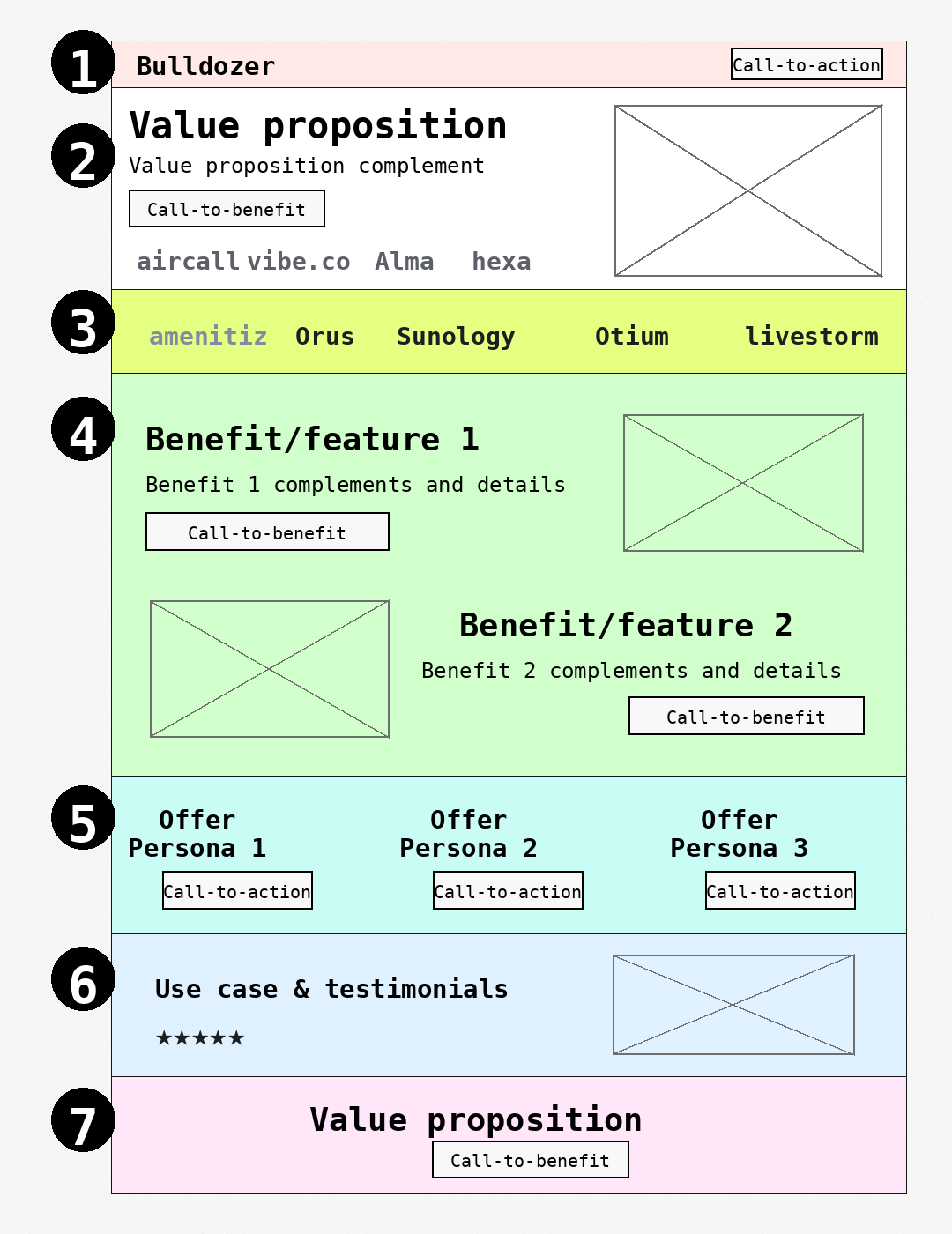
Building a landing page that converts requires a strategic approach. To maximize performance, focus on eight key factors: message-to-audience fit, page structure, emotional triggers, benefits vs. features, positioning, CTA flow, key metrics tracking, and weekly iteration cycles.
The first step is ensuring your message resonates with your target audience. Identify the pain points your audience faces, then craft your messaging to speak directly to them. Building one master landing page and adapting it across multiple marketing angles for different audiences is an effective way to ensure your message lands with each segment.
→ Build one master landing page (LP)
→ Choose 3 marketing angles for 3 audiences
→ Adapt 3 landing pages to your 3 marketing angles
Once you have a resonant message, the next step is building a page structure that drives conversions. The AIDA framework (Attention, Interest, Desire, Action) has proven highly effective here. Your landing page should open with an attention-grabbing headline, a description that builds interest, a benefits-over-features section that creates desire, and offer details that compel action.
→ Headline with a dream outcome
→ Offer description
→ Benefits-over-features sequence
→ Offer details
Emotional triggers are another essential component. Use scarcity (limited time or quantity), social proof (testimonials, reviews, or logos from reputable companies), and authority (press mentions, industry awards, or certifications) to build urgency and credibility that moves your audience to act.
→ Scarcity with limited-time offers
→ Social proof with logos and testimonials
→ Authority with press coverage, data, and proof of work
Emphasizing benefits over features is critical to a converting landing page. Highlight the core benefits of your product or service, backed by tangible descriptions of how they work and the features that deliver them — this convinces your audience that your offer is worth their time and money.
→ Use clear, simple copy
→ Illustrate with visuals and data
→ Prove benefits with examples and testimonials
Positioning is another critical factor affecting conversions. Define a strong brand position and ensure your design and copy reflect it. Invest in distinctive creative direction that sets your landing page apart from competitors, and build a brand atmosphere aligned with your positioning.
→ Define a strong positioning
→ Invest in distinctive creative direction
→ Build a polished design with Webflow
→ Create a brand atmosphere through copywriting
[rta-block=folder-cta][rta-title=h3]Want to find out more about your CRO potential?[rta-title=h3][rta-btn=regular href="/prendre-rendez-vous-typeform" target=_blank]Get a free audit[rta-btn=regular][rta-block=folder-cta]
From landing page to call to action, your page needs to guide users toward the desired action. Remove distractions, maintain the user flow from headline to headline, and insert precise calls to action that make sense. The consistency principle is key: your landing page should propose a single logical next step.
→ Remove distractions, get straight to the point
→ Maintain user flow from headline to headline
→ Insert precise CTAs that make sense
Tracking the right metrics is crucial to landing page success. Monitor your speed score (aim for an "A" rating with GTMetrix), cost per conversion (to compare pages), and conversion rate (percentage of visitors who click the CTA). This lets you accurately evaluate landing page performance.
→ Speed score: aim for an "A" with GTMetrix
→ Cost per conversion to compare your pages
→ Conversion rate: % of visitors who click the CTA
Finally, building a converting landing page is an iterative process. Run weekly iterations to continuously improve your page. A/B testing the H1 section, analyzing heatmaps with Hotjar, and iterating on the form while tracking CTR are all effective ways to optimize over time.
→ A/B test the H1 section
→ Analyze heatmaps with Hotjar
→ Iterate on the form and track CTR
To close, here is a landing page template we regularly use with our clients — one that has already proven its worth.
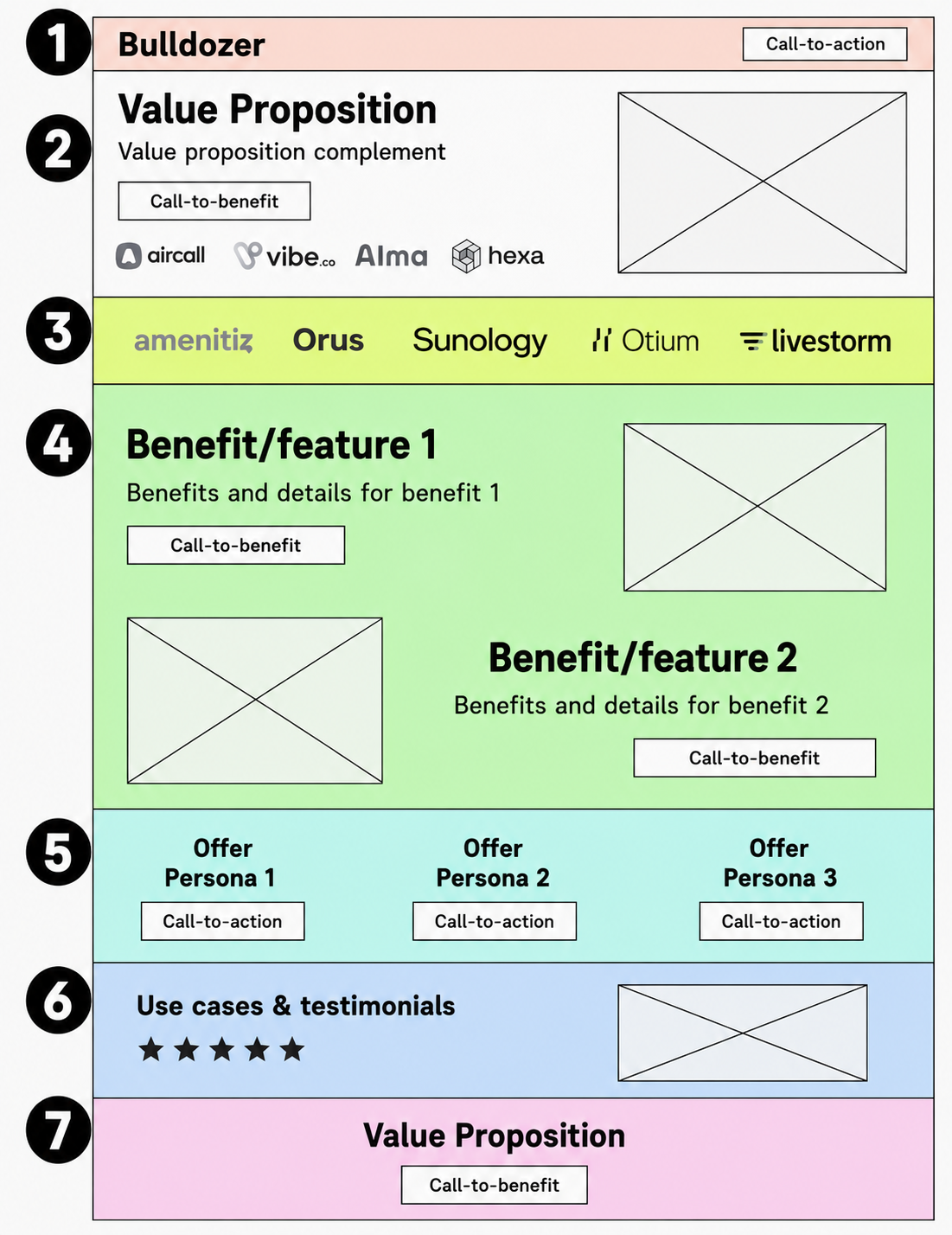
By following these eight steps, you can build a landing page that converts and guides your audience toward your call to action. Remember: this is a continuous process requiring ongoing optimization — be ready to iterate, test, and refine regularly for the best possible results.
Lorem ipsum

Co-founder and CEO of Bulldozer, he writes about B2B growth strategy and go-to-market.
Can't find what you're looking for ? Contact us here
jordan@bulldozer-collective.comGet access to playbooks and feedback from those who are shaping the next wave of marketing and AI.