Voir nos cas clients
Allez plus loin avec nos ressources gratuites
La newsletter de Bulldozer
Êtes-vous prêt à accélérer ?


Conversion Rate Optimization (CRO): The B2B Guide to Supercharge Your Conversions
Most B2B CMOs pour energy into acquiring visitors. Very few stop to ask what happens to those visitors once they land on the site. The result: media budgets that keep climbing, dashboards that flash green — and a conversion rate that refuses to move.
The problem isn't always in acquisition. It's often in what happens after the click: a leaky sales funnel, clunky UX, unclear messaging, off-putting forms. In short, a site that doesn't convert anywhere near its potential.
That's exactly what CRO — Conversion Rate Optimization — is built to fix.
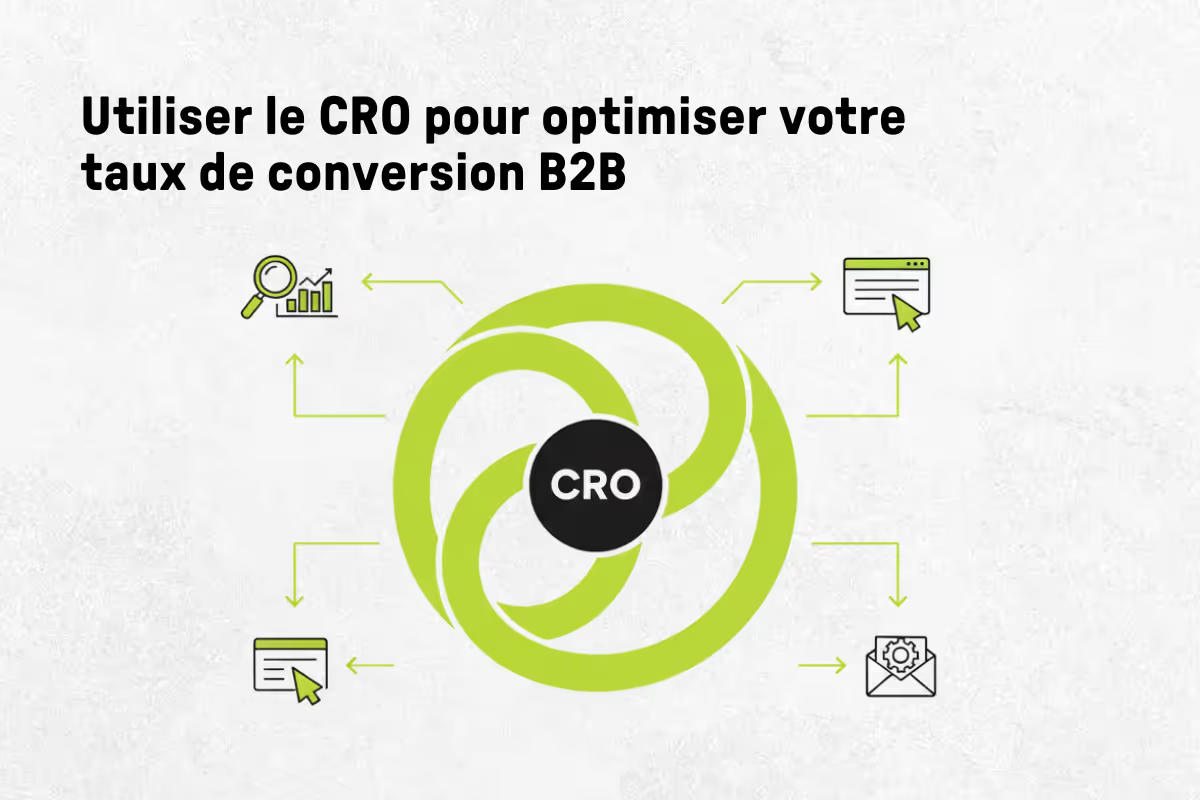
CRO: how to turn visitors into customers in B2B
You've invested in SEO, paid search, LinkedIn Ads, premium content. Your traffic is up, your Analytics dashboards are green — but the conversion rate is stubbornly flat.
This is a classic symptom: the sales funnel is leaking opportunities at every stage, and no one quite knows where or why.
This is exactly where CRO — Conversion Rate Optimization — becomes strategic.
Rather than increasing your media spend further, you focus on optimizing the conversion rate of what you already have: turning more visitors into qualified leads, smoothing out the customer journey, reducing UX friction, and concentrating effort on the pages that actually drive business.
CRO isn't a growth hacker's gadget — it's a web performance optimization methodology grounded in data, A/B testing, UX/UI, and behavioral analysis (heatmaps, session recordings, user feedback).
Applied to a B2B website, blog, or landing pages, it enables you to:
- Generate more leads without increasing ad spend.
- Reduce CAC and protect the ROI of your acquisition channels.
- Align marketing, sales, and product around one shared goal: conversion.
In this guide, we'll cover how B2B CMOs can use Conversion Rate Optimization to improve their conversion funnel, choose the right tools, structure A/B tests, personalize the experience, and build a continuous improvement strategy.
Understanding CRO: definition, stakes, and role in B2B
What is CRO (Conversion Rate Optimization)?
CRO (Conversion Rate Optimization) refers to the full set of techniques, methods, and processes designed to increase the percentage of visitors who take a key action on your website:
- Fill out a demo request form.
- Request a quote.
- Download a white paper.
- Sign up for a webinar.
The idea isn't simply to "get more clicks on a CTA" — it's to maximize the value of every visit by working on UX and conversion end-to-end: clearer copy, page structure, trust signals, design, layout, social proof, segmentation, offers. Everything that can help convince, attract, and convert your target audience.
CRO is distinct from a simple site redesign: it's a continuous process anchored in data analysis, combining analytics, statistical tracking, testing, user feedback, and business decisions. A strong CRO practice draws on both quantitative data and qualitative field insights to understand how the sales funnel actually functions — and to prioritize the highest-impact adjustments.
Types of conversions in B2B marketing
In B2B, not all conversions are equal. Broadly speaking:
- Micro-conversions
- Click on a call-to-action in a blog post.
- Live chat activation.
- Newsletter sign-up.
- Visit to a key page (pricing, feature, case study).
- Macro-conversions
- Product demo request.
- Quote or consultation request.
- High-intent premium content download.
- Sales meeting booking.
In a B2B commerce or subscription context, you can add actions like cart validation, cart abandonment reduction, or average order value increase — each with a direct impact on profitability.
A strong B2B site conversion rate isn't just measured on the final macro-conversion: it's built by orchestrating a logical progression through the sales funnel, where each stage brings the prospect closer to a decision — well beyond simply counting form submissions.
CRO, UX/UI, and business performance
CRO lives at the intersection of several disciplines:
- UX/UI: readability, information hierarchy, intuitive navigation, mobile-first.
- Analytics: metrics, KPIs, audience segments, conversion funnels, statistical tracking over time.
- Conversion digital marketing: copywriting, offers, nurturing sequences, consistency between campaign and landing page.
In practice, a well-run CRO process:
- Improves the user experience, and therefore the overall perception of your brand.
- Increases the conversion rate at every stage of the customer journey.
- Strengthens the overall profitability of your inbound marketing strategy and paid campaigns alike.
For a CMO, it's a direct lever on ROI: at constant traffic, even a modest improvement in conversion rate can generate a significant pipeline increase.
Why integrate CRO into your B2B marketing strategy?
Maximize the value of every visit
Every visitor who lands on your site has a cost: time, media spend, content creation, campaign management, internal resources. Whether you're a B2B SaaS company, a services platform, or a business-to-business commerce operation, every click represents a potential deal.
The role of CRO is to make every visit profitable by converting that traffic into:
- Marketing leads (MQL).
- Commercial opportunities (SQL).
- Mid-term customers.
In other words: do more with the same number of visits, by closing the gap between your digital performance and your commercial goals. Rather than pushing acquisition ever harder, you accept that optimizing the conversion funnel is often a faster and more durable lever for generating meaningful revenue impact.
Reduce customer acquisition cost and protect ROI
By improving conversion rates at every funnel stage — from discovery to contact, then to purchase — you:
- Mechanically reduce CAC (Customer Acquisition Cost).
- Stabilize performance during periods of rising advertising costs.
- Build a compelling case for the board around concrete KPIs: cost per lead, cost per opportunity, revenue per session, ROI by channel.
Conversion Rate Optimization becomes a genuine management discipline — as strategic as your media budget or product roadmap: a key lever for reaching your commercial objectives faster, without necessarily increasing spend.
Improve user experience and brand perception
A site that converts is, very often, a site that:
- Clearly communicates its value proposition, with readable layout and a precise description of the offer.
- Reassures with relevant social proof (case studies, client reviews, logos, key figures).
- Delivers a customer journey that's friction-free and matched to your target audience's expectations.
- Respects UX/UI best practices (readability, responsive design, accessibility, page speed).
The impact goes beyond conversion: you reinforce the perception of your brand as reliable, modern, and solution-oriented — which makes your sales team's job easier and improves the performance of future campaigns.
Complete CRO methodology
An effective CRO process relies on a clear methodological framework. Without one, you fall into the trap of "quick fixes" and anecdotal tests.
Step 1: analyze the current state
Before touching a single landing page, understand where you stand.
- Map the sales funnel
- Homepage → solution/product pages → demo landing → form → thank-you page.
- Identify priority entry paths (SEO, ads, email).
- Identify high-stakes pages
- High-traffic, low-conversion pages.
- Top-performing blog content with lead generation potential.
- Strategic pages (pricing, integrations, case studies).
- Dig into Analytics
- Conversion rate by page, channel, and device.
- Segments by source, location, visitor type.
- Conversion funnels: where are visitors dropping off?
Here, Analytics (GA4 or equivalent) serves as the foundation for detecting areas of tension.
Step 2: run a conversion audit and a UX audit
The conversion audit combines quantitative data with observation of real user behavior:
- Heatmaps to visualize clicked, ignored, and scrolled zones.
- Session recordings to see where users hesitate, encounter bugs, or abandon.
- Form analysis: unfilled fields, errors, unnecessary steps.
Pair this with a UX/UI audit:
- Clarity of the value proposition.
- Relevance of page structure.
- Trust signals (proof, logos, testimonials).
- Mobile performance and page load time.
Finally, a targeted competitor benchmark helps identify:
- Elements they use more effectively than you (structure, social proof, CTAs).
- Angles you can exploit to differentiate.
You can go further by assigning a UX score to your key pages to help prioritize improvements.
Step 3: formulate hypotheses and prioritize actions
From this audit, you can formulate test hypotheses:
- "If we reduce demo form fields from 10 to 5, completion rate will increase."
- "If we replace technical jargon with a clear business benefit in the hero, the CTA click-through rate will increase."
Then prioritize your backlog using a framework like ICE or PIE, combining:
- Impact potential on conversion.
- Confidence in the hypothesis.
- Effort required to deploy the test.
This triage is what transforms a list of ideas into a real web performance optimization plan.
Step 4: deploy, measure, improve (continuous loop)
CRO has no finish line. You enter a cycle:
- You launch an A/B test or improvement.
- You measure impact via your KPIs (conversion rate, completion rate, CTA clicks…).
- You keep, adjust, or roll back the change.
- You document the learnings to inform the next round of tests.
It's this logic of continuous improvement that turns CRO into a durable competitive advantage, rather than a one-off project.
Essential CRO tools
To run a Conversion Rate Optimization strategy, you need a coherent tech stack. You don't need thirty tools — a few well-integrated layers are far more effective.
Analytics and measurement tools
The foundation is an analytics platform:
- Google Analytics 4, Matomo, or equivalent to track:
- Conversion rate by page and channel.
- Event funnels (clicks, forms, downloads).
- Audience segments (new vs. returning, mobile vs. desktop).
The goal: have a reliable view of the KPIs that matter for your business (leads, demo requests, pipeline additions).
Behavioral tools: heatmaps, replays, feedback
To understand what the numbers don't tell you:
- Heatmaps to visualize on-page activity.
- Session recordings to observe, in real situations, where users hesitate or get stuck.
- Micro-surveys and feedback widgets to capture the user's own voice.
Solutions like Hotjar, Microsoft Clarity, and others reveal friction that's invisible in raw bounce rate data.
A/B testing and experimentation tools
Google Optimize democratized free A/B testing. The tool is gone, but the discipline remains essential.
Today, solutions like AB Tasty, Optimizely, VWO, or Kameleoon allow you to:
- Run A/B, multivariate, or personalization tests.
- Target precise segments (device, source, campaign).
- Connect results to your business KPIs.
The tool matters less than your ability to build a culture of experimentation.
CRM, segmentation, and marketing automation
You can't talk about CRO without talking about CRM and marketing automation:
- The CRM (HubSpot, Salesforce, Pipedrive…) lets you track the lead after conversion: qualification, opportunities, closing.
- Automation tools (HubSpot, Brevo, ShopiMind…) orchestrate scenarios adapted to behavior: re-engagement emails, post-download sequences, long-term nurturing.
This infrastructure is what connects site optimization to real commercial performance.
The role of A/B testing and user testing
A/B testing: the pillar of Conversion Rate Optimization
Without A/B testing, CRO amounts to guesswork.
An A/B test presents two versions of the same element (page, block, button…) to different visitor groups, then compares results on a given KPI.
Examples:
- Click-through rate on a call-to-action.
- Conversion rate on a landing page.
- Form completion rate.
The goal is to validate or invalidate a hypothesis with minimal bias.
Methodology for a rigorous A/B test
A solid A/B test rests on a few simple principles:
- A clear objective: e.g., "+15% conversion rate on the demo landing page."
- One primary KPI per test, not ten.
- A sufficient sample size to avoid false positives.
- A minimum duration (often several weeks) to smooth out day-of-week or campaign-driven variation.
You then integrate results into your CRO roadmap, capitalizing on learnings whether they're positive or negative.
Concrete A/B test ideas for B2B
A few starting points for a marketing team:
- CTAs: benefit-oriented vs. descriptive copy, page position, scroll anchor.
- Landing pages: short vs. long format, problem-first vs. solution-first structure, social proof format.
- Forms: number of fields, multi-step vs. single-page, reassurance elements placed near the form.
User testing: the qualitative dimension
User tests complement A/B testing:
- By watching a handful of real users navigate your site, you uncover comprehension problems and usability issues that numbers simply can't reveal.
- You can ask them to verbalize what they understand, what's blocking them, what reassures or concerns them.
The combination of quantitative data and qualitative insights is at the heart of a mature CRO practice.


CRO & personalization: segmentation + message
Adapting the message to the visitor profile
No two visitors read a page the same way. Personalization lets you adapt:
- Key messages.
- Featured case studies.
- Social proof elements.
For example, showing:
- Testimonials from mid-market industrial companies to a visitor coming from "manufacturing" content.
- SaaS case studies to a visitor who came from a SaaS pricing article.
This is segmentation by sector, company size, persona, or maturity stage in the buying cycle.
Targeting funnel stages and the customer journey
Your customer journey optimization must align with the stages of the funnel:
- Top of funnel: educational inbound content, problem-focused.
- Middle of funnel: comparisons, case studies, value demonstrations.
- Bottom of funnel: personalized offers, decision-oriented calls to action.
Personalization means delivering the right content, at the right time, in the right format — based on the real customer journey, not an idealized version of it.
CRO + CRM + marketing automation: the flywheel
When CRO, CRM, and automation work together:
- Behavioral signals (pages viewed, clicks, downloads) enrich CRM records.
- Automation scenarios adapt messages based on engagement level.
- A/B tests extend beyond pages into email sequences, recommended content, and re-engagement triggers.
The result: far more precise digital marketing conversion, driven by both data and genuine customer understanding.
B2B use cases: how a CMO can apply CRO
Optimize a B2B brochure site
For a brochure site, a simple CRO process can already make a real difference:
- Rewrite "solutions" pages to lead with business benefits rather than features.
- Clarify the primary calls to action (demo, consultation, audit).
- Add proof elements: client logos, key figures, user testimonials.
The goal: make your site a lead generation machine rather than a digital business card.
Boost conversions on an inbound blog
Your SEO blog drives traffic? Great. But without CRO, you're harvesting attention without converting it.
A few starting points:
- Place contextual CTAs toward premium content.
- Embed discreet but effective capture blocks (newsletter, checklist, free template).
- Test different reader-engagement formats: pop-in, sticky banner, mid-article embed.
It's the intersection of inbound marketing and Conversion Rate Optimization that turns your content hub into a growth engine.
Improve your landing pages (events, demos, guides)
B2B landing pages are often the core of the funnel:
- Event or webinar registration.
- Demo requests.
- Guide or report downloads.
This is the ideal place to deploy a rigorous CRO approach:
- Clear, outcome-oriented hero.
- Concrete benefits tailored to the target persona.
- Calibrated form (not too long, not too vague).
- Targeted social proof.
Each campaign becomes an opportunity for conversion improvement.
What competitors aren't doing: actionable checklists and frameworks
A B2B CRO checklist to structure your actions
Most CRO content stays theoretical. What CMOs need is an actionable framework.
A few simple questions to start:
- Is my event and conversion tracking clean in Analytics?
- Have I identified the top 3 pages to optimize first?
- Do I have at least one active A/B test per month on a key page?
- Has a comprehensive conversion audit been done on my site in the past 12 months?
- Does my CRM accurately reflect digital conversions and their pipeline impact?
This checklist can become an internal document, updated each quarter.
Connecting CRO, customer experience, and sales
Where many competitors stop at the "click," a more complete approach connects:
- Digital conversions (forms, downloads).
- Actual lead qualification by the sales team.
- The sales cycle and close rates.
Without this loop, customer journey optimization remains incomplete. CRO must feed a broader reflection on B2B customer experience.
Tool orchestration: analytics, CRM, CMS, testing
Few guides go deep on the integration between:
- Analytics tools.
- CRM.
- CMS.
- A/B testing and personalization tools.
Yet this architecture is what enables a unified view of behavior: from the first visit to the won deal.
At Bulldozer, when we implement a CRO process, we think as much about stack as strategy — because without integration, there's no precise steering.
CRO is neither a buzzword nor a cosmetic layer on your site.
It's a structured process for:
- Making better use of your existing traffic.
- Smoothing out your sales funnel.
- Strengthening UX/UI and brand perception.
- Delivering more ROI from the same budgets.
Rather than searching for the one universal "best practice," the real challenge is building a continuous optimization process: regular audits, test backlog, a culture of experimentation, and tight alignment with sales.
If you want to go further, a targeted conversion audit on your strategic pages (demo landing, forms, pricing, top content) is almost always the best starting point for prioritizing your first A/B tests and locking in quick wins.
.avif)