

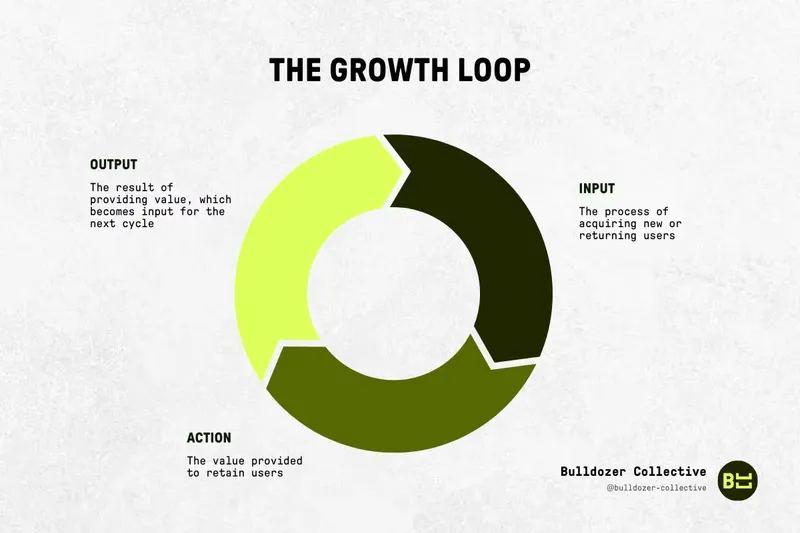
You've discovered the growth loop revolution and want to engage today's users with your product for the long term? Choose the most appropriate strategy. Because growth loops can be observed at Instagram, Airbnb, PayPal, and Duolingo — companies that look quite different. What they share: every user generates exponential, self-sustaining growth through a focus on engagement, retention, and continuous data.
Let's explore the different growth loops and which one is best suited to you — for organic, self-feeding growth.
Reminder: what are we trying to do? Fuel the growth of your company/product in a sustainable, scalable way. What do we put in place? A structured set of strategies, processes, and mechanisms.
A growth loop is a growth marketing model, typically product-based. The concept was popularized by Brian Balfour in his article Growth Loops are the New Funnels. Its structure has the intrinsic advantage of self-sustaining exponential growth. We call it a positive feedback loop, or growth loop. One unit of effort generates one unit of output, which is then fed back into the process to create more growth. The loops feed themselves: a user's actions create an output, which creates a new user.
The principle of the growth loop is that it relies on a virtuous circle where the effort required is non-linear — and therefore decreasing over time. This distinguishes it from the AARRR framework.
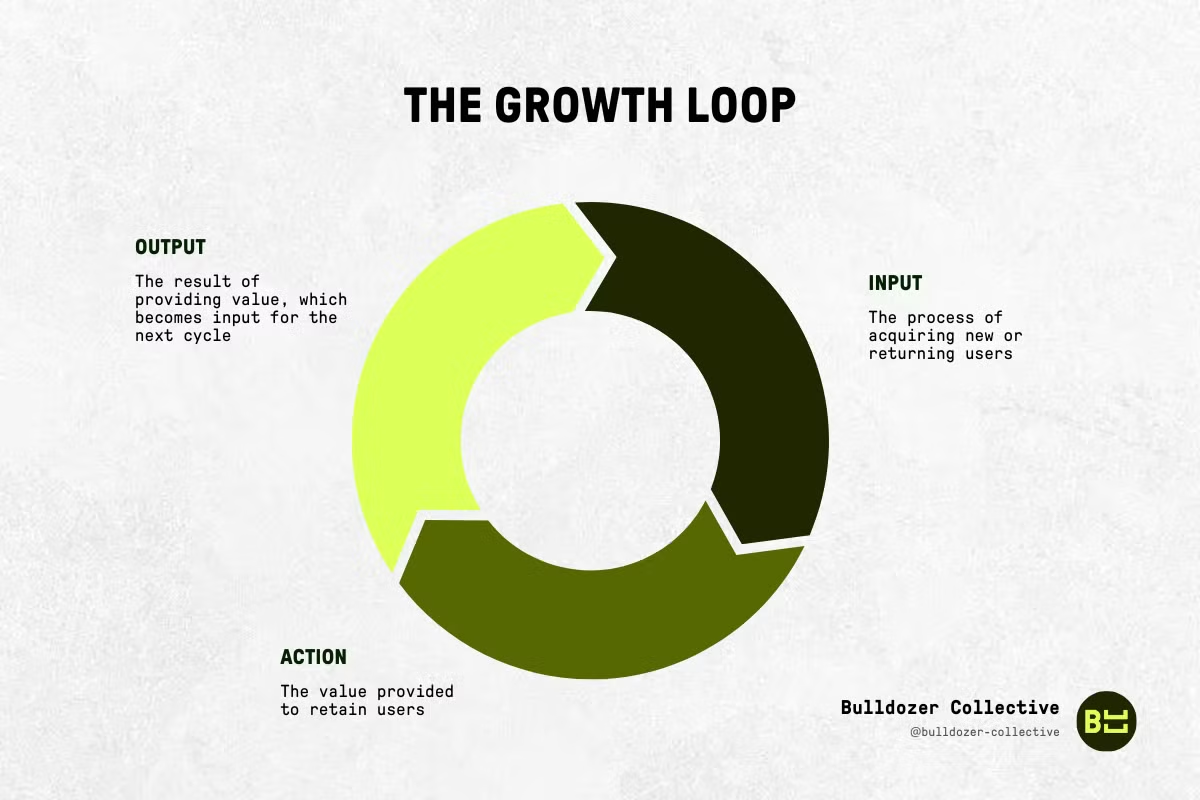
A growth loop is a mechanism composed of:
From the output, a reinvestment effect must be put in place to feed back into the input and create a continuous cycle. This is the stage where leverage and network effects come into play:
Every modern music streaming app builds personalized playlists based on user listening habits. The more a user listens, the better the recommendations. The better the recommendations, the more the user stays on the platform (and tells others about it). And so on. This is an engagement loop that has proven highly effective for retention and engagement at Spotify, Deezer, Apple Music, Tidal…
Let's get to the heart of the matter: the typology of different growth loops and their most and least effective uses.
Let's break down growth loops into 7 main categories, each with pros, cons, strategic relevance, and concrete examples:
.png)
Users generate content, attracting more people, benefiting from a network effect and creating a steady stream of new visitors and creators. The more content from different users, the more compelling it becomes to join your platform. This type of growth loop relies heavily on UGC (User Generated Content), social sharing, and discovery algorithms.
Pros:
Cons:
Build your content loop strategy for:
Avoid this strategy if:
You'd have to have spent the last 15 years in a cave not to know the impact of social networks on the world: Facebook, Instagram, YouTube, TikTok, LinkedIn, X, Snapchat… All of them possess and sustain strong leverage and network effects. Their growth is all the more exponential because it's organic, fueled by content, virality, and word of mouth.
.png)
Users actively share the product with their network, through built-in sharing or recommendations. If your product can incentivize users to invite others to use it — even passively — it has a solid foundation for a viral loop strategy. This is the core of exponential growth.
Pros:
Cons:
Build your viral loop strategy for:
Avoid this strategy if:
Are you of the World of Warcraft, Candy Crush, Pokémon Go, or Fortnite generation? The latter is a relevant example: free, fun, with hyper-accessible gameplay. Originally free-to-play, Fortnite offers short, intense 100-player matches with cross-play (playable across platforms: PC, consoles, mobile). Epic Games also collaborated with Twitch and YouTube influencers to promote the game and its events. The result was phenomenal: between 2019 and 2020, the game generated $10 billion, and Epic Games reached a valuation of $17 billion in 2020.
.png)
[rta-block=folder-cta][rta-title=h3]Want to find out more about your growth potential?[rta-title=h3][rta-btn=regular href="/prendre-rendez-vous-typeform" target=_blank]Get a free audit[rta-btn=regular][rta-block=folder-cta]
Here, users are incentivized to refer others through a rewards system for each new sign-up generated. Incentives can be financial (a percentage or fixed discount/credit) or non-financial (perks, additional features).
Pros:
Cons:
Build your referral loop strategy for:
This strategy won't work if:
Dropbox is the perfect case study for a successful referral loop. Users get free storage space by referring others, who also get free space in return. This referral program delivered Dropbox 3,900% growth. Inspired by PayPal's referral program success, Dropbox launched its own in September 2008. Within 15 months, Dropbox went from 100,000 to 4 million registered users (the famous 3,900% increase). By April 2010, users were sending 2.8 million invitations per month.
The paid loop is a growth loop in which revenue generated by the product is used to reinvest in user acquisition through paid advertising campaigns. The product is able to generate enough revenue to cover acquisition costs and deliver a positive ROI.
Pros / Cons: Fast scalability through reinvested revenue | Dependence on advertising campaign ROI | Can be optimized with precise data | High acquisition cost if poorly managed | Allows rapid testing of new channels | Risk of paid channel saturation: channels can hit performance limits due to high competition, impression frequency, or audience fatigue.
Build your paid loop strategy for:
This strategy won't work for:
Google Ads is built on an ultra-effective paid loop strategy: Google Ads generate revenue, which is directly reinvested into acquiring users and advertisers, driving growth in the user base and thus ad impressions. More clicks and conversions. More ad spend. And so on. In Q2 2024, Google Ads revenue represented 57.2% of Google's revenue, amounting to $48.51 billion through Google Search. Massive, right?
This strategy focuses on retention and, of course, engagement. The product experience must incentivize users to return regularly, mechanically increasing retention and satisfaction. Key tools include notifications, reminders, and rewards.
Pros / Cons: Improves retention and customer value | May require sophisticated features | Increases engagement and interactions | Risk of user fatigue | Facilitates word of mouth through regular usage | Requires a highly habit-forming product
Well-suited for:
Less relevant for:
If you've ever used Duolingo, you already know how effective their rewards system is. Language learning is built on an artificial trigger loop (daily notifications encouraging regular practice) and a gamification loop (learning is framed like a video game, with friend comparisons). Their notifications know how to sting your pride or make you feel guilty: "Hey, it's Duo! You can't learn Japanese if you don't practice."
Retention secured, growth loop optimized.
Here, product usage generates data and/or feedback, fed directly back into continuous product improvement. The more users interact with the product, the better it gets; it's a loop based on the user experience.
Pros:
Cons:
Relevant for:
Not relevant for:
At Notion, users are encouraged to explore the tool and understand its value. The company emphasizes a simplified onboarding and a freemium plan so anyone can test all basic features without commitment. The app is so customizable and adaptable (note-taking, project management, team wiki…) that users create their own product dependency. All content is easily shareable. Meanwhile, data is collected: which templates are popular, which features are most used, which are never touched… These insights feed new features and UX optimization. The product becomes increasingly attractive, drawing new users and reinforcing the engagement loop.
The last — and certainly not least — growth loop strategy: the marketplace loop capitalizes on the network effect between supply and demand. The more sellers on a platform, the more customers will use it, and vice versa. Once the balance between supply and demand is achieved, the marketplace loop becomes increasingly powerful and generates exponential growth.
Pros / Cons: Powerful network effect | Difficulty achieving initial critical mass | Exponential growth once network effect is established | Possible supply-demand imbalance | Increases liquidity and choice diversity | May require significant upfront investment
Perfect for:
Not suited for:
At Uber, drivers are the supply and passengers the demand. The company attracts new passengers through marketing campaigns, promotions, and recommendations. In parallel, Uber actively recruits new drivers through financial incentives (sign-up bonuses, for example). During special events (concerts, club nights, parties), Uber typically applies a surge pricing strategy and activates dynamic pricing, raising fares based on demand. This attracts more drivers onto the road, reducing wait times. Passengers pay a higher fare but are satisfied by the shorter wait. The loop is complete.
For a sustainable growth system, growth loops prove highly effective and better aligned with the times because they're scalable and product-centric. Choosing the right loop depends on your product, your market, and your objectives. A thoughtful, successful implementation can multiply your results and give you a remarkable competitive advantage.
This isn't just tactics — it's a long-term strategy that can transform your product into a true self-feeding growth engine. Now it's your turn to choose the right type of growth loop!
Lorem ipsum
.jpeg)
Writer at Bulldozer, he covers web scraping, UGC and no-code, mixing data, storytelling and SEO.
Can't find what you're looking for ? Contact us here
jordan@bulldozer-collective.comGet access to playbooks and feedback from those who are shaping the next wave of marketing and AI.