If you're publishing content on LinkedIn in 2025, you've probably watched your organic reach collapse.
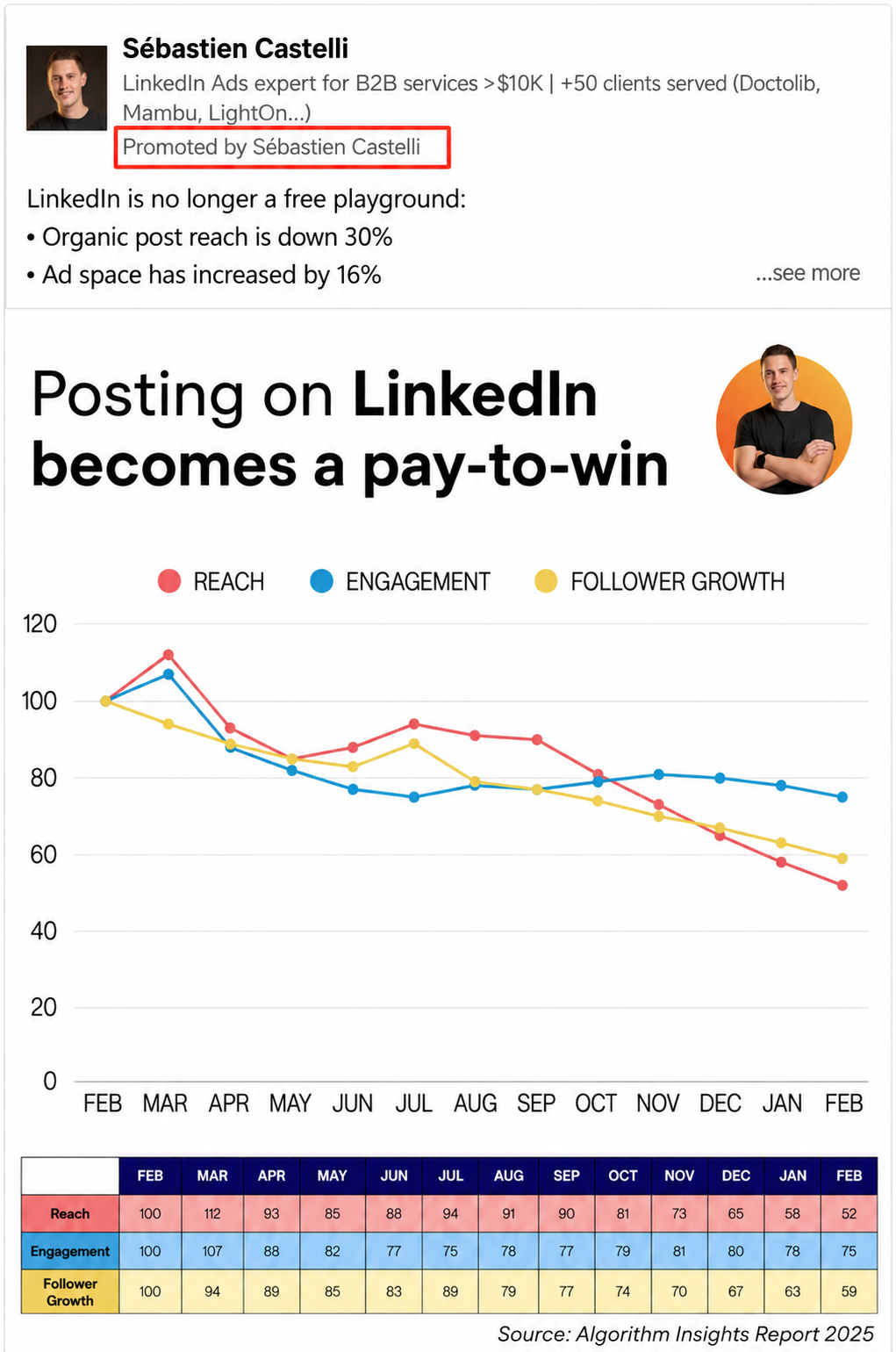
That's expected: organic visibility is dropping across the board. Personal posts are losing ~30% year-over-year, and company pages reach an average of just ~1.6% of their followers. The platform is entering a new stage of maturity — the same shift we saw with Facebook and Instagram.
The good news: you can stay visible and high-performing by paying to distribute the right messages, voiced by the right person.


Three simple reasons:
The era where anyone could "break through" on this professional network through consistency and a few tricks is over. Publishing quality content is no longer enough to increase visibility.
Thought Leader Ads.
The principle: sponsor posts from an individual LinkedIn account (not a company page). In the feed, it looks like a regular organic post — with just the discreet label "Promoted by [Your Company]."
The voice stays that of the CEO, the founder, or the expert. Not the brand.
Why this content strategy works:
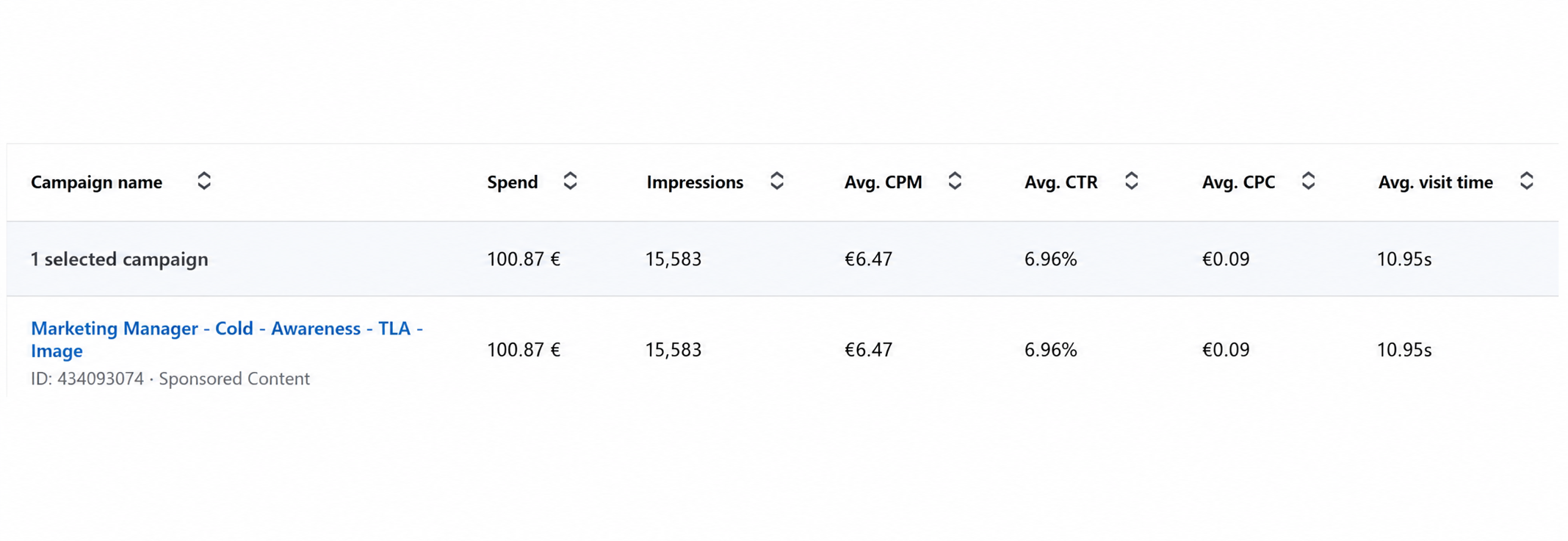
With a €500/month ad budget for sponsoring, you buy 25k to 75k additional impressions on LinkedIn from a targeted audience through LinkedIn Thought Leader Ads.
Worth noting: there's also an indirect effect — you're introducing your content to new LinkedIn users on LinkedIn, who will engage with your older posts and generate additional impressions as a result.
Beyond targeted impressions:
*LinkedIn counts clicks more generously than standard ads (e.g., "see more" clicks are included), which inflates the CTR. But it's still genuinely effective.
Ideally CEO / Founder / C-level. The market listens to those who carry the business. This marketing strategy performs better with a personal voice than a company LinkedIn page.
Let it live for a few hours (at least the first hour, to read early engagement), then before boosting:
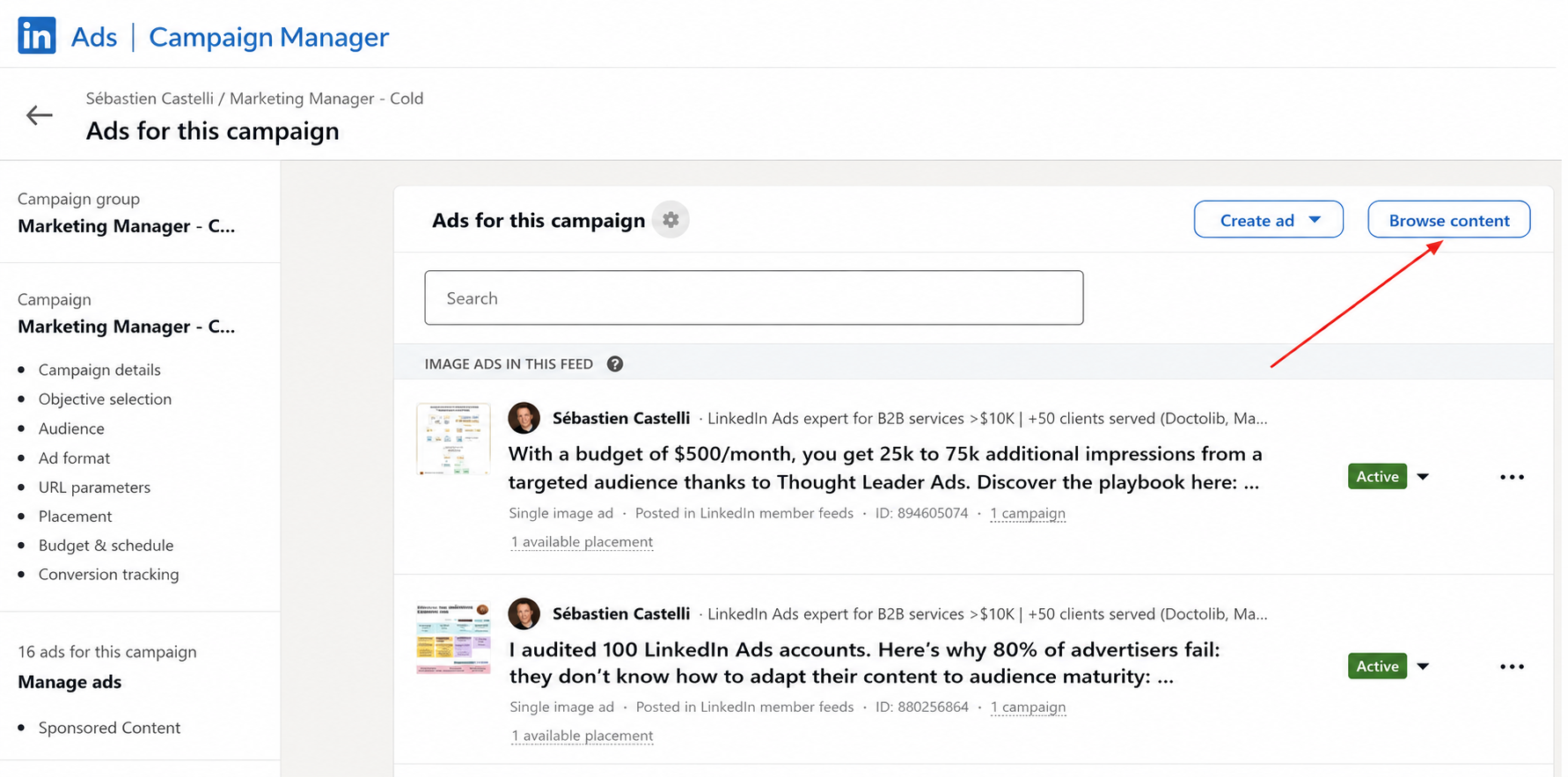
LinkedIn doesn't allow all content types. Keep it simple:
Only boost engaging content that checks all 3 boxes:
The best content types to drive engagement per post:
Thought Leader Ads generate interactions. Now capitalize on them.
Every like, comment, or profile visit is a signal of intent. A prospect who engages with your sponsored content is 5x more likely to respond to your outreach than a cold contact.
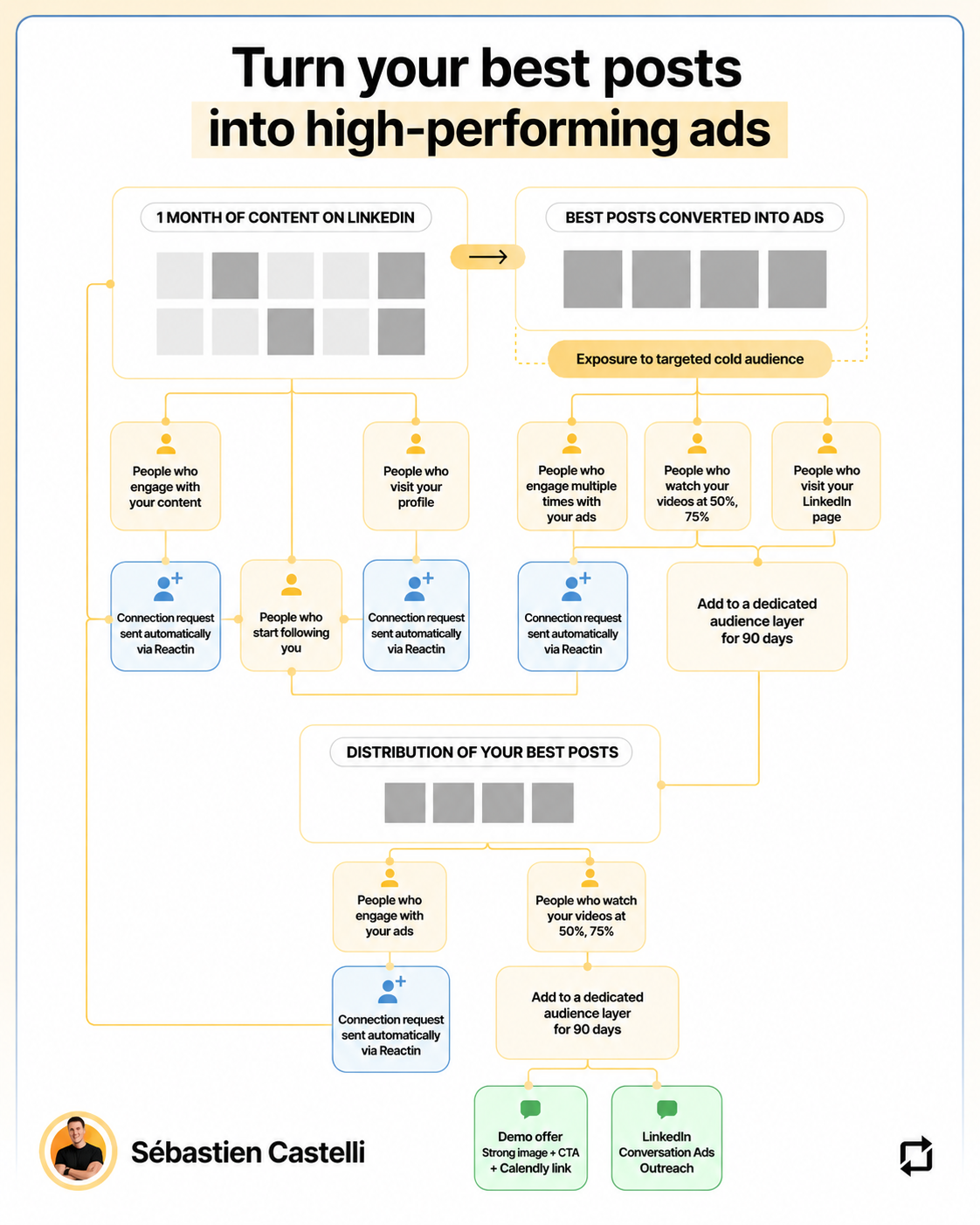
My system in 3 automated workflows (via Reactin):
Anyone who likes/comments on your posts (sponsored or not) automatically receives:
Auto-connection + message: "I see [expertise] is on your radar. Here's our latest framework on the topic: [link]. Any questions?"
Automatic message with a value-add package: "Thanks for connecting! Here are 3 resources you might find useful: [list]. Which one resonates most with you?"
LinkedIn is following the path carved by other social networks: the decline of organic reach is the new normal, but that's no reason to give up. LinkedIn has never had more active members — the opportunity is at its peak.
The ideal time to stake your position? Now.
The Thought Leader Ads market is still underexploited. CPMs are ridiculously low. Attention is at its highest.
In 12 months, everyone will be running Thought Leader Ads. CPMs will have tripled. And you'll regret not having started sooner.
Let's grow.
To spark interactions and gain visibility despite the decline, several formats continue to work. Human, authentic posts first: artificial intelligence has made generated content predictable. What resonates today is real lived experience, direct conversations, sector analyses based on your own experience. Optimized visual formats also work: a quality photo or a well-crafted image improves reactions. Avoid generic stock images. Polls and discussions create immediate interaction, a signal the algorithm takes into account to broaden the reach of your LinkedIn post. Content that makes people think remains essential: contrarian opinions, trend breakdowns, counterintuitive recommendations. If your content sparks healthy debate, it reaches a broader audience and generates quality conversations.
Three major changes explain this considerable drop in organic reach on LinkedIn. First, content saturation: LinkedIn has become an ultra-competitive platform. Hundreds of thousands of creators publish every week, and artificial intelligence has made it possible to generate content en masse. The result: too many posts for the total number of active users. Next, the algorithm change: the algorithm now favors pure relevance rather than following. Being subscribed to an account no longer guarantees that the content will reach your community. This is a key point to understand in order to adjust your strategy. Finally, the rollout of paid advertising: +16% of ads in the feed. LinkedIn has launched new ad formats that take up space, mechanically reducing the reach of organic posts.
Here's the essential practical advice: start small and test methodically. The preparatory work involves identifying 5-10 posts that performed well organically (engagement rate, number of comments, quality of reactions), then optimizing them by adding a clear call to action, a link to your site, and removing the hashtags. Let them run organically for 24-48h before sponsoring them. To launch the campaign, start with a budget of 10-20EUR/day per post with targeting of fewer than 100k people (be surgical, not broad). Choose the Brand Awareness objective to maximize reach, or Engagement to generate clicks and conversions. This tip lets you reach your target audience without wasting your budget on an audience that's too broad. Analysis and optimization come next: let it run for at least 7-10 days, analyze the engagement signals (CTR, dwell time, qualified comments), cut what doesn't work and double down on the winners. The effort required is significant, but the results reflect the reality of the current market. Only sponsor content that delivers value. If your post is just a corporate update or self-promotion, it won't work, even sponsored.
This is THE advanced strategy that too few companies apply: capitalizing on hot signals. When someone likes, comments or visits your profile after seeing your sponsored content, it's a direct signal of interest linked to your expertise. Here's how to turn these interactions into business opportunities and considerably improve your conversion rate. The first automated workflow targets engagers: detect anyone who interacts with your posts, send a connection request within 24h, then a personalized DM along the lines of "I saw that [topic] interests you. Are you facing any challenges related to that right now?" This direct approach lets you start an authentic conversation. The second workflow targets visitors who find your profile interesting: connect with a message like "Here's our latest framework on [expertise]. Any questions?" Sharing resources builds a relationship of trust from the very first contact. The third workflow addresses people who send you connection requests: send a welcome message with resources, such as "Thanks! Here are 3 resources that might interest you. Which one speaks to you?" This automation feature lets you reach your community effectively without constant manual effort. The result: a conversion rate 5x higher than cold outbound. The prospects are already warm; all you have to do is continue the conversation.
The optimal frequency: 2-3 posts per week, with an absolute focus on quality. Posting mediocre content every day kills your growth. The algorithm penalizes accounts that saturate the feed without delivering value; this has become a major trend on the platform. Our recommendation: 2 in-depth posts per week (expert content, analysis, case study, playbook) and 1 interaction post per week (poll, open question, quick share). This approach lets you bet on the best quality rather than on the total number of posts published. The essential complementary activity: comment on 10-15 relevant posts in your sector every day. This is often more effective than posting frantically. You build your community, you appear in other feeds, you create conversations. This regular activity also includes active participation in the LinkedIn groups where your prospects are. Active engagement remains the key to gaining visibility and broadening your professional network, even with the algorithm's current behavior.
Yes, but it requires a different strategy and more effort than before. Pure organic reach (publishing and waiting for the algorithm to distribute) has become ineffective due to market saturation. But you can still get visibility for free by changing your approach and adopting better practices. The first strategy is to bet on LinkedIn groups: actively take part in discussions in the groups in your sector. You reach the right people directly without depending on the main feed's algorithm. This feature remains underused even though it offers a real chance to create quality connections. The second strategy relies on active engagement: comment intelligently on the posts of your customers, prospects and thought leaders. Your comments generate visibility within their community and let you reach a relevant audience. Writing quality comments takes time, but it's an investment that pays off. The third strategy favors ultra-targeted content: instead of aiming broad, create hyper-specific content for a niche. A post that speaks to 1,000 precise people will work better than a generic post for 100k. This approach also lets you test different messages and adjust your editorial line based on reactions and the interest generated. The fourth strategy leverages smart sharing: when a colleague, a manager or a customer shares your content, it considerably broadens your reach with no budget. Encourage these shares by creating content that delivers real added value, resonates with your network and deserves to be shared. A catchy headline, a relevant photo, a clear summary: all these elements matter to make sharing easier.