Publié par
curve whitecurve white
Killian Drecq
Rédacteur
Blog
/
Brand Strategy
/
Web-to-Store: Turn Your Visitors into Physical Customers

Web-to-Store: Turn Your Visitors into Physical Customers

The same scenario plays out everywhere: your prospects spend hours comparing products online, reading reviews, browsing your Google listings, scrolling through your social channels — and then disappear before ever setting foot in your physical location. From the consumer's perspective, this behavior makes complete sense: they want as much information as possible before making the trip.

So the question becomes very concrete: how do you turn that digital traffic into real-world visits, boost in-store footfall, without blowing your local marketing budget or losing control of the customer experience?

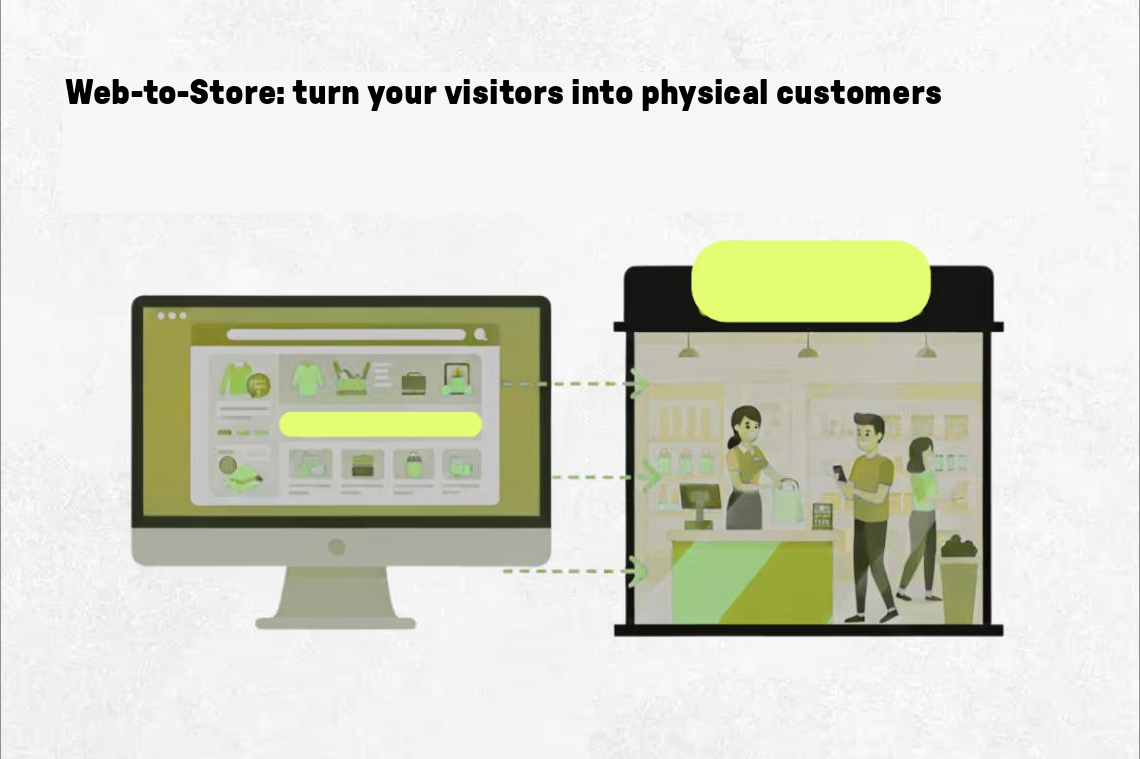
That's exactly the challenge web-to-store addresses — using digital as a springboard into physical commerce, generating visits, drawing customers into your locations, and driving revenue across your network of stores, agencies, or showrooms.

We'll lay out a straightforward, actionable framework designed for both B2C retailers and B2B players with a physical presence — built around an omnichannel digital strategy and real business outcomes, not just a communication layer bolted on top.

Ressource en lien
The 25 Marketing Tactics
Dernière mise à jour :
05
/
06
/
2026

Web-to-store, drive-to-store, ROPO: understanding the mechanics

Defining web-to-store

Web-to-store is everything you do online to bring someone into a physical location and motivate them to buy in person.

Concretely, a web-to-store strategy encompasses:

  • your website (e-commerce or brochure), optimized for organic search to capture the right intent;
  • your local web pages, designed to make a visit to a specific physical location compelling;
  • your Google Business Profile listings and each establishment linked to a point of sale;
  • geo-targeted advertising campaigns across channels (search, social, display, Waze, etc.);
  • emails, SMS, and optionally a mobile app that centralizes benefits, offers, and loyalty programs;
  • local marketing initiatives, community outreach, and user experience optimization.

The goal isn't necessarily to sell online — it's to influence customer behavior and purchasing decisions to trigger a visit to a store, agency, dealership, or showroom: the place where real value is created for the business.

Several related terms orbit this concept:

  • drive to store: everything that "pushes" a user from a digital channel toward physical commerce;
  • digital to store: same idea, more corporate terminology;
  • web2store: an alternative spelling used in certain industries;
  • buy online, pick up in store (BOPIS): a concrete form of web-to-store via click and collect.

The key point: digital is not an end in itself — it's an accelerator of physical footfall.

ROPO: Research Online, Purchase Offline

ROPO (Research Online, Purchase Offline) describes an extremely common purchasing behavior: research happens online, the decision closes offline.

Simple examples:

  • I compare TV models on my phone, read reviews, then go to the store to see the screen in person;
  • I search "tax attorney London reviews," read recommendations, then book an appointment at a physical office;
  • in B2B, I review technical specs for an industrial machine, watch a demo video, then request an on-site visit.

Every time your prospects behave this way, there's a web-to-store opportunity at stake.

Ignoring this means letting competitors capture your ROPO traffic for free — simply because they did a better job on local visibility, content, or in-store clarity.

The business case for web-to-store

Why does a web-to-store strategy become a strategic priority rather than "just another thing to do"?

  • local visibility: appearing in the right results, for the right keywords, in the right location (city, neighborhood, catchment area);
  • in-store traffic: turning your impressions, clicks, and page views into actual visits to your stores or agencies;
  • omnichannel customer experience: delivering continuity between what users see online and what they experience in person;
  • profitability: optimizing your media spend by targeting the people most likely to actually show up.

At Bulldozer, web-to-store is a performance topic, not just a brand awareness play: we're talking drive-to-store campaigns with measurable results, A/B tests, targeted email and SMS scenarios, geo-targeted ABM — not just "updating your Google hours."

The Bulldozer angle: web-to-store on the B2B side

Web-to-store is often treated as a purely B2C retail topic. That's a mistake.

In B2B, ROPO behaviors are even more pronounced:

  • industrial companies with technical showrooms,
  • B2B automotive dealerships,
  • commercial real estate agencies,
  • equipment distributors,
  • IT integrators, consulting firms, etc.

A decision-maker will research online, compare vendors, review case studies — but they'll finalize the decision with a physical visit, an on-site demo, or a meeting at your premises.

Neglecting web-to-store in B2B means losing qualified in-person meetings that your competitors will happily pick up.

Foundations and tools for a solid web-to-store setup

Before launching major drive-to-store campaigns, you need a clean foundation. Otherwise, you're sending traffic to a leaky vessel.

A website built to drive in-store visits

Your website should breathe web-to-store from every page. This subtly shifts the UX:

  • practical information front and center: address, directions, hours, phone number, accessibility options;
  • prominent in-store pickup, click-and-collect, or e-reservation options if applicable;
  • visit-oriented CTAs: "Try it in store," "Book an appointment," "See it in the showroom."

Key pages in a web-to-store strategy:

  • store locator: quickly find the nearest location;
  • product locator: check availability at a specific store;
  • store pages: photos, team, services, reviews, local events, unique features;
  • SEO-optimized local pages: [product/service type] + [city/neighborhood].

Every detail either reduces or increases the friction between web browsing and walking through the door.

Local visibility, business listings, and customer reviews

Local SEO is heavily determined by your Google Business Profile (formerly Google My Business).

A simple but critical checklist:

  • name, address, and phone number (NAP) rigorously consistent everywhere;
  • up-to-date photos of the exterior, interior, products, and team;
  • accurate hours, including holidays;
  • links to your website, booking page, and product pages.

Add customer reviews to that: they influence purchasing decisions as much as your shopfront does.

A serious web-to-store strategy always includes a review management platform (Guest Suite or equivalent) to:

  • collect reviews after visits or purchases;
  • respond promptly (especially to negative reviews);
  • analyze feedback to improve the in-store experience.

Geo-targeted SEO and proximity content

Local SEO isn't just "putting the city name in the title."

A strong geo-targeted SEO strategy covers:

  • "city" or "area" pages: "hardware store Grenoble," "kitchen showroom Lyon 7";
  • content that answers hyper-specific questions: "where to try this product near Bristol," "optician open Monday in Leeds";
  • long-tail keywords tied to local purchasing behavior.

Ideally, a user searching "phone repair Bristol reviews" lands on:

  • an optimized local page,
  • a clear snippet,
  • visible reviews,
  • a simple promise: "diagnostic in 30 minutes, in-store."

Geo-targeted social media and local advertising

Social media isn't just a global brand awareness channel.

A web-to-store approach leverages:

  • geo-targeted social ads around your store locations;
  • short-form content showing the real life of your physical space: ambiance, team, new arrivals;
  • local events: special days, workshops, evening openings, product demos, in-store showcases.

On the advertising side, drive-to-store geo-targeted campaigns can combine:

  • Meta Ads (Facebook/Instagram) targeted within a radius around each store;
  • Google Ads on local queries or with location extensions;
  • Waze Ads to capture users in transit near your locations.

We're no longer talking about simple visibility — we're talking "I see an ad on my commute, I stop by."

Core tech stack: PIM, CRM, in-store analytics

At scale, the right tools become structural.

PIM (Product Information Management)

A PIM ensures product information (prices, specs, visuals, stock) is consistent across:

  • website,
  • catalogs,
  • in-store kiosks,
  • POS systems.

Without it, you're promising products online that aren't available or are mislabeled in-store — and you're sabotaging your web-to-store strategy at the source.

CRM and marketing automation

Your CRM centralizes customer and prospect data. Combined with marketing automation, it enables you to:

  • send an SMS reminder before an agency appointment;
  • re-engage someone who viewed a store page without booking;
  • trigger local commercial prospecting campaigns to reactivate a zone.

In-store traffic analysis

To measure a drive-to-store campaign, you need at minimum:

  • in-store footfall data (counters, WiFi, beacons, anonymized cameras);
  • associated sales data, ideally by acquisition channel;
  • digital interactions preceding a visit.

Crossing web analytics with in-store analytics lets you understand what actually drives profitable physical visits.

Seven web-to-store levers to activate (with examples)

With the foundation in place, you can activate the accelerators. Here are the web-to-store classics, with concrete use cases.

Click and collect

Click and collect is one of the best-known formats: buy online, pick up in store.

Benefits for the customer:

  • speed,
  • no shipping costs,
  • ability to inspect the product before leaving.

Benefits for the retailer:

  • in-store traffic (with upsell opportunities on the floor),
  • better local inventory management,
  • reduced logistics costs.

The key: a clear promise on lead times, and genuinely synchronized stock levels.

Store locator and product locator

The store locator is often treated as a simple directory.

Done well, it's a web-to-store conversion tool:

  • search by city, postcode, or geolocation;
  • highlighting services available at each location;
  • direct integration into drive-to-store campaigns ("find the nearest store").

The product locator goes further: it lets users check whether a specific product is available at a specific store.

It's a powerful trigger for ROPO purchasing behavior: if I know the item is available 10 minutes away, I'll go.

E-reservation and online booking

E-reservation lets customers hold a product without paying online, then finalize the purchase in store.

Very effective for:

  • fashion (in-store fitting),
  • high-touch products requiring expert advice,
  • sectors where customers need to see or try before committing.

In B2B, the same logic applies via showroom or agency time-slot booking tools: schedule online, meet face-to-face.

Drive-to-store contests and prize mechanics

Competitions can become genuine drive-to-store mechanics — if designed properly.

Examples:

  • online entry, prize collection or final participation in store;
  • "instant win" format requiring prize validation in-store;
  • campaigns with coupons to scan on-site.

This combines qualified in-store footfall with data collection (emails, opt-ins, SMS consent).

Omnichannel promotions

A coherent web-to-store strategy aligns offers across channels:

  • what's promoted on the website and social media must be available in store;
  • digital coupons (email, SMS, social) must be easily redeemable at the till.

Customers hate making the trip for a promotion they saw online — only to find it doesn't exist in store. It's the fastest way to destroy trust and the customer experience.

Geo-targeted advertising

Geo-targeted campaigns are a cornerstone of modern drive-to-store.

Use cases:

  • Waze ads to highlight a petrol station, drive-through, fast food outlet, or dealership;
  • Meta Ads with radius targeting around a specific store for a local commercial campaign;
  • Google Ads with location extensions, pushing clicks toward Google Business Profile listings or store pages.

Again, the goal is to measure the impact on in-store footfall — not just clicks.

Targeted SMS marketing

SMS remains a highly effective web-to-store tool, especially at a local scale:

  • reminding a customer of their agency or healthcare appointment;
  • notifying that a product has arrived in store;
  • communicating a time-limited offer in a specific zone.

You obviously need to respect the legal framework (consent, opt-out, GDPR) and avoid over-solicitation.

Used selectively, geo-targeted SMS marketing becomes a genuine driver of qualified footfall.

A typical web-to-store journey

Combine all of the above and a high-performing web-to-store journey might look like this:

  • a prospect searches "convertible sofa London reviews";
  • they land on your optimized local page + your Google Business Profile listing;
  • a product locator tells them the item is in stock at their nearest store;
  • they e-reserve the model, receive confirmation by email and SMS;
  • they come to try it in store, discover other products, and leave with a larger basket.

Digital marketing's role is no longer to "drive traffic to the website" — it's to orchestrate purchasing behaviors that close in person.

Want to know more about your growth potential? 

Demander un audit gratuit
Carte ou profil utilisateur central mis en évidence, entouré d’autres profils en arrière-plan, suggérant une sélection ou une mise en avant d’un utilisateur.
bulldozer

Web-to-store in B2B: an underexploited lever

B2B sectors where it applies

Whenever there's a physical meeting, a location, or a demonstration involved, web-to-store is relevant in B2B.

A few examples:

  • B2B automotive dealerships, heavy vehicles, fleet operators;
  • showrooms for industrial equipment or professional tools;
  • commercial real estate agencies specializing in offices or business premises;
  • fit-out showrooms, joinery, professional kitchens, lighting;
  • consulting firms, IT integrators, or professional services companies that receive clients on-site.

Every visit is potentially a large deal. Ignoring drive-to-store in these sectors means leaving revenue on the table.

Turning a digital lead into a physical appointment

In B2B, web-to-store strategy relies heavily on conversion content:

  • simulators, configurators, case studies, video demos, white papers;
  • online appointment scheduling pages integrated with your CRM;
  • emailing workflows and commercial prospecting sequences to support decision-making.

The typical scenario:

  • a decision-maker discovers a piece of content via LinkedIn or Google;
  • they browse several pages, watch a case study, configure a solution;
  • they book an on-site demo, agency visit, or showroom appointment.

Digital prepares the physical meeting rather than replacing it.

Geo-targeted ABM: when account-based marketing meets web-to-store

In B2B, ABM (account-based marketing) lets you target a handful of strategic accounts with a fully customized program.

In "geo-targeted ABM" mode, you can:

  • target a limited set of companies within a defined radius around your office or showroom;
  • run highly personalized campaigns (LinkedIn Ads, email, outreach);
  • explicitly invite them to a private visit, demo, or exclusive open day.

Here, web-to-store becomes a premium commercial prospecting tool: digital opens the door, the physical experience closes the deal.

Nurturing all the way to the face-to-face meeting

Between the first click and the in-person visit, several weeks may pass.

That's where structured nurturing pays off:

  • targeted email sequences based on pages visited;
  • soft advertising retargeting to stay top of mind without being intrusive;
  • content sent ahead of the appointment to raise the prospect's maturity level.

The sales rep's role is then to continue that journey rather than start from scratch — they know what the person has viewed, read, and requested, and can adapt accordingly.

Building and managing your web-to-store strategy

Avoiding the classic pitfalls

A few traps can kill a web-to-store strategy before it has any chance of proving its value.

Broken omnichannel promises: a promotion seen online isn't available in store, conditions differ, offers are confusing. All of that destroys trust.

Unsynchronized stock: you promise in-store pickup, but the product isn't there. The customer makes an unnecessary trip, in-store staff are put in a difficult position, and your brand image takes a hit.

Poor review management: not responding, responding aggressively, ignoring recurring themes. Customer reviews are a management tool, not a necessary evil.

Internal silos: digital marketing, store managers, and sales teams aren't looking at the same metrics. Result: nobody truly owns the drive-to-store strategy.

Prioritizing the work

The idea isn't to launch everything at once — it's to sequence properly.

An effective web-to-store plan typically starts with:

  • updating and optimizing Google Business Profile listings;
  • locking down practical information and the basics of local SEO;
  • deploying a proper store locator;
  • defining a few simple offers, consistent across web and physical.

Then come the heavier initiatives:

  • CRM setup or overhaul;
  • configuring marketing automation scenarios for local commercial prospecting;
  • deploying a PIM;
  • integrating in-store traffic analysis tools.

A typical 3-to-6-month roadmap

Over a short horizon, a solid plan might look like this:

  • month 1: web-to-store audit (website, local SEO, business listings, existing campaigns, in-store analytics) and KPI selection;
  • month 2: foundation upgrade (Google Business Profile, store pages, UX, practical information, tracking);
  • month 3: launch of a first drive-to-store initiative (local promotion, click and collect, contest, Waze or Meta Ads campaign) with measurement;
  • months 4–6: iterations, CRM/automation scenario rollout, A/B testing on journeys, expansion to additional zones or locations.

The challenge: test fast, learn fast, and scale what works.

How Bulldozer approaches this type of project

At Bulldozer, we don't sell a generic "web-to-store package." We start by:

  • mapping your physical locations and local marketing challenges;
  • analyzing your existing data (web traffic, in-store footfall, sales, CRM);
  • building a web-to-store strategy tailored to your sector, your personas, and your operational reality.

We then deploy drive-to-store and geo-targeted ABM campaigns, connect the right tools, and track the metrics that matter: in-store traffic, conversions, and profitability.

Web-to-store isn't just another digital transformation buzzword.

It's a very concrete way to reconnect your digital marketing to what actually keeps your business running: visits, meetings, and sales at your physical locations.

By working on your local visibility, local SEO, ROPO journeys, CRM tools, and drive-to-store campaigns, you can:

  • generate more qualified in-store footfall,
  • deliver a smoother customer experience,
  • better manage your local marketing investment,
  • finally unlock the ROPO potential of both your B2C customers and your B2B accounts.

The question is no longer "should we do web-to-store?" — it's "how much longer are we willing to leave this to our competitors?"

FAQ

Web-to-store is a term that refers, in its most complete definition, to a set of digital initiatives aimed at attracting consumers into a physical store from an online product, a page, an ad or an email. Rather than settling for a basic digital presence, the retailer builds a genuine omnichannel marketing strategy that connects digital channels (website, mobile app, social media and social ads, review platforms, Google Business Profile) with the physical store. The goal is not only to "communicate" but to generate visits and encourage the customer to buy a product or service at the point of sale, with a clear process that meets customer expectations in terms of user experience, customer service, payment and availability. From the consumer's point of view, the main benefit is time savings and a smoother shopping experience: they spot a product online, check stock in real time, then choose to buy in store whenever it suits them.

Web-to-store serves as an umbrella term for a digital strategy aimed at boosting traffic to a physical store. Drive-to-store refers instead to paid or heavily acquisition-oriented mechanics, for example a geolocated mobile campaign that directly encourages a user to visit a physical store thanks to an exclusive offer, gifts or an extra promotion. ROPO, or the ROPO effect, describes a specific purchasing behavior: Research Online Purchase Offline, sometimes translated as research online buy offline or research online purchase offline. A consumer who reads a product description online, reads a testimonial, checks the location of a point of sale and ends up ordering or buying in store perfectly illustrates this customer behavior and purchasing behavior. In recent studies by firms such as Wavestone on French consumption and retail, the ROPO phenomenon is considered structural in the new era of omnichannel commerce, because it reveals essential insights into the impact on the consumer of digital journeys.

For a network of points of sale, a well-structured web-to-store strategy targets several benefits at once. In terms of attractiveness, it helps draw in consumers locally through organic search, a stronger presence on each store's Google Business Profile and communication adapted to the moment, for example a special operation in October or a new collection. On the business side, it contributes to increased traffic and to optimizing the in-store conversion rate, while reducing the risk of a wasted visit thanks to better management of stock information and out-of-stock risks. It also helps win new customers who might never have discovered the brand without this digital setup. On the relational side, it provides a solid foundation for developing the customer relationship, building lasting loyalty with a loyalty program, gathering satisfaction through reviews and ensuring better customer engagement, especially if the retailer relies on professional resources to structure its digital channels. Finally, an effective web-to-store strategy becomes an essential solution for French retailers looking to reconcile an improved user experience, operational constraints and sustainable growth goals; in this omnichannel logic, the web is no longer a simple advertising channel but a genuine source of traffic and revenue for each physical store.

The best web-to-store strategies generally combine several channels to attract, encourage and convert. A retailer can, for example, create a free downloadable guide that answers a specific customer need, then promote it for free via its social media and social ads, its website and its email campaigns, while offering a paid deal or an exclusive in-store benefit for those who come in person. You can pair this with a mobile app that lets customers prepare an order, check product location, track the status of an order or a click and collect, and be notified in real time of a limited-time offer. This kind of setup encourages the customer to visit the store, generates additional visits and helps boost traffic without degrading the in-store experience. The important thing is to think of each campaign as a coherent omnichannel process that clearly describes what the user should do, on which platform to get in touch, how payment works and how the retailer then handles customer service and follow-up.

When a retailer starts from scratch, the first challenge is to clarify the definition of its digital strategy and its priorities. The first step is to identify existing traffic sources, available internal resources, the teams' digital skills and the technical limitations of the tools in place. A good starting point is to consolidate Google Business Profiles, optimize the location and description of each physical store, fix the most visible issues (incorrect opening hours, a contact form that requires enabling JavaScript to view the map, missing phone number) and secure the basics of local organic search. Then you can gradually develop email and SMS scenarios that inform customers of the option to order online, reserve a product or service and pay directly via click and collect, with a clear policy on out-of-stock risks and on customer service. The key is to move forward in stages, measuring the effect of each new building block on purchasing behavior, the number of contacts generated and the increase in store visits, rather than seeking the perfect solution from the outset.

Yes. For a B2B player with a showroom or a network of branch offices, web-to-store often becomes an even more essential lever than for classic retail, because each visit represents high order potential. In this professional context, the web-to-store marketing strategy aims to attract a highly targeted audience from digital resources such as case studies, white papers, video demonstrations or simulators, then to convert these contacts into in-person meetings. The channels can remain varied: a social media campaign on LinkedIn, a personalized email, a contact form on a dedicated platform, appointment booking built into an app, and so on. The challenge is to offer a clear process that genuinely saves the decision-maker time, while giving the sales rep enough insight to tailor their pitch based on the customer behavior observed online. A frequent conclusion, in the feedback and testimonials of companies that have already put this kind of system in place, is that a B2B digital strategy oriented toward web-to-store improves the quality of the customer relationship, prospect engagement and the durability of loyalty, provided you accept the initial implementation constraints, limit the risk of unnecessary complexity and manage optimization on an ongoing basis.

Pour aller plus loin

Defining Your ICP When You Don't Know Where to Start: The Bulldozer GTM Framework

Brand Strategy
Bulldozer
Growth
Charlotte Nowak

The Complete Guide to B2B Programmatic Paid (5 Stages of Awareness)

B2B
Brand Strategy
Bulldozer
Charlotte Nowak
Comment utiliser le snack content pour engager votre audience B2B

How to Use Snack Content to Engage Your B2B Audience?

Content Marketing
B2B
Killian Drecq

Let's talk.

Full-funnel
500+ clients
300+ membres
Prendre un rdv stratégique