
What if you could capture the attention of a decision-maker in under 10 seconds — without resorting to shallow, throwaway content?
Snack content (also called micro-content, short-form content, bite-size content) has taken hold because audiences consume marketing at scroll speed: mobile-first, infinite feed, zero patience. In B2B, that doesn't mean "doing TikTok for the sake of it." It means producing short, useful, memorable content — anchored in a digital strategy that actually converts.
In this article: definition, methodology, KPIs, and most importantly, 7 snack content formats to adapt for LinkedIn, Instagram, and TikTok.
Snack content (microcontent, micro-content, snackable content) is a short content type, designed to be consumed in a few seconds on mobile. You'll find it primarily on social media, where a brand wants to deliver a direct, to-the-point message to a target audience and capture attention quickly.
In a digital marketing and content marketing strategy, it's a content format built to boost online presence, maximize organic reach, and prompt the user to act (comment, share, click through to a website).
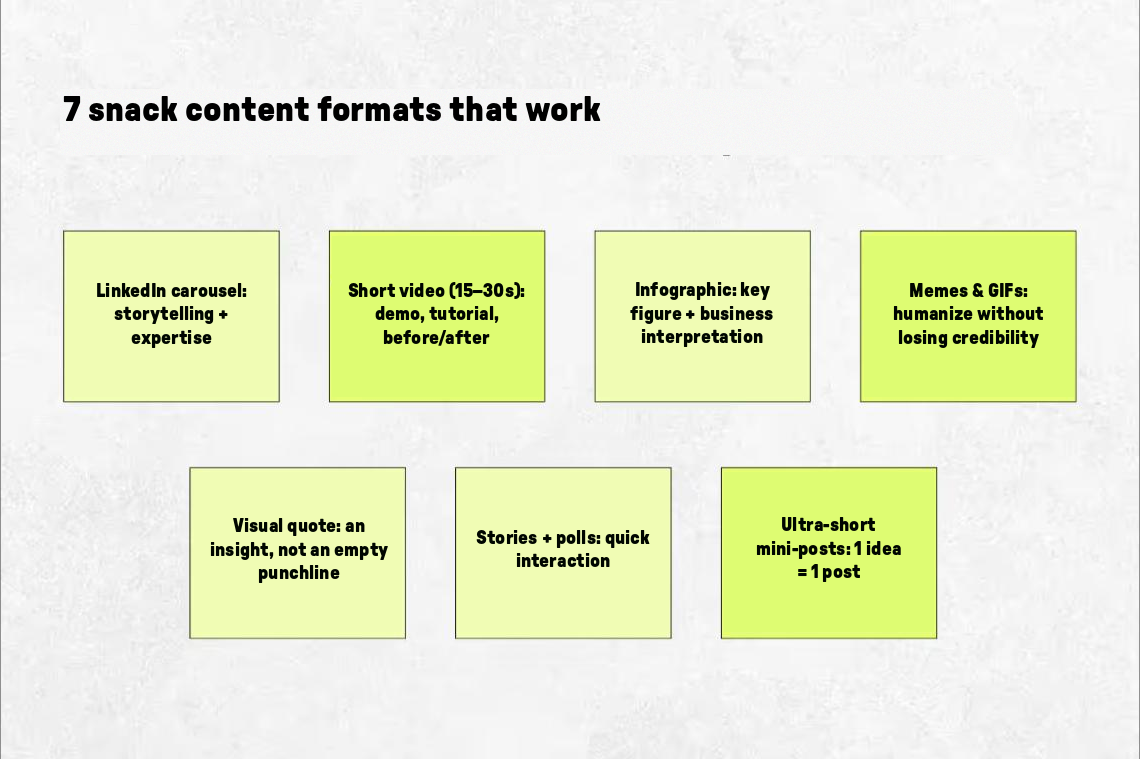
It often takes the form of an image or video format (snack video, short-form video), but also includes LinkedIn carousels, infographics, stories, polls, memes, and animated motion design content. The principle is consistent: fast, adapted digital communication suited to distribution channels across the web.
The term comes from the idea of "snackable" content: something you consume like a snack. Not a full meal.
The format maps to three concrete realities:
Snackable content isn't "against" long-form. It's part of an integrated strategy.
Think of it this way:
If you produce micro-content without bridging to something more substantial, you're generating visibility — without capitalizing on it.
A CMO, Head of Growth, or executive doesn't "read" LinkedIn the way they read a book. On social media, the behavior is scanning: consume fast, filter, save, come back if the message is clear and direct.
In digital marketing, this changes everything: you don't win attention with "more information," but with information that's well-packaged, easy to consume, and adapted to the target audience. Snack content becomes the ideal format for a B2B company that wants to stay present on its channels without exhausting its teams.
Your job isn't to convey your entire expertise in one post. Your job is to get one useful message across, at the right moment, to the right audience.
Every platform has its own rules, but in practice they tend to amplify content that triggers engagement signals and higher time-on-content.
For the full TikTok logic: How TikTok Recommends Content
And for Instagram: Instagram Ranking Explained
In short, short-form content gets a lift when it's engaging, well-crafted, and immediately understandable. This is even more true for short-form video, animated content, and visual formats (images, motion design, clean typography) — especially when originality and relevant humor are part of the mix.
Common engagement signals include:
When those signals rise, your organic reach grows — and your viral potential increases, even without paid amplification.
In B2B, snack content isn't just a social trend. It's a communication strategy that serves concrete objectives — especially when it's part of a broader system (content marketing + social strategy + website).
Snack content helps you:
It's not always a direct conversion lever. But it's consistently a trust accelerator, which indirectly improves the ROI of a well-executed marketing strategy.
Track metrics based on your intent, and set up clean measurement with a tracking tool: UTMs, dashboard, website analytics.
For visibility:
For engagement:
For business impact:
If you're running paid campaigns, add a media layer: cost per click, cost per lead, return on investment, and potentially retargeting. In some cases, a Google Ads or social ads campaign can boost high-performing organic content — as long as the format and message are already validated organically.
Don't judge a piece of content solely on likes. In B2B, a content format can generate very few likes but produce highly qualified inbound contacts and real business impact.
Why it works: it's readable, sequenceable, and forces structure.
Example carousel structure:
Variants that consistently perform:
Why it works: direct, human, perfectly suited to Reels/TikTok/Shorts.
Ready-to-shoot script (15s):
Simple ideas:
Why it works: people share a clear data point far more readily than a long piece of text.
Snack infographic template:
Example: "X% of leads come from Y" + "So: invest Z hours/week on…" + "Here's how."
If you don't have proprietary data, use public figures — or turn your observations into a "pattern" (noting it's a field observation).
Yes, it works in B2B — when used with restraint.
What it does:
💡 Simple rule: a meme should point to a real marketing problem (vague briefs, vanity metrics, a rebrand "for the sake of it"), then redirect to a useful idea in the caption.
A B2B quote performs when it contains an actionable idea.
Examples:
Always add a line of context in the caption: why it's true, and how to apply it.
Especially useful for:
Poll examples:
Then recycle the results into a short format: "X% of you said Y. Here are 3 actions."
The most underrated format: a post that says one thing, very clearly.
Simple structure:
💡 Example: "The problem with your short-form content isn't the editing. It's the angle. Give people a decision, not just information. Want a hook template?"
Most brands produce snack content "to stay present." And stop there.
Three high-ROI upgrades:
[rta-block=folder-cta][rta-title=h3]Want to explore your content potential?[rta-title=h3][rta-btn=regular href="/prendre-rendez-vous-typeform" target=_blank]Get a free audit[rta-btn=regular][rta-block=folder-cta]
Avoid "decision-makers" as a target. For any brand, the target needs to be specific enough that your message is immediately relevant to that person's industry and maturity level. Choose a real persona (or a defined audience segment) and note three things: their role, their context, and their job-to-be-done online.
Example targets:
Then define a single priority problem to address — otherwise your communication becomes vague and unlikely to generate shares:
Quick rule: if you can't summarize the problem in a single sentence, your snack content will rarely land.
Short-form content is much easier to produce when it's fed by solid long-form. That's where you gain quality, originality, and real value-add — even when producing a short article or video format.
Possible sources:
Then you slice it into micro-content and adapt each type to your distribution channels:
1 article → 1 carousel → 3 mini-posts → 2 short videos → 1 infographic.
This is content repurposing: you start from long-form (inbound marketing / content marketing) and atomize it into micro-formats, driven by a clear editorial calendar and content strategy. The goal: publish more frequently, across more channels, without reinventing the substance — while improving your online presence.
Good snack content is one message, one proof point, then one action. On social media, someone needs to understand in 2 seconds why they should stop scrolling.
A few B2B hooks you can steal and adapt to increase engagement and share likelihood:
Actionable tip: keep a "hook bank" in a management tool (Notion, Sheets, etc.) and recycle the strongest ones across channels, adjusting tone and length each time.
If it can't be read in 2 seconds on mobile, it's dead on arrival. Design and brand identity genuinely matter here, especially for visual content.
Quick checklist:
If you add motion design or more technical production, keep the "simplicity" rule: short-form content must stay easy to consume and highly shareable.
You have two families of CTA — choose based on funnel stage and channel (LinkedIn, Instagram, TikTok):
The right reflex: soft CTA on high-funnel formats to maximize organic reach, hard CTA on "proof" content to drive conversion. And to measure improvement, tie each CTA to a simple metric (CTR, UTM clicks, conversions) to optimize return on investment over time.
When you want to accelerate: a paid campaign can amplify high-performing content — but only once the message, format, and audience have been validated organically.
The same format can be "underperforming" on one objective and excellent on another.
Example:
Decide before you post: awareness, engagement, traffic, conversion, or social selling.
Each week:
Each month:
Compare your content:
Otherwise you risk killing useful formats just because they didn't "get likes."
To connect engagement to business outcomes, also track CTR, video completion rate, and post-click conversions on landing pages.
Short-form content published on social media lives primarily in the logic of the feed. It's consumed quickly, then replaced by the next post. Even when it performs strongly, it's hard to capitalize on from an SEO perspective for three straightforward reasons:
The result: if you only produce snack content, you generate reach and engagement — but you build few lasting assets. SEO, by contrast, builds pages that live for years and capture explicit intent.
The right goal isn't to make snack content "SEO-friendly." It's to use it as an amplifier that feeds your website.
The most ROI-positive combination in B2B looks like a simple loop:
The classic trap is the vague CTA ("link in bio", "contact us"). Instead, pair each short-form piece with a single objective and a clear destination:
Then lock in the value with a simple structure on the landing page:
One highly actionable rule: a long-form piece should generate at least 3 different micro-content formats, and each micro-content piece should point to a page (or anchor) that's aligned — not the same generic landing page for everything.
Mapping the funnel is useful. Mapping the destinations is better. Here's a simple grid.
Formats: memes, mini-posts, quotes, stories, polls.
Objective: trigger a reaction (comment, save) and direct to a "definition / guide" page that answers the intent.
Formats: method carousels, mini-cases, infographics, tutorial videos.
Objective: feed the reflection and link to pages that go deeper (detailed article, template, comparison, study, resource landing page).
Formats: demos, before/afters, client stories, complete frameworks, "here's how we do it."
Objective: align a direct CTA with a logical destination (audit, meeting booking, service page, scoping checklist).
The shift is to stop opposing virality and conversion. You're building a chain: snack content creates the entry point, long-form content captures the intent, internal linking moves prospects forward, and your assets (newsletter, lead magnet, service pages) turn attention into demand.
Want to move faster? Request a full content audit (angles, hooks, formats, KPIs) or book a call to build your system: snack content + long-form + nurturing.
Lorem ipsum
.jpeg)
Writer at Bulldozer, he covers web scraping, UGC and no-code, mixing data, storytelling and SEO.
Can't find what you're looking for ? Contact us here
jordan@bulldozer-collective.comGet access to playbooks and feedback from those who are shaping the next wave of marketing and AI.