What if every marketing campaign spoke to a single strategic account, as if you were whispering: "I know exactly what you need"?
That's the promise of Account-Based Marketing. In a B2B landscape where sales cycles are stretching and competition is intensifying, an effective ABM strategy allows marketing teams to:
focus budgets on the highest-value target accounts,
align sales and marketing teams around shared objectives,
deliver personalized, multichannel buying experiences at scale,
generate measurable ROI — consistently outperforming traditional inbound.
Ready to transform your growth engine and optimize your ABM strategy? This complete guide covers the foundations of ABM, the criteria for choosing the right platform, and our Top 10 2026 with real-world use cases and detailed reviews of each solution.
Understanding ABM: why it's non-negotiable for marketers in 2026
1. Account-Based Marketing: a quick definition
Account-Based Marketing is a strategic approach that treats each target account (rather than each individual lead or prospect) as a market in its own right. This ABM strategy relies on:
Data and intent signals to identify "hot" accounts with high conversion potential,
Advanced personalization (content, advertising, email, social media) to craft messages that resonate with the specific needs of each organization,
Sales and marketing alignment to orchestrate the customer journey all the way to close — and beyond into upsell.
2. Key stats on ABM tool effectiveness
76% of B2B companies that have adopted an ABM strategy report a larger deal size (source: Demandbase, 2024).
Mature ABM programs generate 208% more revenue than untargeted marketing efforts.
87% of ABM marketers report higher ROI than any other B2B strategy.
3. ABM as a growth marketing accelerator
Growth marketing combines data, rapid experimentation, and scalability. ABM adds surgical precision: instead of casting a wide net across a market, you sniper the 50 target accounts that will drive 80% of your revenue. The result: controlled acquisition costs, a more reliable pipeline, and more predictable revenue.
This approach also enables real-time optimization of the customer journey, improved buying experience, and stronger long-term client relationships.
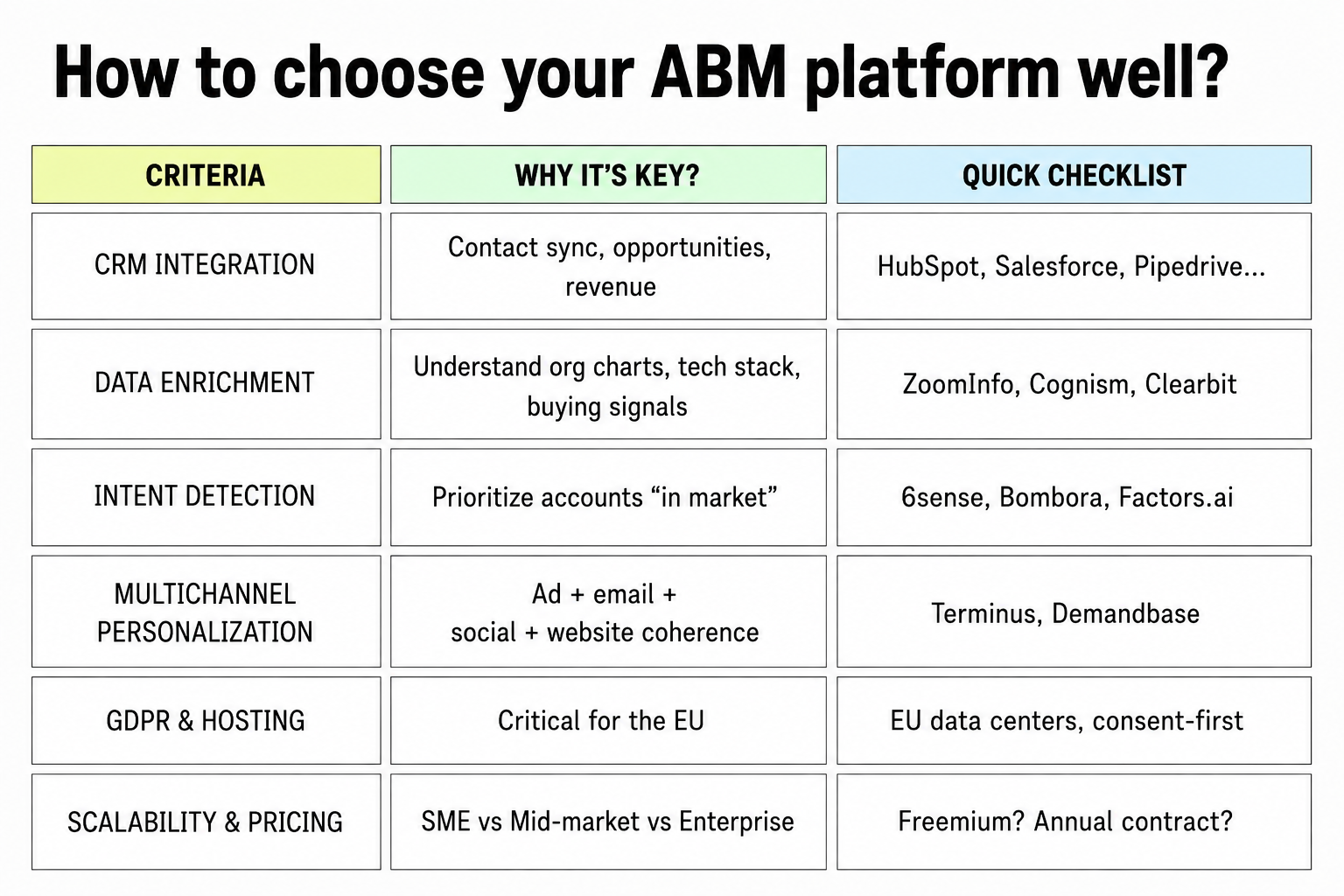
How to choose the right ABM platform
💡 Pro tip: list your data sources (CRM, analytics, enrichment) and your activation channels; choose the tool that centralizes the most steps to avoid data silos and maximize campaign efficiency.
Top 10 ABM tools to know in 2026
Methodology: ranked by functional depth, B2B market adoption, pricing scalability, growth marketing compatibility, and customer reviews on user experience.
Positioning: a blend of granular analytics and real-time intent alerts.
Superpower: automatically scores every anonymous visit, cross-references corporate IP and on-site behavior, then fires a Slack alert the moment a priority target account heats up.
Why we love it: perfect for triggering retargeting or SDR outreach without delay — helps teams identify new qualified prospects fast.
Rating: 4.5 out of 5 stars based on customer reviews
Growth plan: free for startups, with progressive paid tiers.
Positioning: built so marketers set the ABM strategy and let AI agents run the motion end-to-end.
AI Agents: four specialized agents — Campaign, Content, Bidding, and Insights — build full-funnel campaigns, write on-brand assets, optimize ad spend in real time, and surface next-best actions for sales.
Superpower: auto-generates hyper-personalized microsites and LinkedIn ABM ads for each target account, plus a Sales Plugin so reps can spin up ABM content and track engagement themselves.
Native integrations: Salesforce, HubSpot, Marketo, Demandbase, 6sense, Outreach, Salesloft, LinkedIn Campaign Manager, and 15+ other platforms.
G2 rating: 4.8 out of 5 stars (200+ verified reviews).
Growth tip: customers report scaling target-account coverage 10x without adding headcount — ideal for lean ABM teams.
4. 6sense: Predictive intelligence with machine learning
Proprietary AI that analyzes over 2 trillion signals per quarter to predict where buyers are in their purchasing journey.
"Next Best Action" feature: email suggestions, SDR sequences, personalized content.
Impact: users report an average +15% close rate improvement through better segmentation.
Advanced machine learning to predict customer behavior
Tip: sync your "Target, Engage, Close" lists directly inside Salesforce.
Focus: identifies companies visiting your site and pushes them directly into your CRM.
Scoring: based on company size, industry, and pipeline stage.
Bonus: responsive customer support team.
Real-time tracking to measure target account engagement
[rta-block=folder-cta][rta-title=h3]Want to explore your outbound potential?[rta-title=h3][rta-btn=regular href="/prendre-rendez-vous-typeform" target=_blank]Get a free audit[rta-btn=regular][rta-block=folder-cta]
Practical guide: how to integrate and optimize your ABM strategy
Before selecting an ABM tool, it's essential to analyze your current audience and create a precise segmentation of your target accounts. This step helps identify:
Companies with the highest conversion potential
Key buyer personas within each organization
Intent signals indicating a prospect is ready to buy
The most effective channels for engaging your target audience
2. Measuring and optimizing performance
An effective ABM strategy requires continuous performance tracking across multiple touchpoints. Key KPIs to monitor include:
Lead quality and conversion rate by target account
Engagement rate across channels (social media, advertising, email)
Pipeline velocity and time to close
Customer lifetime value and return on investment
Account penetration and expansion revenue
3. Creating personalized content and targeted messaging
The effectiveness of your ABM campaign depends largely on your ability to create content that resonates with each account's specific context. This means:
Developing messages tailored to each buyer persona
Personalizing the experience across all touchpoints
Using data insights to adjust your approach in real time
Optimizing the customer journey to maximize conversions
Better ROI: budgets focused on high-value accounts
Stronger alignment with commercial teams
Precise measurement of revenue generated per campaign
Continuous optimization powered by data analytics
For the customer experience
Deep personalization that addresses specific needs
Smooth, consistent customer journey across multiple channels
Quality interactions with relevant, timely messages
Tailored service aligned with each organization's priorities
Conclusion: ABM as an indispensable growth lever
ABM is no longer a nice-to-have — it's an essential revenue accelerator for any ambitious B2B organization. With the ABM tools covered here, you can:
Track target account interest in real time
Deliver a personalized buying experience across all channels
Measure the precise ROI of your marketing efforts
Continuously optimize your approach based on real data insights
The best ABM platforms offer a comprehensive approach that integrates with your existing marketing tools while providing advanced functionality to help you engage your target audience more effectively.
🎯 Next step: Evaluate your current lead generation and account targeting needs to choose the right ABM tool that fits seamlessly into your existing tech stack.
An ABM tool is a software platform that centralizes account data, detects intent signals, makes it possible to personalize content, and measures revenue per account throughout the cycle. These tools are designed to help marketing teams manage and optimize their ABM strategy effectively.
What is the difference between a CRM and an ABM platform?
The CRM stores the customer relationship and the history of interactions. The ABM platform activates this data to orchestrate targeted campaigns on a limited group of target accounts and attribute a precise ROI to them. The ABM tool integrates with your CRM to provide additional functionality.
Which ABM tools are right for an SME or startup?
Apollo.io, Albacross, or Factors.ai offer plans under 100 euros/month and a gentle learning curve. These solutions offer good value with the essential features to get started with ABM without a massive investment.
ABM strategy or Inbound Marketing, which should you choose?
The two approaches complement each other: inbound fills your top of funnel with leads, while ABM concentrates resources on the highest-value target accounts to accelerate closing. A hybrid strategy optimizes customer acquisition across all stages.
What is the cost of an ABM platform?
Adobe Experience Platform: quote-based (Enterprise)
Demandbase: 70-150k euros/year (Enterprise)
Terminus: 20-60k euros/year depending on modules
Apollo.io: freemium model, $50/user/month
Factors.ai: starting from 0 euros, then scalable plans
How do you measure the success of your ABM strategy?
Key KPIs include:
Pipeline generated per target account
Average deal size and sales cycle
Engagement metrics (visits, emails opened, ads clicked)
Conversion rate per audience segment
Customer lifetime value and expansion revenue
Overall ROI of your ABM campaigns The important thing is to show clear attribution between your ABM efforts and the business results in order to justify the investment in these marketing tools.
Newsletter
Join those who are redefining AI-driven growth.
Get access to playbooks and feedback from those who are shaping the next wave of marketing and AI.
Thank you! Your submission has been received!
Oops! Something went wrong while submitting the form.