
October 15, 2024
CRM Audit: Maximize Your Customer Performance with Experts
Discover how a CRM audit can transform your customer relationship management and optimize your commercial performance.
October 15, 2024
Discover how a CRM audit can transform your customer relationship management and optimize your commercial performance.
You invested in a CRM solution supposed to streamline your sales processes… but in reality, it's sluggish, data is unclear, and both your marketing teams and salespeople end up frustrated?
No need to panic: a CRM audit (or an audit of your HubSpot instance, if applicable) lets you identify anomalies, fix the gaps, and above all get the most out of your tool.
In a few steps, a CRM expert can help you analyze your data, improve your workflows, and restore the effectiveness of your customer relationship.
We'll explain how to do it, why it's essential, and how to turn it into a real development opportunity.
Waiting means letting problems settle in.
A CRM audit is an opportunity to reset the counters, regain clarity, and above all… turn your CRM into a growth lever.
💡 Still unsure? If your CRM is slow, underused, or poorly integrated into your processes, then every month without an audit = lost opportunities.
A CRM audit is a complete diagnostic of your customer tool and its actual usage by your teams. It's not just about "checking that everything works." It's a full check-up to see what works, what's blocking, and how to make everything more efficient to sell better and build loyalty.
What it is: Data analysis, processes, usage — Technical surface verification — Automation strategy evaluation
What it isn't: A bug list to fix — CRM / business / team alignment — A static report that's useless after 2 months
A CRM audit isn't there to look pretty. It needs to produce measurable effects, starting the following month.
What we expect from an audited and optimized CRM is simple:
Result? A tool that no longer slows your teams down, but propels them forward.
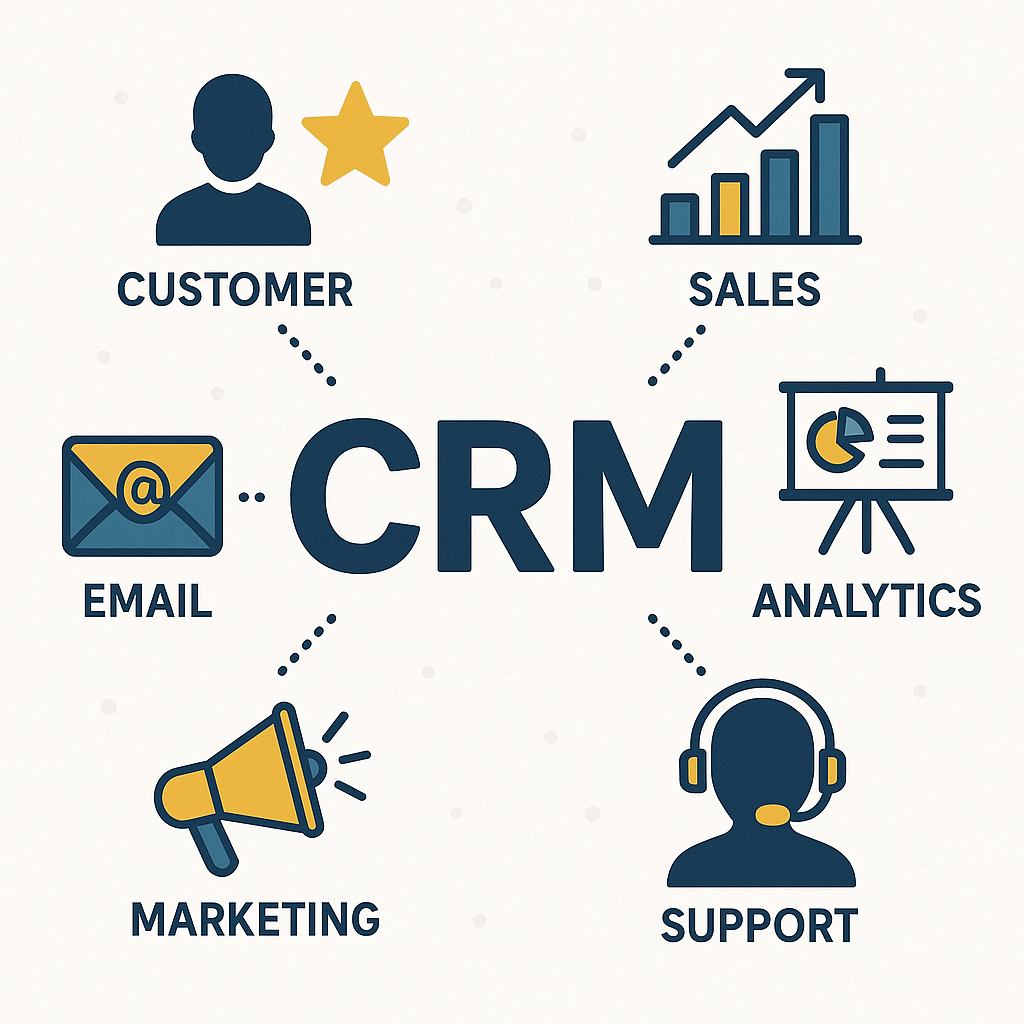
No need to wait for your CRM platform to become a ball and chain.
As soon as any of these symptoms appears, your customer relationship management system needs a good check-up.
Is your customer database riddled with duplicates, empty fields, or outdated information? That's a sign that data quality is declining.
Impact: imprecise segmentation, failing campaigns, time wasted on manual corrections.
👉 It's time to identify anomalies and restore data reliability.
If your staff are juggling Excel, emails, and Slack, your CRM tool is no longer doing its job.
🚩 Result: a platform available, but unused.
A personalized CRM audit can help you adapt the tool to the real needs of your marketing and sales teams.
You have leads, forms, campaigns… but few results?
A CRM audit connects the dots between data, targeting, and marketing performance.
A good CRM automates. A bad CRM slows things down.
Classic symptom: your salespeople complain they spend more time filling in fields than closing deals.
Some situations call for an audit, even when everything seems to be ‘working.’
A well-conducted audit is your guarantee of keeping a solid foundation during the storm.
[rta-block=folder-cta][rta-title=h3]Want to learn more about your CRM potential?[rta-title=h3][rta-btn=regular href="/prendre-rendez-vous-typeform" target=_blank]Get a free audit[rta-btn=regular][rta-block=folder-cta]
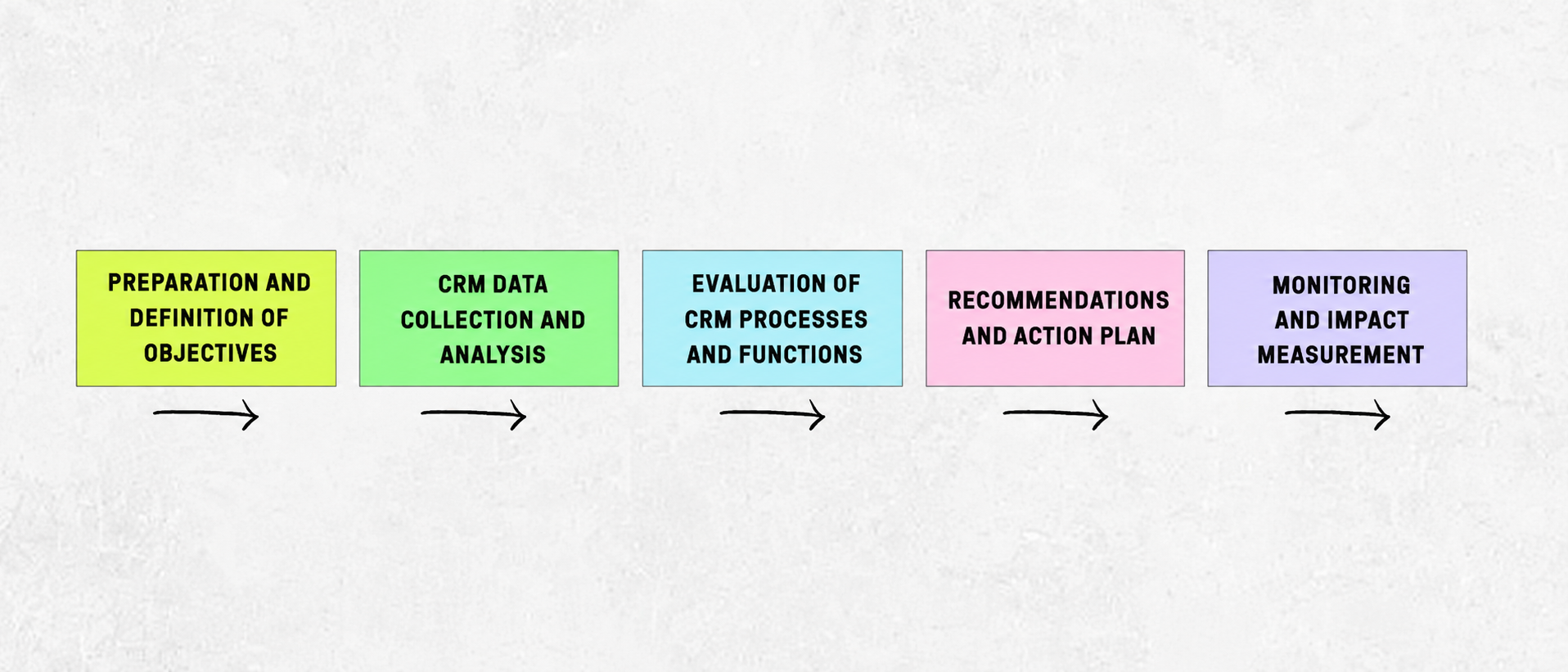
A CRM audit isn't a .pdf report sitting in a drive. It's a structured process aimed at immediate, measurable results.
We can break it down into 5 key steps, with a simple logic: understand, analyze, recommend, act.
Before diving into the data, we take time to talk to people.
Objective: understand your real business goals and current friction points related to CRM usage.
We draw a clear map of what's happening in your CRM, without unnecessary jargon.
Result: we quickly see what's blocking and what can be optimized without rebuilding everything.
This is where we check whether your CRM holds up on the stack and automation side.
A CRM is rarely alone: it needs to play as a team with your other tools. We make sure it does.
We don't leave you with a hollow PowerPoint. We give you a prioritized action plan, ready to execute.
This is where the audit becomes a strategic lever, not just a diagnosis.
Some companies want to do it themselves, others prefer a helping hand. We adapt.
Because an effective CRM is above all a team that uses it well, over the long term.
Most CRM audits we see are… clean, well-presented… but largely incomplete. ✖️
They stay at the surface, ignore the human element, and fail to account for the digital ecosystem as a whole. Result: ‘out of touch’ recommendations and actions that don't match ground-level reality.
Here's what you're rarely told (and what we'll always tell you at Bulldozer).
A one-shot audit is good.
But in 6 months, your organization, tools, and teams will have evolved.
What needs to be put in place: a recurring audit logic or light monitoring to keep a CRM always aligned with your business challenges.
The best audits don't come from an Excel spreadsheet, but from a conversation with your salespeople.
What we often see: technical issues are secondary. What blocks performance is actual usage on the ground.
Bad news: a CRM is useless if it's not integrated into your growth strategy.
A good CRM audit must lay out the entire acquisition funnel, from first click to closing.
Your CRM is connected to an ecosystem. If it's isolated, it loses its value.
Often overlooked stack:
What's needed: a CRM designed as a hub, not a black box.
At Bulldozer, we don't sell a ‘CRM audit’ just to tick a box.
We offer a performance accelerator that connects your tool to your real business challenges.
We don't stop at the tool. We look at the impact on your results.
Clean records? Yes.
But above all: system efficiency as a whole.
Where others stop at the CRM, we cross-reference the data and connect the dots.
Result: a tool built to last and adapt.
We like tools that are simple, powerful, and well-connected. Here are the ones we most often encounter in our audits:
Automation: Zapier, Make
Collection / UX: Typeform, Webflow
Analysis & tracking: GA4, BigQuery, Looker
Automation: Slack, Trello
Collection / UX: Google Forms, Calendly
Analysis & tracking: Matomo, Hotjar
Regardless of your stack size: what matters is that it's coherent and profitable.
Our strength is the articulation between diagnosis, strategy, and execution.
CRM audit + business vision + culture of action = the Bulldozer effect.
A good CRM audit isn't a luxury.
It's a business accelerator, a concrete way to align your teams, optimize your campaigns, and make your data reliable.
At Bulldozer, we don't sell PowerPoints. We help you take back control, and transform your CRM into a growth machine.
Ready to take action? Let's talk diagnostics.
Lorem ipsum
.jpeg)
Writer at Bulldozer, he covers web scraping, UGC and no-code, mixing data, storytelling and SEO.
Can't find what you're looking for ? Contact us here
jordan@bulldozer-collective.comGet access to playbooks and feedback from those who are shaping the next wave of marketing and AI.