Publié par
curve whitecurve white
Killian Drecq
Rédacteur
Blog
/
Brand Strategy
/
Boost Your Brand Awareness with Brand Marketing

Boost Your Brand Awareness with Brand Marketing

In competitive markets, it's no longer just the product that makes the difference — it's the strength of the brand. Brand marketing helps you build awareness, sharpen your brand identity, and create a lasting relationship with your audience, whether they're B2B buyers or end consumers.

Here's how to build an effective brand marketing strategy to strengthen your brand equity, stand out from the competition, and earn long-term loyalty.

Dernière mise à jour :
05
/
06
/
2026

Building a strong brand identity through brand marketing

Understanding brand marketing

What is brand marketing?

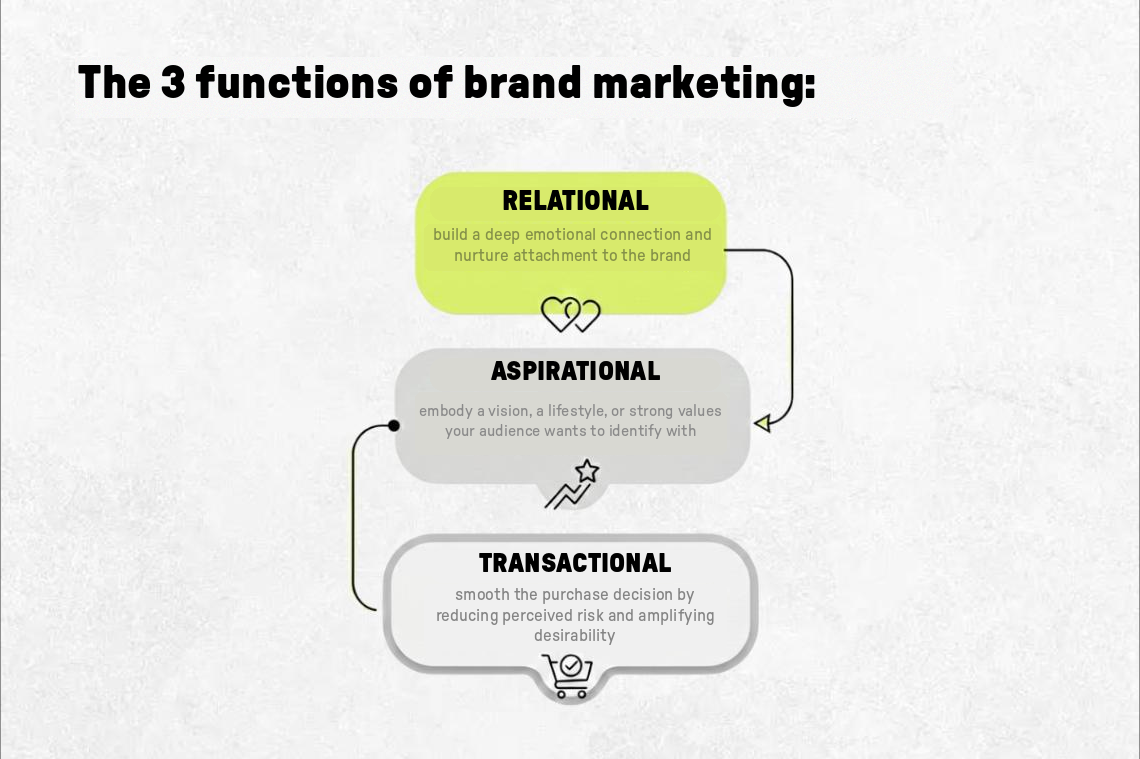
Brand marketing refers to the full set of strategic actions designed to build, assert, and reinforce a brand's image in the minds of its audiences — whether B2C or B2B.

🎯 Core objective:

Create a lasting emotional connection with your customers, partners, and prospects — well beyond a transactional relationship.

Why it matters:
  • Differentiate durably in increasingly crowded and competitive markets
  • Build trust, credibility, and genuine brand preference
  • Give meaning and value to the purchase decision, fostering loyalty that goes beyond price or features
Understanding brand marketing

In short, brand marketing acts as the invisible but essential foundation that supports your operational marketing, drives your sales, and shapes your attractiveness to talent and partners alike.

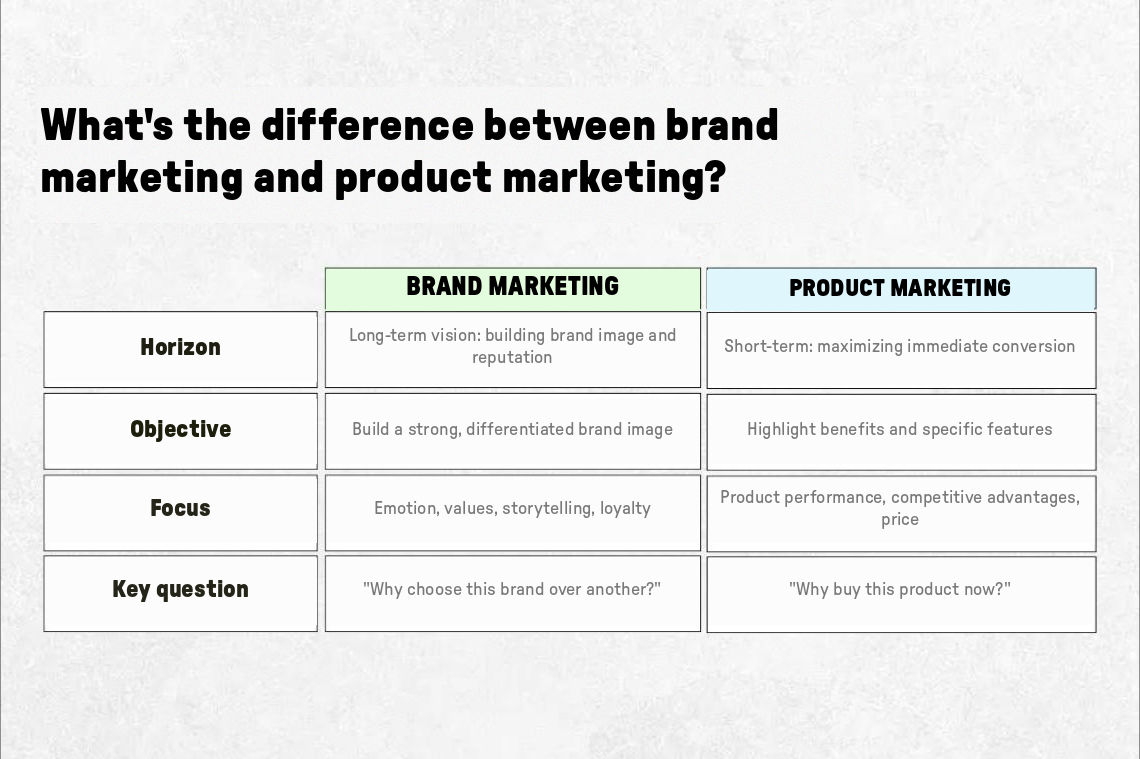
What's the difference between brand marketing and product marketing?

Same family, different missions:

What's the difference between brand marketing and product marketing?

Key distinction:

  • Brand marketing builds emotional and symbolic capital that supports every future interaction with the brand.
  • Product marketing leverages that capital to convert and drive immediate sales.

A concrete example:

  • Brand marketing builds emotional and symbolic capital that supports every future interaction with the brand.
  • Product marketing leverages that capital to convert and drive immediate sales.

Without solid branding, even the best product risks being forgotten.

Without effective product marketing, even the most inspiring brand will struggle to turn its promise into revenue.

👉 Success comes from intelligently aligning both strategies: the brand creates desire, the product fulfills the promise.

How to build an effective, coherent brand marketing strategy

Values, mission, vision: laying your brand foundation

Before thinking about logos, taglines, or campaigns, you need to define who you are and what you stand for.

The 3 founding pillars of a strong brand:

  • Values: what your brand stands for day in, day out (e.g. innovation, transparency, boldness)
  • Mission: your reason for being, the contribution you want to make (e.g. "Accelerating energy transition for businesses")
  • Vision: your ambition for the future, the direction you're charting (e.g. "Become the leading European sustainable transport company")

Why it's non-negotiable:

  • Give natural coherence to everything you say publicly
  • Rally your team and partners around a shared project
  • Inspire and sustainably engage your customers

This foundation is your brand marketing's strategic compass. Without it, every action risks feeling hollow or falling flat.

Building the brand book: the cornerstone of consistency

The brand book (or brand guidelines) is your reference document for maintaining a strong, consistent, and credible image across every touchpoint.

What it should contain:

  • Visual identity (logo, color palette, typography, iconography)
  • Tone and editorial style (formal, warm, innovative…)
  • Application best practices, use cases, common mistakes to avoid

Its strategic role:

  • Ensure visual and editorial consistency across all communications
  • Align all teams (marketing, sales, HR, product…) around a unified brand expression
  • Facilitate onboarding for new team members and partners

A well-designed brand book means less improvisation, more clarity, and a smoother, more impactful customer experience.

Brand identity: embodying your DNA 🎨

Your brand identity is your public face. It captures attention and leaves a lasting impression in people's minds.

The essential elements:

  • Logo: simple, memorable, representative
  • Color palette: carries your emotional values (e.g. blue = trust, green = sustainability)
  • Typography: matched to your brand personality
  • Brand voice: serious, irreverent, inspiring — but always consistent with your DNA

🧠 Key point: your identity isn't just "a nice design" — it visually and emotionally expresses your strategic positioning, your differentiation, and your brand promise.

Deploying a multichannel, aligned brand marketing strategy

The critical role of the Brand Manager and CMO

To make your brand marketing succeed, two strategic roles are essential:

Brand Manager:

  • Leads brand building and day-to-day brand management
  • Ensures identity consistency across all channels and touchpoints
  • Monitors positioning evolution and adjusts strategy to stay competitive

Chief Marketing Officer (CMO):

  • Oversees the overall marketing strategy, aligning acquisition, retention, and branding
  • Ensures brand marketing is integrated into commercial performance and customer experience
  • Coordinates creative, digital, sales, and PR teams to activate the brand across every touchpoint

🎯 The challenge: making sure brand identity permeates every action — from advertising to email, from customer relationships to recruiting.

Successful B2B branding depends on constant alignment between the Brand Manager's vision and its operational execution by the CMO.

Choosing B2B communication channels

In B2B, brand marketing success depends on channel choice — but also on the ability to deliver a consistent, multichannel brand experience.

Must-have channels:

  • Corporate website: your digital storefront, the foundation of credibility and expertise
  • LinkedIn: the premier channel for reaching decision-makers and nurturing thought leadership
  • Sector press and earned media: build legitimacy with specialist publications
  • Professional events (trade shows, conferences, webinars): create direct connections and reinforce human proximity
  • B2B newsletter: maintain regular touchpoints and support lead nurturing over time

💡 Tip: your B2B brand marketing should prioritize message clarity, content value, and social proof (client testimonials, case studies, certifications).

👉 The more consistent your touchpoints are, the more firmly your brand embeds in your prospects' minds.

Aligning with sales, HR, and product teams

Your branding shouldn't live only in marketing's hands.

To be truly powerful, it needs to show up in every interaction with your audiences.

Why align all teams?

  • Sales: to tell the same story as marketing, adapted to each prospect's specific needs
  • HR: to attract and retain talent who are aligned with your values and culture
  • Product: to develop offerings and innovations consistent with your brand promise

The expected result: a unified message = more credibility, more customer trust, more loyalty... and ultimately, more durable business growth.

Want to explore your brand marketing potential?

Demander un audit gratuit
Carte ou profil utilisateur central mis en évidence, entouré d’autres profils en arrière-plan, suggérant une sélection ou une mise en avant d’un utilisateur.
bulldozer

Content and branding: the strategic duo

Brand content vs. content marketing: understanding the difference

Complementary as they are, brand content and content marketing don't pursue exactly the same objectives in a brand marketing strategy.

Brand ContentContent MarketingPurposeBuild and reinforce brand imageGenerate leads and drive conversionContent typeStorytelling, values, creative universesPractical guides, case studies, SEO articlesExamplesBrand films, inspirational podcasts, creative mini-seriesTechnical blog posts, white papers, newsletters

In short:

  • Brand content nurtures emotional attachment and strengthens your differentiation in your audience's mind.
  • Content marketing serves your acquisition strategy and accelerates your sales cycle.

Both are essential: used together, they create a coherent content ecosystem that's powerful for building and activating your brand.

B2B storytelling: humanizing your brand

Storytelling isn't reserved for B2C — in B2B too, you're selling to humans, not to logos.

Keys to effective B2B storytelling:

  • Lead with real stories (clients, employees, founders…)
  • Address the concrete challenges your audience faces and show how you solve them
  • Share your vision of the future to rally people around your ambition
  • Use emotion, authenticity, and narrative consistency to anchor your brand in people's memory

A compelling story accelerates trust, strengthens recall (leveraging emotion-linked cognitive biases), and differentiates your brand in buying cycles that are often long and complex.

Co-branding and brand ambassadors

To amplify your brand marketing, playing collectively can be a powerful lever.

Co-branding:

  • Partner with a complementary brand to co-create a product, event, or campaign
  • Pool audiences to accelerate brand awareness and extend organic reach without blowing your acquisition budget

Brand ambassadors:

  • Your employees, clients, or partners can embody your values and speak on your behalf
  • A strong ambassador becomes a natural vector of social proof, credibilizing your brand in the field

🎯 In B2B, a strategic co-branding initiative or a recognized ambassador can open commercial doors far faster than a traditional advertising campaign.

Measuring and optimizing your brand marketing

The essential brand marketing KPIs

No high-performing brand marketing strategy without rigorous measurement.

To assess your impact and adjust your actions, track the right performance indicators.

📊 KPIs to monitor:

  • Unaided and aided awareness: how many people recognize your brand spontaneously or when prompted? A solid indicator of your mental presence in your market.
  • Engagement: interaction rate on your brand content (likes, shares, comments, mentions) — reflects the emotional vitality of your community.
  • NPS (Net Promoter Score): measures how likely your customers are to recommend your brand — an excellent mirror of your trust equity.
  • Ad recall rate: evaluates your audience's ability to remember your message after exposure — key to optimizing brand content campaigns.
  • Perceived image: analyzes how your brand is perceived on strategic dimensions (reliability, innovation, proximity…) to validate or adjust your positioning.

🎯 Overall objective: connect the evolution of your brand image to business performance indicators: revenue growth, customer retention, talent attraction, institutional reputation.

Customer feedback as an engine for improvement

Brand marketing isn't a monologue — it's a living dialogue with your audiences.

Effective methods for capturing strategic feedback:

  • Regular satisfaction surveys: to track changes in customer perception over time.
  • Qualitative interviews: to dig deep into motivations, expectations, and blockers.
  • Post-purchase or post-engagement feedback: to identify what strengthened (or weakened) trust.
  • Online review monitoring: to detect weak signals and adjust your communications on an ongoing basis.

Key to success: listen, analyze, adapt — continuously. Effective branding is living branding, capable of evolving with the market and shifting customer expectations.

Perception studies and recall tests

To refine your brand marketing strategy and make informed decisions, invest in dedicated research.

Two essential tools:

  • Brand perception studies: measure how your brand is perceived relative to competitors, identify your distinctive strengths, and highlight gaps to address.
  • Ad recall tests: evaluate how effectively your messages stick and help you optimize creative campaigns for maximum impact.

Why it's essential:

  • Detect any gaps between your intended and perceived image
  • Prioritize your strategic improvement areas to strengthen alignment between your promise and your perceived reality

Brand marketing isn't a luxury — it's the silent engine that gives weight to your commercial actions, retains your customers, and sets you apart for the long term.

Investing in your brand today means building tomorrow's wins.

FAQ

Brand marketing focuses on perceived value, brand identity and building strong brand equity over the long term. Digital marketing, on the other hand, encompasses online activities to reach a target audience through digital channels (SEO, SEA, social media, etc.).

Building awareness requires a consistent strategy combining branded content, a social media presence, storytelling and on-the-ground initiatives. The key: reaching your target audience with consistency and authenticity.

A brand that conveys clear values, a consistent experience and genuine emotional closeness naturally strengthens brand loyalty. It is a powerful lever for differentiation in a saturated market.

The marketing manager drives the overall strategy, ensuring consistency across campaigns, the visual identity, the tone of voice and the content strategy. They work with HR (on employer branding) and sales teams to deliver cross-functional branding.

In B2B, brand marketing plays a central role: it builds the company's credibility, reassures customers, strengthens the commercial relationship and supports the content strategy over the long term. A strong brand shortens the sales cycle.

Yes. Even for a private-label brand, creating a distinctive, well-defined image helps build customer loyalty, even on similar products. Brand marketing can strengthen perceived value, even at an equal price point.

The brand guidelines ensure the visual consistency of your brand image across all media (website, social networks, internal documents, etc.). They are the visual extension of your values and your brand identity.

Pour aller plus loin

Defining Your ICP When You Don't Know Where to Start: The Bulldozer GTM Framework

Brand Strategy
Bulldozer
Growth
Charlotte Nowak

The Complete Guide to B2B Programmatic Paid (5 Stages of Awareness)

B2B
Brand Strategy
Bulldozer
Charlotte Nowak
Web-to-Store

Web-to-Store: Turn Your Visitors into Physical Customers

Brand Strategy
Content Marketing
Killian Drecq

Let's talk.

Full-funnel
500+ clients
300+ membres
Prendre un rdv stratégique