
What is the AIDA Copywriting Model and How to Use It in Marketing?
Learn how to use the AIDA model to capture attention, build interest, create desire, and drive action — with concrete examples and tools.
Learn how to use the AIDA model to capture attention, build interest, create desire, and drive action — with concrete examples and tools.
Is your content getting overlooked? Struggling to convince prospects and turn them into customers? The AIDA model is a powerful framework for structuring persuasive communication and maximizing its impact. Used in advertising, copywriting, and digital communication, this strategic framework rests on four essential stages: capturing attention, sparking curiosity, creating desire, and driving action.
In this article, discover how to apply the AIDA method in practice, with real-world examples, analytical tools, and proven techniques to optimize your conversions. Ready to make your content irresistible and boost your results?
If you've ever wondered how to capture a potential client's attention and convince them in just a few lines, you're in the right place. The AIDA model, also called the AIDA framework, is a method that attracts attention, maintains engagement, strengthens desire, and drives conversion. This copywriting model is essential for creating effective, persuasive campaigns.
💡 This framework is nothing new. It was conceived at the end of the 19th century by Elias St. Elmo Lewis, a marketing pioneer, long before the digital age. At the time, it was primarily used to make advertising and sales more effective. Today, you find it everywhere: in advertising campaigns, on websites, in marketing emails, and even in well-crafted LinkedIn posts.
Why does it work so well? Because it follows a logical, almost natural progression:
The goal of the AIDA method is simple: structure a communication to maximize its impact and effectively guide a potential client toward purchase. Whether it's to sell a product, generate leads, or simply captivate a reader, this framework is an invaluable ally for anyone who wants to write persuasive, effective content.
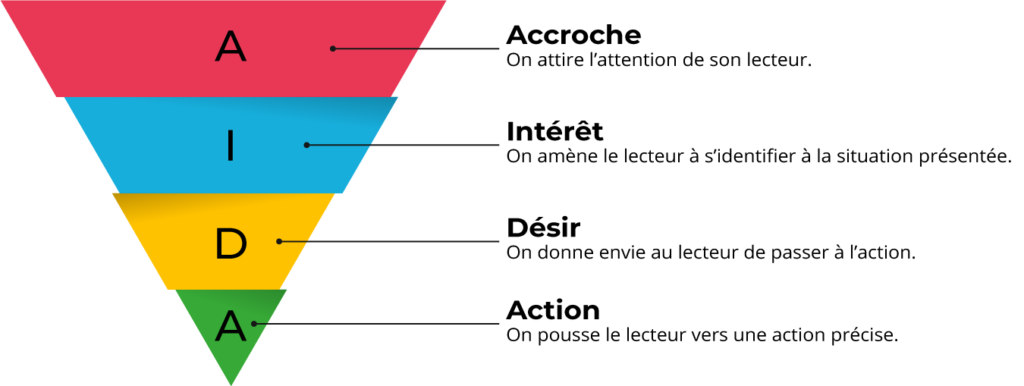
Source: https://www.joptimisemonsite.fr/modele-aida-tunnel-conversion/
Think of the AIDA model like a recipe: each ingredient has its role, and if one is missing, the dish falls flat. To convince a prospect, you need to follow these four essential steps.
The first step is cutting through the ambient noise. Every day, we're bombarded by ads, emails, notifications... If your content doesn't make an immediate impact, it's already forgotten.
A great example: the most-watched entertainment YouTubers. Whether you watch them or not, these are creators who routinely rack up millions of views per video. They know how to stand out — and they keep doing it.
You've caught the eye. But without an engaging hook, your potential client risks switching off. The objective here is to nurture their curiosity by proving that your content speaks directly to them. This is where the AIDA model comes into its own: capture, engage, and convince.
At this stage, your prospect is hooked. But engagement alone isn't enough: you need to trigger a genuine motivation to act. The idea is to make your offer attractive by connecting it to your audience's emotions and deep needs.
Trustpilot Reviews — Discover the power of customer testimonials
This is the key moment: without this step, all the preceding work counts for nothing. You need to prompt the prospect to respond, in the simplest and most obvious way possible.
By applying these four stages, you build a fluid, effective strategy that naturally guides your prospect toward a final decision. Simple, right?
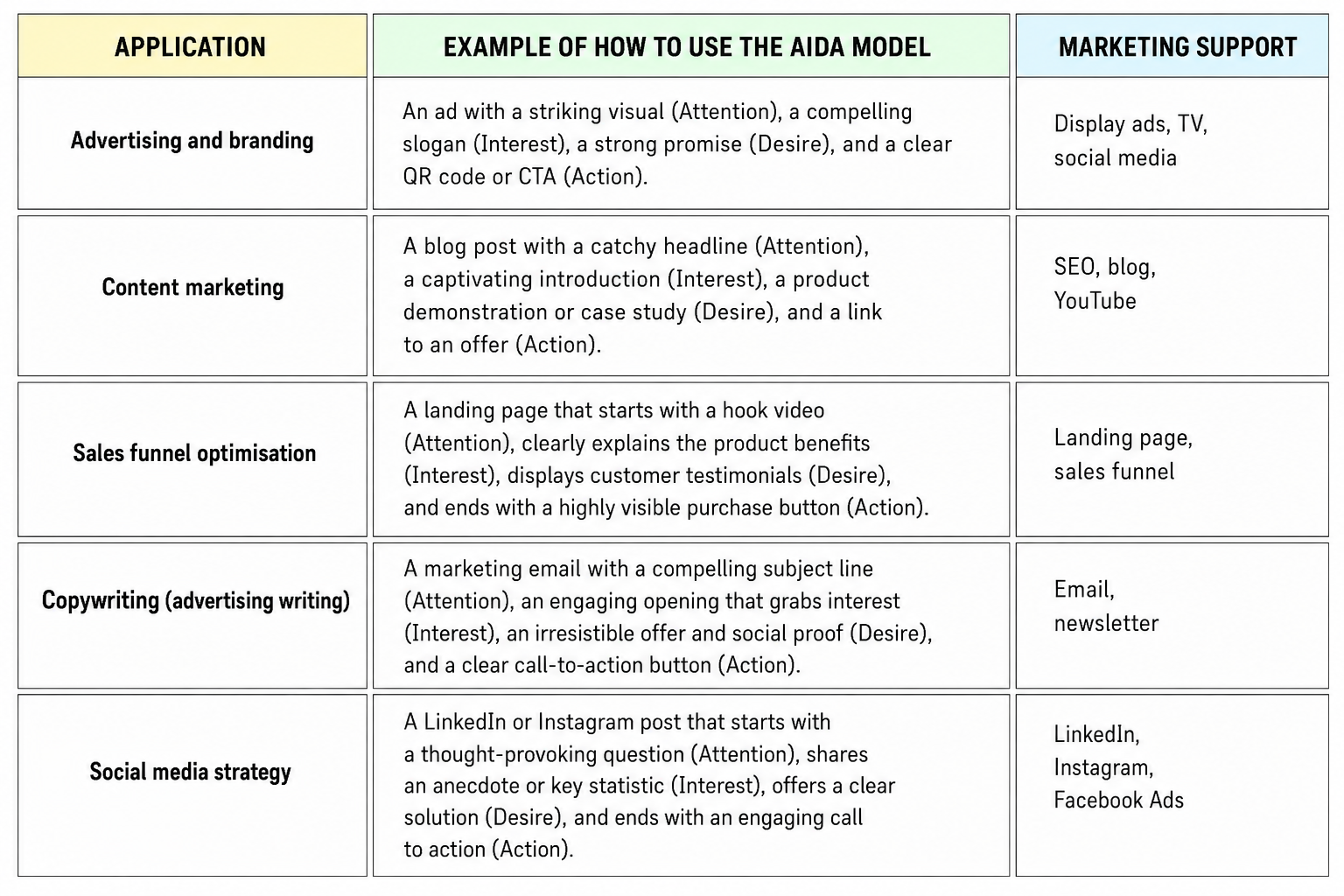
The AIDA model is everywhere in content strategies — and once you spot it, you can't unsee it! Whether in an ad, a social media post, or a sales email, it structures content to maximize impact. Here are 5 concrete ways to use it.
[rta-block=folder-cta][rta-title=h3]Want to sharpen your copywriting and conversion strategy?[rta-title=h3][rta-btn=regular]Get a Free Audit[rta-btn=regular][rta-block=folder-cta]
Applying the AIDA model is good. Knowing whether it's working is even better. Fortunately, several indicators let you verify whether your content is creating genuine attention, stimulating engagement, sparking real desire, and provoking a response.
If your audience doesn't even notice your content, everything else falls apart. To measure this first phase of the AIDA framework, track these indicators:
Once you've caught the eye, you need to maintain engagement and trigger a genuine motivation to act. For this, monitor:
This is the ultimate stage of the AIDA model, where the prospect becomes a client or qualified lead. Key KPIs here are:
To analyze campaign performance and optimize your AIDA method-based strategy, here are some essential tools:
Good copywriting isn't just judged by its style — it's measured. If your numbers aren't where you want them, test different approaches: change your hook, optimize your message, reposition your CTA… Sometimes a simple tweak can boost conversions.
The AIDA model is a cornerstone of marketing and copywriting. It structures a message to capture attention, hold interest, spark genuine desire, and drive action. Applied well, it transforms a simple prospect into a convinced client.
The AIDA model is far more than a theoretical method: it's a powerful lever for boosting the impact of your messages and turning your prospects into clients. Already using it? Looking to adapt it to your strategies? Whether for punchy advertising, effective copywriting, or conversion funnel optimization, the AIDA framework is your best ally.
.jpeg)
Lorem
Can't find what you're looking for ? Contact us here
jordan@bulldozer-collective.comGet access to playbooks and feedback from those who are shaping the next wave of marketing and AI.


Lorem ipsum dolor sit amet, consectetur adipiscing elit. Suspendisse varius enim in eros elementum tristique. Duis cursus, mi quis viverra ornare, eros dolor interdum nulla, ut commodo diam libero vitae erat. Aenean faucibus nibh et justo cursus id rutrum lorem imperdiet. Nunc ut sem vitae risus tristique posuere.


 ChatGPT
 Perplexity
 Claude