
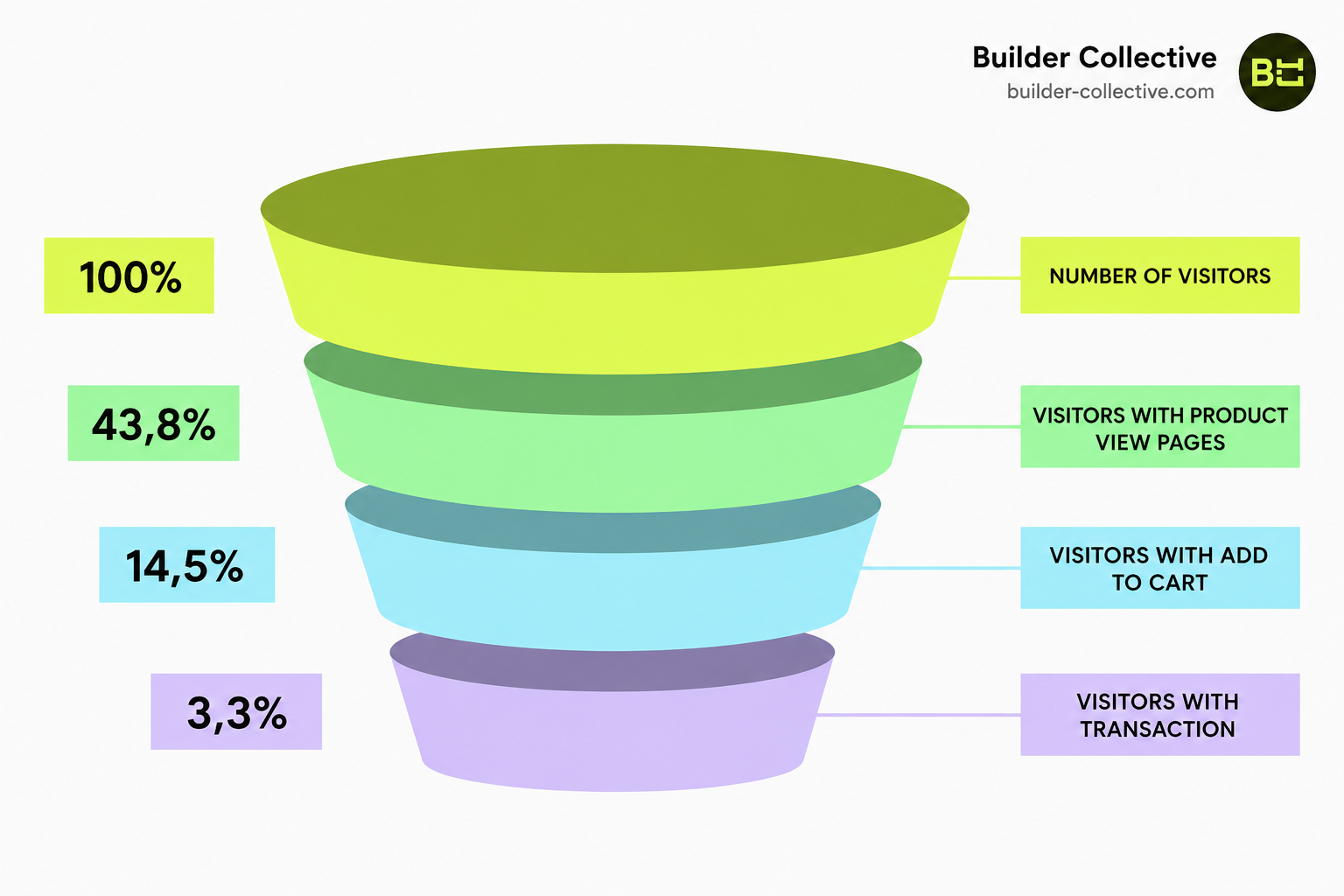
Wondering how to turn your visitors into loyal customers? In an increasingly competitive digital landscape, conversion rate optimization has become a critical challenge for any business looking to grow sustainably.
Improving your conversion rate can not only increase your sales, but also maximize the return on investment of your web traffic. Discover the most effective strategies to grow your sales and build customer loyalty.
The conversion rate is far more than a simple number: it is the barometer of your website's effectiveness.
According to HubSpot, this key metric measures the percentage of visitors who complete a desired action, whether that's a purchase, a newsletter sign-up, or downloading a white paper. A high conversion rate means your site excels at transforming casual visitors into valuable customers or leads.
The conversion rate calculation is straightforward: divide the number of conversions by the total number of visitors, then multiply by 100.
In other words, the formula is:
Conversion Rate = (number of conversions / number of visitors) x 100
For example, if your e-commerce site receives 10,000 visitors per month and generates 300 sales, your conversion rate is 3%.
SLN Web notes that in B2B, a rate of 1% is considered good, while in B2C, targeting 2% to 3% is a solid objective. For landing pages in B2B, a rate of 10% to 15% is often the goal.
However, it is important to compare against your own past performance and seek continuous improvement rather than focusing solely on industry averages.
To optimize your conversion rate, start with a thorough analysis of your current performance. Google Analytics remains the go-to tool, but other solutions like Hotjar, Mixpanel, or Kissmetrics offer valuable complementary features.
We strongly recommend using heat maps to visualize the most engaging areas and identify where your visitors interact most with your website.
Analyzing your data will reveal the obstacles limiting your conversions. These friction points take many forms: overly complex forms, slow-loading pages, or a lack of critical information.
Stripe highlights that the checkout process is often the Achilles' heel of e-commerce sites, where many potential customers abandon their cart. Identify these bottlenecks and make them your optimization priority.
[rta-block=folder-cta][rta-title=h3]Want to learn more about your growth potential?[rta-title=h3][rta-btn=regular href="/prendre-rendez-vous-typeform" target=_blank]Get a free audit[rta-btn=regular][rta-block=folder-cta]
Your landing pages are the cornerstone of your conversion strategy. They must be clear, concise, and focused on a single objective (capturing attention, increasing time on site, highlighting your competitive advantage…). Here are some best practices:
Call-to-Action (CTA) elements are the conversion triggers on your site. To make them irresistible:
An intuitive user journey is essential for maintaining visitor engagement through to conversion. Don't hesitate to simplify the checkout process by reducing the number of steps and offering options like guest checkout.
Every additional click is an opportunity for the visitor to disengage, so aim for simplicity and efficiency at every step.
With the constant rise in smartphone traffic, mobile optimization has become essential. To maintain a strong conversion rate across all devices, it's best to offer:
Neglecting the mobile experience can significantly impact your overall conversion rate.
A/B testing is your ally for continuous conversion rate optimization. This technique involves comparing two versions of a page or element to determine which performs better. For example, you might test two versions of a headline on your homepage:
By measuring the conversion rate of each version, you can identify which resonates best with your audience.
Rigorous analysis of your test results is crucial. Freshworks recommends going beyond raw numbers and trying to understand the "why" behind each result.
Use these insights to refine your strategy, then launch new tests. Conversion rate optimization is a continuous improvement process.
Personalizing the user experience (UX) can significantly improve your conversion rate. Here are some advanced techniques:
Marketing automation can radically transform your conversion strategy. Here's how to use it effectively:
Conversion rate optimization is essential for achieving your growth objectives. Analysis, personalization, and continuous improvement techniques allow you to significantly enhance your website's performance and maximize return on investment.
Remember that every site is unique. What works for one may not work for another. The key to success lies in constant testing, rigorous analysis, and agile adaptation of your strategies.
Ready to transform your site into a true conversion machine? Start today by applying these proven techniques. And remember, the Bulldozer Collective team is here to support you at every step of your optimization journey. Together, let's propel your online presence to new heights!
Book a free consultation to discover our solutions.
Lorem ipsum

Content Marketing Manager at Bulldozer, she writes about content strategy, editorial systems and distribution.
Can't find what you're looking for ? Contact us here
jordan@bulldozer-collective.comGet access to playbooks and feedback from those who are shaping the next wave of marketing and AI.