Publié par
curve whitecurve white
Killian Drecq
Rédacteur
Blog
/
Paid
/
Google Ads: How to Make It an Essential Lever for Your Visibility

Google Ads: How to Make It an Essential Lever for Your Visibility

Google Ads, formerly Google AdWords, is one of the most powerful levers for quickly generating qualified traffic, leads, and sales. But you need to understand how it works: bidding, cost per click, campaign types, quality score…

In this guide, we cut to the chase: how Google Ads works, how to create a high-performing campaign, and above all, how to optimize your results. Whether you're a B2B CMO or a marketer looking for efficiency, you'll find the keys here to get the most from Google advertising.

Dernière mise à jour :
05
/
06
/
2026

What Are the Basics and How Does Google Ads Work?

What Is Google Ads?

Launched as Google AdWords in 2000, Google Ads is today the go-to advertising platform for reaching users in the middle of a purchase intent or active search. The principle is simple: you run ads on Google (and its partners) targeting specific keywords or audiences, and you only pay when a user clicks on your ad (the CPC, or cost-per-click, model).

The goal? Quickly gain visibility, generate qualified leads, and boost sales. It's a remarkably effective tool when properly configured, especially in B2B strategies where targeting precision and return on investment are essential.

How Does Google Ads Work?

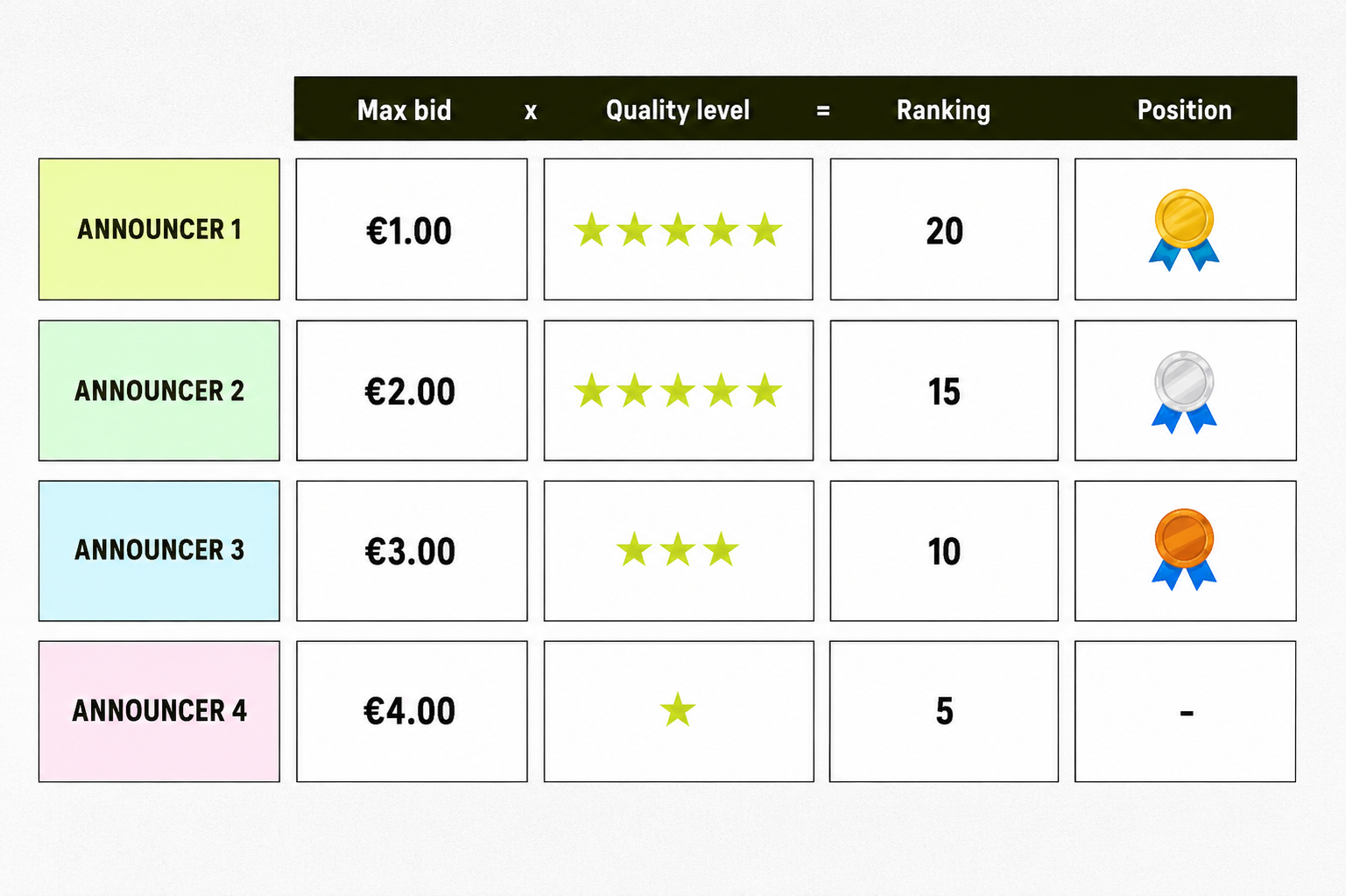
The heart of the system is an auction model. When a user performs a search, Google triggers a competition between advertisers who want to appear on the corresponding keywords. Each ad is assigned an Ad Rank, a score that determines its position in the sponsored results.

This ranking doesn't depend solely on your maximum bid — it also depends on your Quality Score. This quality score is calculated from several criteria:

  • Expected click-through rate (CTR)
  • Ad relevance to the search query
  • Landing page quality

The result: a well-crafted, relevant ad linked to an effective page can outrank a competitor's ad, even with a lower bid. That's the whole point of a well-optimized Google Ads campaign.

Available Campaign Types

Google Ads offers several campaign formats, each suited to a specific goal:
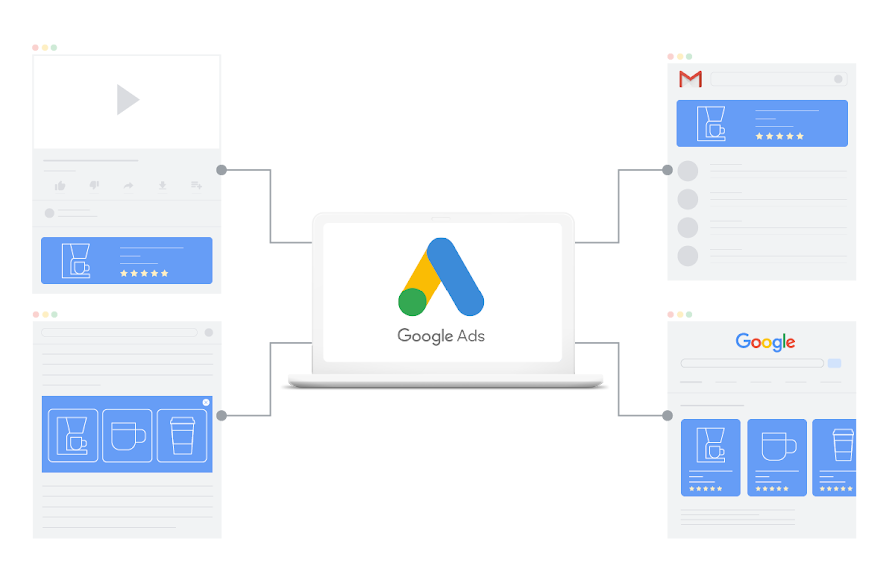
  • Search Network: your text ads appear directly in Google search results. Ideal for capturing strong intent and generating conversions.
  • Display Network: your visual banners are shown on Google partner sites. Perfect for building brand awareness or running remarketing campaigns.
  • Google Shopping Campaigns: designed for e-commerce, they showcase your products with image, price, and seller name directly in Google results.
  • Video Campaigns (YouTube): reach your audiences through sponsored videos shown before or during other YouTube videos. Highly useful for strengthening your branding or driving traffic.
  • Performance Max Campaigns: an automated format distributed across all Google channels (Search, Display, YouTube, Shopping, Discover...). You set your goals, and Google handles the rest through machine learning.
__wf_reserved_inherit

Designing and Structuring an Effective Campaign

Creating a high-performing Google Ads campaign doesn't happen by chance. To avoid burning budget unnecessarily, you need solid foundations: clear objectives, a strong structure, ads that speak to the right people, and landing pages that convert. Here are the key steps.

Defining the Right Marketing Objectives

Before launching anything, ask yourself: what is the purpose of this campaign?

Google Ads can serve several types of objectives:

  • Driving qualified traffic to a website or landing page
  • Generating leads through a form or phone call
  • Increasing sales on an e-commerce site
  • Growing awareness for a brand, product, or event

A good objective is measurable, tied to a concrete action, and aligned with your sales cycle. It's what will guide your keyword choices, ad copy, and campaign types.

Technical Campaign Structure

Google Ads is built on a hierarchical structure:

  • A campaign contains one or more ad groups
  • Each ad group contains one or more ads targeting a specific list of keywords

The classic mistake is mixing everything together. Better to segment: one ad group = one specific theme = consistent keywords. This lets you write tailored ads and increase your Quality Score.

Also consider match types:

  • Broad: wide visibility, but less targeted
  • Phrase: keyword within an exact phrase
  • Exact: very precise query
  • And above all, add negative keywords to avoid paying for unqualified clicks.

Creating Relevant Ads

Your ads must capture attention, reassure, and make people want to click. Concretely:

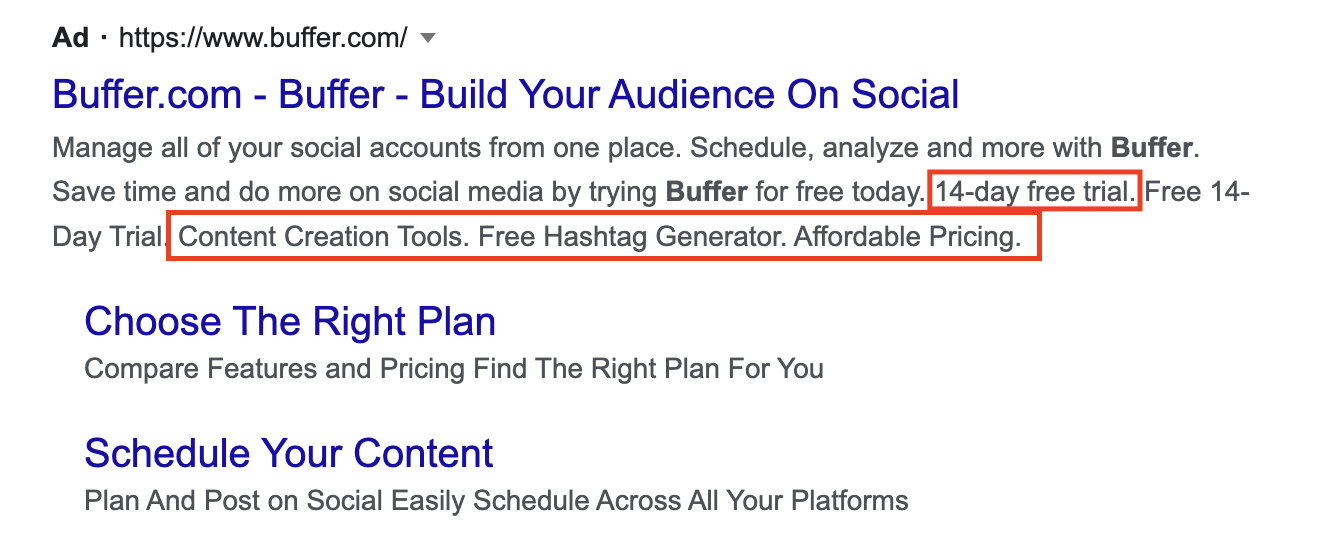
  • A clear, compelling headline that includes the targeted keyword
  • A concise description with your key arguments (price, timeframe, special offer…)
  • A well-constructed display URL, even if it's just for display purposes

Also think about ad extensions, which are often overlooked:
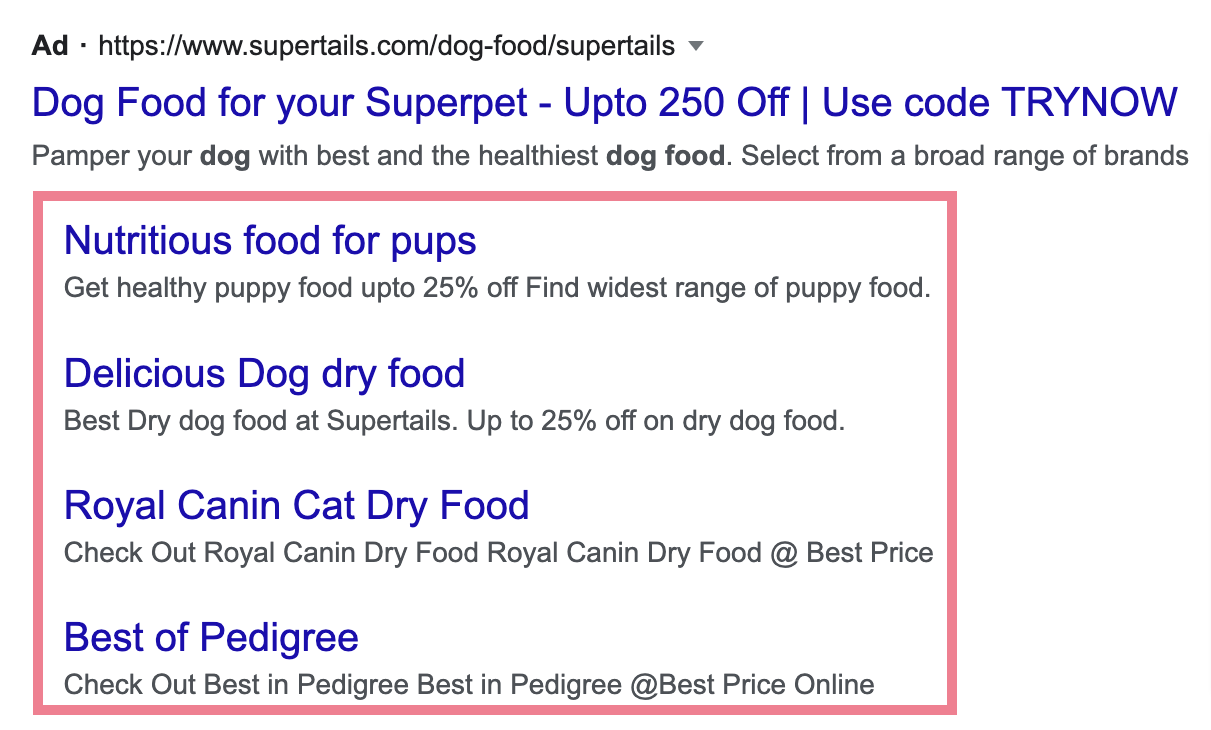
  • Sitelinks: additional links to other pages on your site
__wf_reserved_inherit
  • Callouts: complementary taglines (free delivery, 24/7 support…)
__wf_reserved_inherit

They visually enrich your ads and improve performance.

Optimizing Landing Pages

The best ad in the world is useless if the landing page doesn't deliver. Here's what it must ensure:

  • Total consistency with the ad (same promise, same keyword)
  • Smooth and fast navigation (load time, mobile-responsive)
  • A clear, visible call to action: form, purchase, quote request
  • A clean, conversion-focused design with no unnecessary distractions

Working on your conversion rates is just as important as lowering your CPCs. That's often where the real ROI is made.

Want to learn more about your paid advertising potential? 

Demander un audit gratuit
Carte ou profil utilisateur central mis en évidence, entouré d’autres profils en arrière-plan, suggérant une sélection ou une mise en avant d’un utilisateur.
bulldozer

How to Effectively Manage Your Budget While Optimizing Performance?

One of Google Ads' greatest strengths is the ability to precisely control what you spend — as long as you know what you're doing. Whether you have €500 or €50,000, the key is to manage your budget intelligently to maximize your return on investment (ROI).

Defining and Allocating Your Advertising Budget

On Google Ads, you set a daily budget for each campaign. Google guarantees you'll never exceed your monthly cap (approximately 30.4 times the daily budget). You can also work with a fixed monthly budget, but daily budgets remain more flexible for testing and adjusting.

It's essential to adapt your budget to performance:

  • Cut or reduce underperforming campaigns
  • Scale up those that convert well
  • Prepare adjustments for key periods: launches, seasonality, major commercial events

Your budget should never be set in stone: it lives at the pace of your goals and results.

Conversion Tracking and Key KPIs

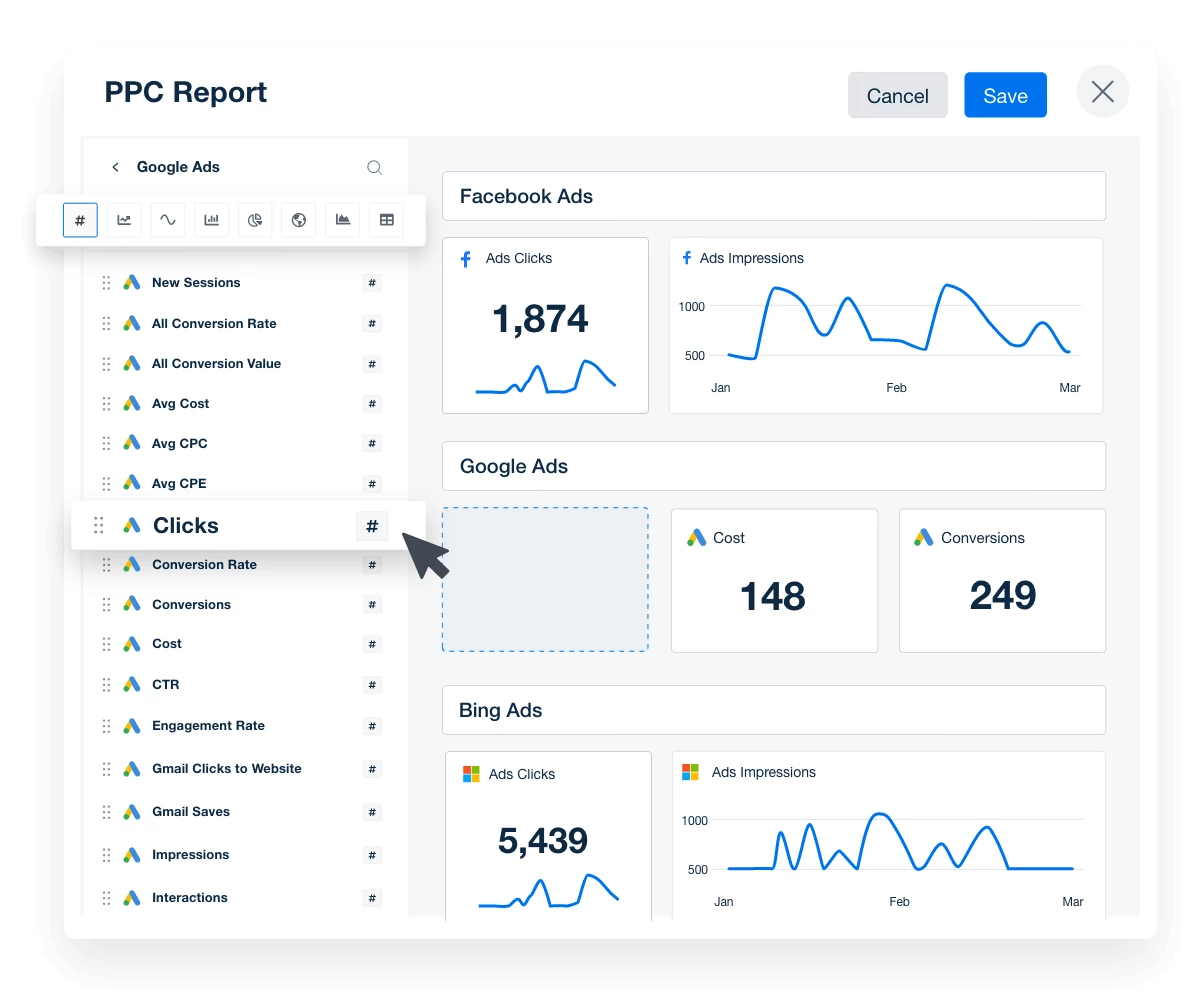
You can't optimize what you don't measure. To track your campaign effectiveness, install reliable conversion tracking:

Here are the key performance indicators (KPIs) to monitor:

  • CPC (cost per click): how much does a click cost you?
  • CPA (cost per acquisition): how much does a real conversion cost you?
  • CTR (click-through rate): does your ad make people want to click?
  • ROAS (return on ad spend): how much does each euro invested return?
  • Quality Score: overall indicator of your campaign quality

This data lets you manage your campaigns methodically, not blindly.
__wf_reserved_inherit

Adjustments and Optimizations

Google Ads isn't a plug-and-play tool. To perform, you need to test, compare, and adjust.

Three levers are at your disposal:

  • A/B testing: compare two versions of ads (or two pages) to identify what works best.
  • Advanced targeting: adjust delivery based on location, time, device, or demographics. You reach the right people at the right time.
  • Bidding strategies: test smart automation (bids maximizing conversions or ROAS) if you have enough data, or keep manual control for more precise campaigns.

Optimization is continuous work. But it's also where the real profitability of a Google Ads campaign is made.

Google Ads and SEO: Rivals or Complements?

SEO (organic search) and SEA (paid search) are often pitted against each other, as if you had to choose one or the other. In reality, they are perfectly complementary — especially in B2B, where acquisition relies as much on precision as on durability.

SEA: Immediate Visibility, Precise Control

With Google Ads, you can be visible at the top of search results as early as tomorrow, even on highly competitive keywords. You choose your keywords, control your budget, test your messaging — all with real-time data.

It's a fast, highly controllable lever, and formidable for capturing leads or launching an offer. For a product launch, event campaign, or urgent visibility need, SEA is unbeatable.

SEO: Long-Term Strategy and Organic Acquisition

SEO is the opposite of SEA in the short term: slow to implement, but extremely profitable over time. By working on your content, backlinks, and technical site optimization, you build qualified, free, and sustainable traffic.

It's a strategic lever for:

  • Reducing acquisition costs
  • Establishing your authority in a market
  • Positioning yourself on informational or low-commercial-intent queries

In short, SEO requires time and consistency, but it's a solid foundation for any digital strategy.

Why Combine SEO + SEA in B2B?

In B2B, combining both approaches is often the best option. Here's why:

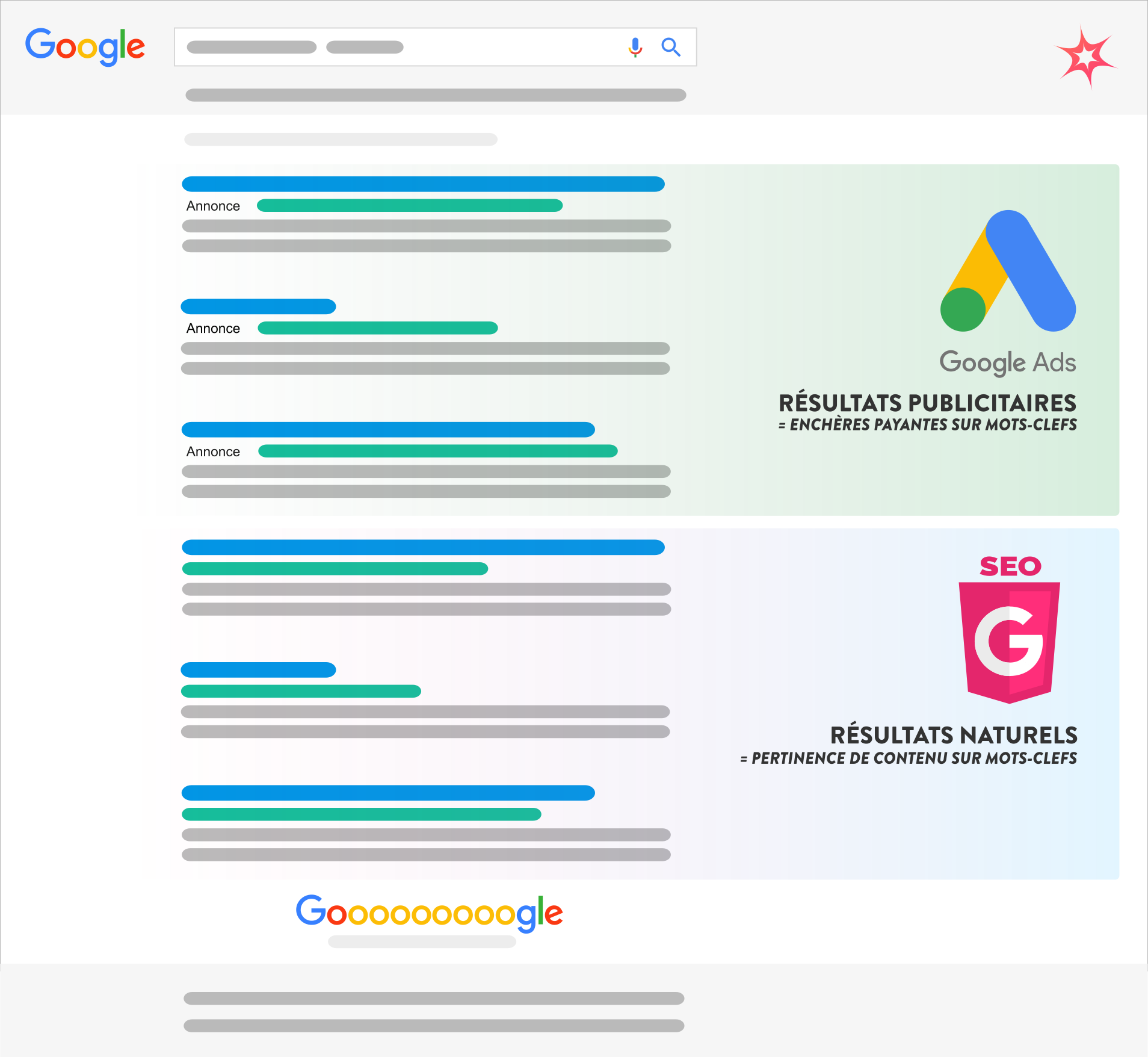
  • Maximize your presence on search results pages (SERP): by being visible in both sponsored and organic results, you increase your credibility and click-through rate.
  • Combine speed and durability: SEA brings leads quickly, while SEO lets you stabilize acquisition over the long term.
  • Exploit synergies: keywords that perform in SEA can feed your SEO strategy (and vice versa). Pages that convert well can be strengthened on both channels.

In summary: SEA and SEO are not rivals — they are two sides of an intelligent acquisition strategy.
__wf_reserved_inherit

Common Mistakes to Avoid on Google Ads

Here are the most common pitfalls that undermine Google Ads campaign performance, and how to avoid them:

  • Targeting keywords that are too broad or poorly qualified
  • → Attracts irrelevant clicks, increases costs with no return.
  • Start with precise match types, add negative keywords, then expand based on performance.
  • Forgetting negative keywords
  • → Your ad appears on irrelevant search queries.
  • Regularly clean your search term reports to exclude non-qualified terms.
  • Writing overly generic ads
  • → Low click-through rate, low relevance, declining Quality Score.
  • Include the main keyword in the headline, a clear promise, a strong benefit, and test multiple variants.
  • Neglecting ad extensions
  • → Ads that are less visible and less complete.
  • Systematically add sitelinks, callouts, call, or location extensions.
  • Directing to poorly optimized landing pages
  • → High bounce rate, few or no conversions.
  • Ensure consistency between the ad and the page, with a clear value proposition, good load time, and a visible CTA.
  • Not tracking conversions
  • → No way of knowing what works.
  • Install Google Analytics, Tag Manager, and Google Ads conversion tags from the start.
  • Ignoring essential KPIs
  • → You're flying blind.
  • Monitor CPC, CPA, CTR, ROAS, and Quality Score to continuously adjust your campaigns.
  • Failing to test and optimize regularly
  • → Performance degrades without you noticing.
  • Set up A/B tests on your ads, adjust your bids, geographic targeting, time scheduling, and device targeting.

Google Ads is a powerful tool, but not a magic one. To get a real return on investment, you need to understand its mechanics, structure campaigns intelligently, and adjust continuously. Mastered well, it becomes an ultra-profitable acquisition lever, particularly in B2B, where each click can represent a real business opportunity.

Want to go further?

👉 Get your Google Ads account audited.

👉 Test a well-structured first campaign.

👉 Or entrust us with optimizing your performance.

Every euro counts. Make sure it works for you.

FAQ

Oui. Que vous soyez une TPE, une entreprise e-commerce, un cabinet de conseil B2B ou une structure locale, Google Ads permet de promouvoir votre activité en ligne. La publicité de Google s’adapte à tous les budgets et à tous les objectifs : visibilité, trafic sur un site web, génération de leads ou ventes directes.

Google Ads relève du search engine advertising (SEA), donc de la publicité en ligne payante, tandis que le SEO est gratuit mais long à mettre en place. Le SEA vous donne une visibilité immédiate en haut des résultats. C’est idéal pour lancer une campagne publicitaire ciblée, notamment quand vous débutez ou que vous voulez tester un service ou un produit.

La plateforme publicitaire de Google utilise un système d’enchères, mais pas seulement. Elle prend en compte votre niveau de qualité (ou Quality Score) qui dépend de plusieurs critères : pertinence de l’annonce, mot clé, page de destination et taux de clics estimé. Plus votre campagne est bien construite, moins vous paierez pour apparaître.

Oui. Google Ads permet aussi d’afficher vos annonces sur le réseau Display, sur YouTube, dans Gmail, dans les applications mobiles, et même sur Google Maps si vous avez un commerce physique. C’est une vraie opportunité pour améliorer votre présence en ligne sur plusieurs canaux à la fois.

Absolument. Si vous gérez un service local (coiffeur, avocat, artisan…), vous pouvez créer une campagne publicitaire géolocalisée. Grâce à Google Maps, aux extensions d’adresse, et au ciblage par zone, vos prospects vous trouvent exactement au bon endroit et au bon moment.

La plateforme vous fournit des insights détaillés : nombre de clics, conversions, coût par acquisition, taux d’impression, etc. En connectant votre compte à Google Analytics, vous pouvez aussi suivre le comportement des visiteurs sur votre site web, comparer les pages de destination, et analyser les performances de manière fine.

Oui, et c’est même un levier essentiel pour l’e-commerce. Les campagnes Shopping, les campagnes Performance Max et le remarketing permettent de cibler les visiteurs ayant déjà montré un intérêt pour vos produits, ou de pousser automatiquement votre catalogue vers les internautes en phase d’achat.

Pour aller plus loin

Which Google Ads Agency in Toulouse for Your B2B Growth?

Paid
Charlotte Nowak
agence Google Ads Paris

Top Google Ads Agency in Paris: Who to Choose to Maximise Your ROI?

Paid
SEA
Charlotte Nowak

Effective Strategies to Improve Your Facebook Ads Conversion Rate

Brand Strategy
Growth
Paid
Killian Drecq

Let's talk.

Full-funnel
500+ clients
300+ membres
Prendre un rdv stratégique