
A buyer persona is a detailed ideal customer profile that describes your typical buyer — their role, goals, frustrations, purchasing behaviors, acquisition channels, and decision criteria — in order to guide your digital marketing (SEO, acquisition) and sales efforts. When built properly, your messages, content, and campaigns become more targeted and effective, with a direct impact on traffic and lead generation (website, email, social media).
If you're searching "buyer persona example," you're not looking for theory — you want a clear, reusable model, maybe a buyer persona template, to structure your profile without spending weeks on it.
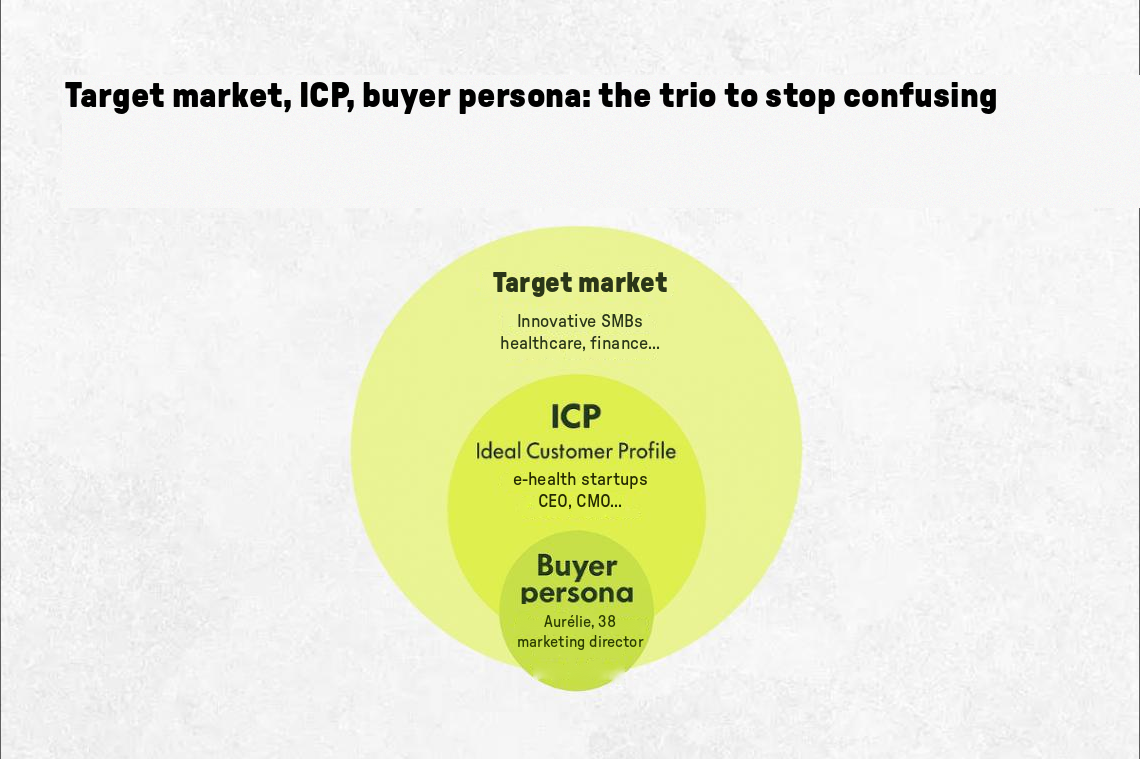
In this article, we'll do exactly that: clarify the difference between target market, ICP, and marketing persona; break down the anatomy of a high-performing buyer persona; walk you through a concrete example — and then give you a simple method for building an actionable buyer persona you can put to work in your next content campaign.
Many teams think they "know their customer" — when all they really know is their market segment.
Target market, ICP, user persona, buyer profile — the terms get blurred, and the message gets diluted.
Let's clear it up:
In other words:
When you describe "the mid-market industrial segment," you're still at the market level.
When you describe "Julien, an operations director who needs to digitize his processes without disrupting production," you're starting to build a real customer avatar.
A well-built buyer persona isn't just another deliverable — it's a filter for every decision you make across digital marketing, prospecting, and content.
If your buyer persona doesn't change how you write an email, a landing page, a LinkedIn post, or a sales pitch — it's not a persona. It's a decorative document.
There are three key moments when working on buyer personas isn't optional.
Good instinct: whenever your content underperforms, your campaigns stall, or your leads no longer look like your ideal customer — start by revisiting your buyer personas before changing your tools or channels.
A useful buyer persona is not "Male, 35–45, high earner, likes innovation."
It's a precise buyer persona sheet that the whole team can use day-to-day.
To build a solid marketing persona, start with a structure that's simple but complete:
Add one often-overlooked element: 1–3 verbatim quotes from customer interviews or discovery calls. They give texture and authenticity to your persona model and help teams speak the actual language of your target customer.
Time for the real thing. Here's a B2B marketing buyer persona example you can use as a starting point.
Claire is 36. She's CMO at a B2B SaaS scale-up doing around $8M ARR.
She runs a small marketing team (3 people) and works closely with the Head of Sales.
Context:
Claire is the primary marketing decision-maker: she chooses tools, agencies, and budgets — but gets sign-off from the CEO and CFO on major projects.
Primary goals:
Her frustrations:
What Claire searches for: "B2B buyer persona example," "SaaS persona template," "CMO marketing persona example" — but also "SaaS lead gen strategy" or "structure B2B conversion funnel." She follows a few CMOs on LinkedIn, some growth agencies, B2B newsletters, and tool benchmarks — though she rarely has time to read everything.
When Claire evaluates a vendor or methodology:
Too much buzzword-speak drives her away; a clear, structured approach — "we start from your buyer personas, rebuild your messaging, then connect it to your conversion funnel" — builds confidence.
This buyer persona example shows what a usable buyer profile looks like: grounded, situated in a real company, with a clear purchase journey. It's not an abstract psychological portrait — it's a tool for writing better messages and prioritizing your actions.
[rta-block=folder-cta][rta-title=h3]Want to know more about your growth potential?[rta-title=h3][rta-btn=regular]Get a Free Audit[rta-btn=regular][rta-block=folder-cta]
Let's get practical: how to build a marketing persona that actually holds up — without getting lost in a never-ending branding exercise.
Before inventing anything, dig into what you already have: CRM (won accounts, size, sector, roles involved), analytics (page views, content that converts, funnel drop-off points), forms (filled fields, open-text responses), support/CS (recurring questions, irritants, friction moments).
Goal: identify patterns in company types, roles, challenges, and recurring objections — not write the perfect profile yet.
No persona model holds up without real conversations. Run 5 to 10 interviews with satisfied customers, average-fit customers, and lost deals — using simple questions:
These interviews surface the actual words your target customers use, the triggers in their purchase journey, and the blockers that kill deals. A persona built without interviews is just internal projection.
Once the data is gathered, group the common threads.
Goal:
For each persona, describe the company context, their role in the buying decision, 3 major goals, 3 core frustrations, 3 project triggers. One crystal-clear persona model beats a collection of fuzzy profiles every time.
Final step: make your buyer personas visible and actionable.
Build a simple profile in Notion, Google Docs, or your CRM — using the same structure for all (identity, goals, frustrations, journey, objections, verbatims) — and share it with marketing, sales, CS, and product.
You can embed a summary in your sales playbooks, create an empathy map per persona for workshops, and link each persona to their key content in your editorial calendar. From that point on, your buyer personas become the reference point for every email, every landing page, every campaign, and every pitch.
A buyer persona only has value if it shapes your daily actions. Here's how to plug it into your marketing and sales.
For each target profile, ask yourself:
Map your existing content onto these customer journey stages, spot the gaps by persona, then adjust your offers and messages by channel (SEO, LinkedIn, email, nurturing). You're building an editorial funnel for each priority customer avatar.
A clear marketing persona directly influences your audiences (LinkedIn Ads targeting, CRM segments), your hooks and CTAs, and your offers (audit, template, diagnostic, training, guided demo). The goal: make your persona think "this is literally made for me."
Share your buyer persona profiles in campaign kickoffs, new sales hire onboarding, and regular alignment sessions between marketing, sales, and customer success.
In practice, you can:
This is how you shift from a product-centric company to a customer-centric one — and the impact shows up in your conversion rates.
"SMB owner, 30–60, likes innovation" is not a buyer persona — it's a blurry sketch.
A strong buyer profile:
If a sales rep reads it and asks "OK, but what do I actually say to them?" — your persona needs work.
Building 7 or 8 profiles for one marketer to manage guarantees you'll target no one.
Instead, aim for:
Focus does more for your pipeline than collecting profiles.
A persona invented in a meeting room — without customers or sales input — is almost always biased.
Avoid:
Do instead:
A persona that goes untouched for 3 years becomes fiction.
From the start, set:
Your simple action plan from here:
Only then should you start building out additional personas — but on solid foundations.

Lorem ipsum dolor sit amet, consectetur adipiscing elit. Duis quis iaculis est. Nulla ac ligula feugiat, cursus turpis volutpat, ultricies eros.
Can't find what you're looking for ? Contact us here
jordan@bulldozer-collective.comGet access to playbooks and feedback from those who are shaping the next wave of marketing and AI.


Lorem ipsum dolor sit amet, consectetur adipiscing elit. Suspendisse varius enim in eros elementum tristique. Duis cursus, mi quis viverra ornare, eros dolor interdum nulla, ut commodo diam libero vitae erat. Aenean faucibus nibh et justo cursus id rutrum lorem imperdiet. Nunc ut sem vitae risus tristique posuere.