
Defining Your ICP When You Don't Know Where to Start: The Bulldozer GTM Framework
Defining your B2B ICP without data? The Bulldozer GTM Framework: TAM/SAM/SOM, personas, decision-maker mapping. A 2500-word guide for CMOs and Growth leads.
Defining your B2B ICP without data? The Bulldozer GTM Framework: TAM/SAM/SOM, personas, decision-maker mapping. A 2500-word guide for CMOs and Growth leads.
Of the 50 GTM engagements Bulldozer ran in 2024, more than 60% started with the same sentence: "Our target is B2B SMBs." Eleven words. Zero actionable criteria.
The problem isn't ambition. It's that without a precise ICP, every marketing decision becomes a guess. Content doesn't resonate. Outbound campaigns fire into the void. And sales reps qualify — or disqualify — using different criteria week to week.
In 2025, Gartner documented that in high-growth companies, the ICP is not a marketing document: it's the central tool that aligns marketing, sales, and product on the same priority accounts. Everywhere else, it collects dust in an onboarding deck.
In this article, we break down the Bulldozer GTM framework into 5 steps to build an operational B2B ICP — even when you're starting without a solid customer base.
"Tech SMB in growth mode, 20–200 employees, B2B." That's the kind of ICP you'll find in 80% of pitch decks. Technically accurate. Operationally useless.
A 22-person seed-stage company and a 180-person Series B startup don't share the same budget, the same decision-making process, or the same pain points. Targeting both with the same message guarantees the message speaks to no one.
Cognism documented this with their own data: sales teams working with a precise ICP see 36% higher retention and 38% better closing rates — compared to teams working from a broad definition.
Another common mistake: conflating the ICP with a persona. The ICP describes the target company (industry, size, maturity, stack, budget, buying cycle). The persona describes the individual within that company (role, pain points, goals, communication channels).
Both are necessary. But building them in the right order changes everything. ICP first — to identify the accounts. Personas second — to know how to reach them and who to target in the org chart.
Without a defined ICP, your marketing and sales teams operate in spray-and-pray mode. They try to force product-market fit everywhere, instead of finding it where it already exists. This is especially costly in the early stages: every mis-targeted account means 3–6 weeks of wasted sales cycle.
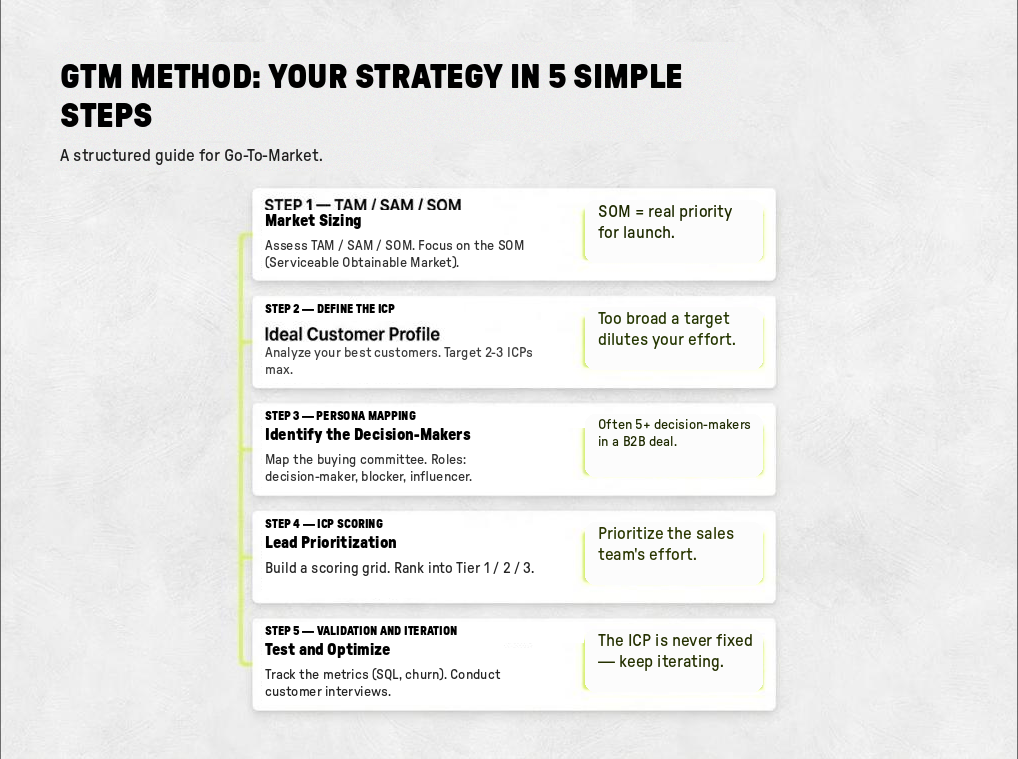
Before defining your ideal customer, you need to size the space you operate in. Many companies skip this step and build an ICP that's disconnected from the reality of their addressable market.
TAM (Total Addressable Market) represents the maximum revenue you could generate if you captured 100% of the market with no constraints. It's a useful number for investors and strategic trade-offs — not a number to drive your day-to-day sales activity.
Two methods to calculate it:
SAM (Serviceable Addressable Market) is the portion of TAM accessible with your current offer, distribution channels, and geographic or regulatory constraints. This is the number that should drive your GTM planning.
To calculate it: take your TAM, then narrow by your real criteria — language, geography, average contract value, target company size, sectors where your solution is relevant.
SOM (Serviceable Obtainable Market) is the realistic share of the SAM you can capture within 12–18 months, given your resources, brand awareness, and competitive position. This is the only number that should drive your budget allocation and pipeline targets.
Rule of thumb: If your SOM is under 500 qualified accounts, your ICP is probably too narrow. Over 5,000 accounts for a 2-rep sales team, it's probably too broad.
→ Want to frame your addressable market and ICP with a GTM expert? Book a free diagnostic with Bulldozer.
The ICP is built on 4 axes of criteria, from most objective to most qualitative.
These are the structural data points of the target company:
What does their current stack look like? What tools are they using — CRM, marketing automation, prospecting tools? Tools like Clearbit, Clay, or Pharow can enrich your databases with this information.
These are the signals that indicate a company is in a buying or transformation phase:
Analyze your 5–10 best current customers — the most profitable, the most loyal, those with the best NPS. Identify the commonalities that don't appear in any database: company culture, data maturity, appetite for experimentation.
Key takeaway: An ICP that's too broad dilutes your efforts. An ICP that's too narrow limits your volume. Best practice: create 2–3 tiered ICP profiles (primary, secondary, tertiary), each with different qualification criteria.
[rta-block=folder-cta][rta-title=h3]Want to explore your ICP potential?[rta-title=h3][rta-btn=regular]Get a Free Audit[rta-btn=regular][rta-block=folder-cta]
Once the ICP is defined, you need to map the individuals involved in the buying cycle. In B2B, Gartner notes that the average software buying committee involves 5 decision-makers. That means targeting a single persona — typically the CMO or CEO — is not enough.
This is the final authority on budget and vendor selection. In B2B this may be the CMO, COO, CFO, or CEO. Their primary concern: ROI and risk.
This is the operator who will actually work with your solution — Head of Growth, Marketing Manager, RevOps. Their primary concern: ease of implementation, support quality, and proof of quick impact.
Often a cross-functional profile — CTO, technical director — who validates alignment with the rest of the stack. They can accelerate or block a decision without ever being in the primary conversation.
Every organization has structural blockers: the CFO who wants to delay, the CTO who needs to validate security, legal reviewing the terms. Identifying them early changes how you approach the sales cycle.
For each persona, build a profile card: exact title, main pain points, professional goals, common objections, preferred channels, and interest triggers.
An ICP without scoring remains theoretical. Build a model that lets your teams quickly qualify each inbound account.
Assign a score from 1 to 3 for each key ICP criterion:
| Criterion | Score 1 | Score 2 | Score 3 |
|---|---|---|---|
| Size (headcount) | Off-target | Near target | On target |
| Industry | Secondary | Priority | Exact ICP |
| Maturity stage | Too early / too late | Adjustable | Ideal |
| Situational signal | None | 1 signal | 2+ signals |
| Compatible stack | Incompatible | Neutral | Compatible |
Score 12–15: ICP account. 8–11: qualify manually. Below 8: deprioritize.
After 4–8 weeks of activation, measure: response rate by ICP segment, MQL→SQL conversion by profile, average sales cycle by ICP, churn rate by segment.
Schedule 8–10 interviews with your best current customers. Three key questions:
Revisit your ICP every 6 months, or at any major inflection point: new product, new market, fundraise, new sales hire.

Defining your ICP is not a positioning exercise. It's the operational foundation of your entire acquisition strategy: who to talk to, what to say, on which channels, and with what level of effort.
The next step: turn that ICP into an actionable account list and build the acquisition sequences to match. Our complete growth marketing guide covers exactly that.
→ Book a free GTM diagnostic with Bulldozer — 45 minutes to audit your current ICP, identify priority accounts, and structure your acquisition plan.

Lorem ipsum dolor sit amet, consectetur adipiscing elit. Duis quis iaculis est. Nulla ac ligula feugiat, cursus turpis volutpat, ultricies eros.
Can't find what you're looking for ? Contact us here
jordan@bulldozer-collective.comGet access to playbooks and feedback from those who are shaping the next wave of marketing and AI.


Lorem ipsum dolor sit amet, consectetur adipiscing elit. Suspendisse varius enim in eros elementum tristique. Duis cursus, mi quis viverra ornare, eros dolor interdum nulla, ut commodo diam libero vitae erat. Aenean faucibus nibh et justo cursus id rutrum lorem imperdiet. Nunc ut sem vitae risus tristique posuere.