Want your business to succeed, attract, and keep customers? Stay agile. That's where growth marketing becomes essential. It's not just a set of tactics — it's a real strategy for driving sustainable, measurable growth. Unlike traditional marketing, it doesn't stop at finding prospects: it works across the entire customer lifecycle through rapid testing, powerful solutions, and a well-oiled team. In this guide, we'll cover the fundamentals, tactics, and key roles for winning at growth marketing — all geared toward a strong 2026!
What Is Growth Marketing?
The growth marketing is a strategy aimed at growing a business rapidly and over the long term — and it differs sharply from traditional marketing. In growth marketing, the focus is on data, scalability, and optimizing every stage of the customer lifecycle. While traditional marketing often revolves around broad, non-iterative campaigns, growth marketing is built on an iterative, agile approach that leverages rapid testing to identify the most effective growth levers.
📝 An example of a broad, non-iterative campaign? A Coca-Cola TV campaign broadcast nationally to reinforce brand awareness. It relies on a single, universal message ("Taste the Feeling") with no ability to adapt or iterate quickly based on consumer feedback or real-time performance.
How would you adapt this campaign in a growth marketing version? For example, by launching a series of ads on YouTube, TikTok, and Instagram, with personalized messages per audience segment (young people, families, sports fans, etc.):
Each ad would be tested with different variants (visuals, slogans, short or long formats). Real-time data would identify the most engaging messages and allow quick budget reallocation to maximize impact.
In parallel, retargeting tools could be used to encourage viewers to interact further with the brand through local promotions or immersive online experiences.
A Full-Funnel Approach via the AARRR Framework
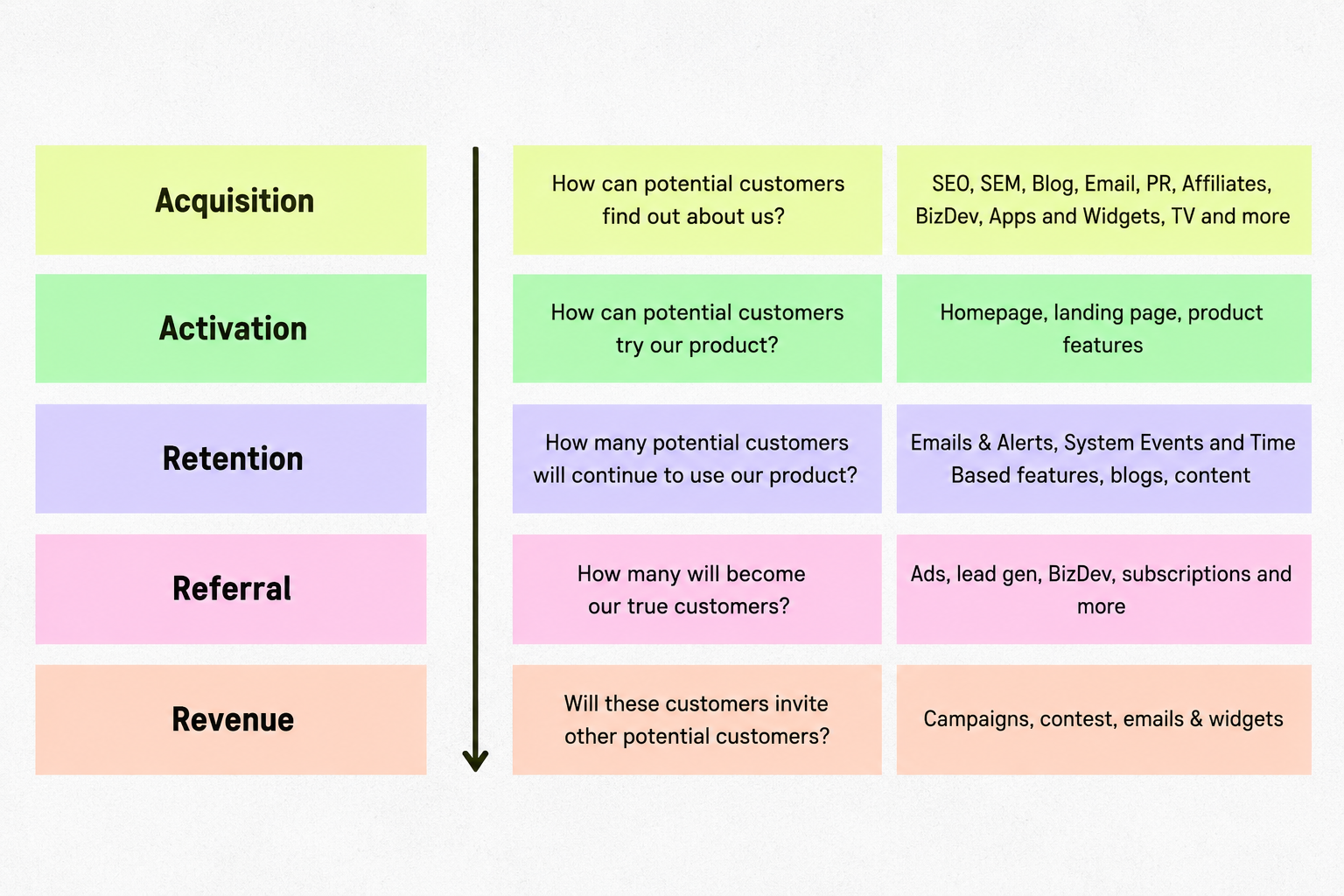
Growth marketing relies on the well-known AARRR framework: Acquisition, Activation, Retention, Referral, Revenue. This model structures marketing efforts and is essential for maximizing impact at every stage of the funnel — here's each stage illustrated with a company selling mate tea:
Acquisition: convert audiences into qualified prospects.
Example: offer a free e-book "The Secrets of Mate" in exchange for a newsletter sign-up.
Activation: encourage first engaging actions (e.g., sign-up, product trial).
Example: offer a discount on the first mate purchase via a code sent after sign-up.
Retention: maintain a lasting relationship with leads to build loyalty.
Example: send creative mate-based recipes and usage tips by email every week.
Referral: turn satisfied customers into brand ambassadors.
Example: launch a referral program with a discount for each friend referred.
Revenue: maximize the value of each target to grow revenue sustainably.
Example: offer bundles (mate packs with accessories like gourds) or monthly subscriptions for recurring revenue.
Worth repeating because it's essential: unlike traditional marketing, growth marketing doesn't stop at lead acquisition. It works across the entire customer lifecycle to maximize both customer engagement and revenue growth.
Strong Alignment Between Marketing and Sales
One of growth marketing's pillars is the tight link between marketing and sales. Where these two departments often operated in silos under traditional approaches, growth marketing promotes fluid collaboration. Through shared objectives (e.g., qualified leads generating revenue) and shared tracking tools like a CRM to follow the full customer journey, this integration reduces friction and ensures better conversion of generated leads into concrete commercial opportunities — and optimized growth.
Growth Marketing vs. Growth Hacking: What's the Difference?
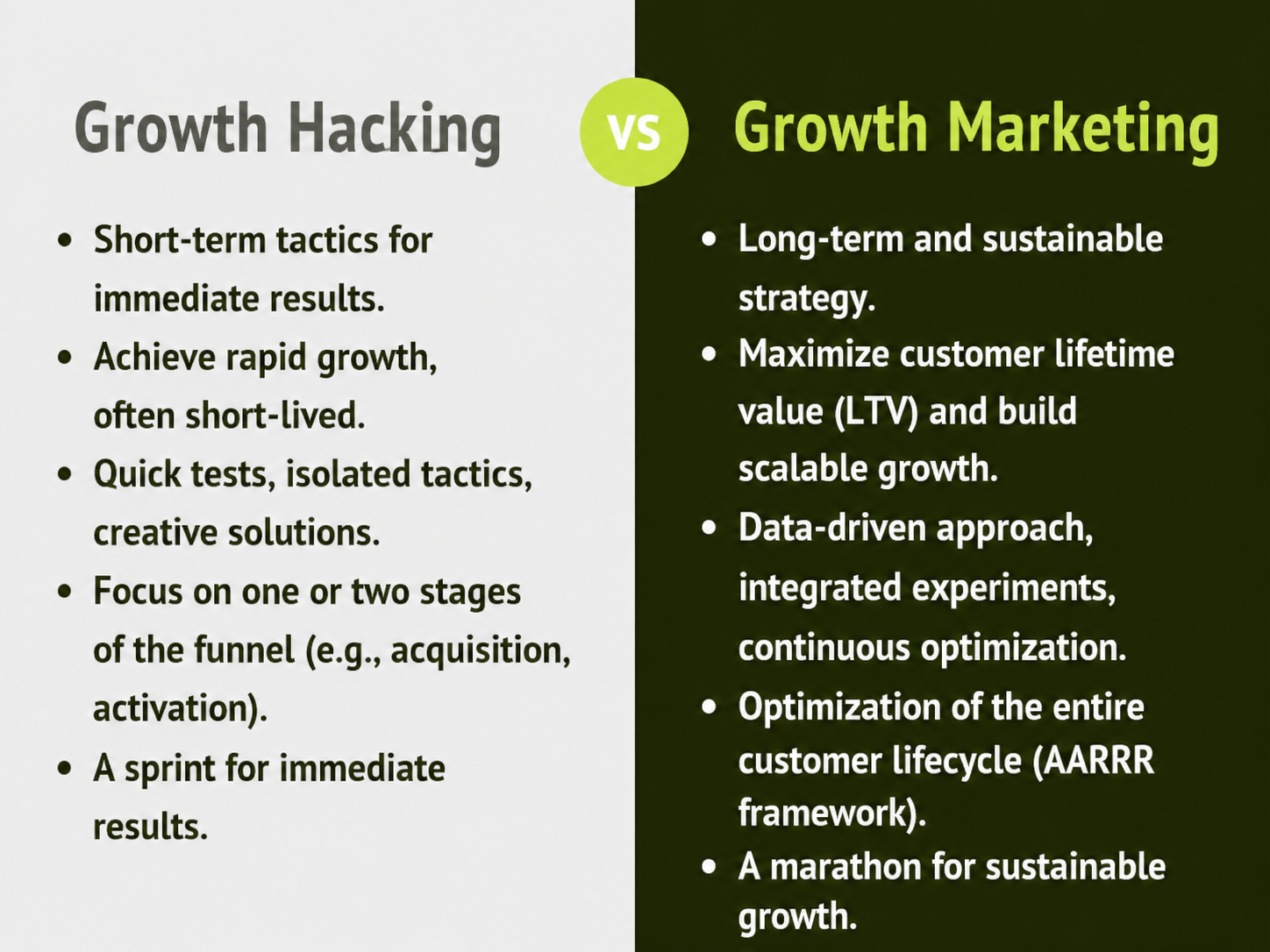
Growth marketing and growth hacking share an experimentation-driven approach, but differ fundamentally in their objectives. Growth hacking focuses on short-term tactics to generate immediate results — like launching a time-limited viral promotional offer to boost product sales.
In contrast, growth marketing takes a long-term strategic vision — like implementing a loyalty program based on customer data analysis, aimed at increasing retention and customer lifetime value. The goal of growth marketing is to ensure sustainable, scalable growth by integrating actions that support the long-term strength and durability of the business.
The Growth Marketing Methodology
To maximize growth at every stage of the customer lifecycle, your strategies will combine rapid experimentation, data analysis, and continuous optimization. Start by defining your business objectives: identify what you want to achieve — increase conversions, reduce churn, maximize LTV. Prioritize objectives based on their growth impact. Then, follow this methodology:
1. Structure Growth Efforts Using the AARRR Framework
The pirate funnel guides optimization efforts across key stages of the customer lifecycle (Awareness, Acquisition, Activation, Retention, Referral) — a marketing essential. Analyze where the main bottlenecks are, then prioritize which stages to optimize based on your objectives.
Two examples:
Acquisition: work on personalization through dynamic segmentation and targeting to increase conversions in the acquisition phase.
Example: for a music streaming service campaign, segment the audience by preferred music genres (pop, classical, rap) and show them personalized playlists in the ads. Actionable tactic: use past interaction data (such as site clicks or app downloads) to adjust the content of ads or emails sent.
Retention: reduce the churn rate (the percentage of buyers who stop using a product or service over a given period) with retention marketing efforts based on behavioral triggers.
Example: a SaaS customer hasn't used the product in 15 days. Send an email with a tutorial video explaining how to get the most out of the most-used feature for that type of user. Actionable tactic: set up automated notifications to re-engage customers after a specific event, such as an abandoned cart or decreased app activity.
2. An Experimental Approach: Test, Learn, Optimize
The test and learn principle is at the core of growth marketing. Based on the bottlenecks identified in the funnel model, this will involve:
Short sprints: define rapid experimentation cycles, typically one to two weeks, to test new ideas. This lets you iterate quickly on what works and what doesn't.
Example: 10 days to test a new positioning and analyze first results.
A/B testing: compare two versions of an ad or landing page to identify the better performer.
Example: compare two email versions — one with a visual CTA and one with a text button — to identify which generates more clicks.
Multivariate testing: simultaneously explore several content or design variations for more comprehensive results. These experiments identify actions with the greatest impact on KPIs like conversion rate or customer lifetime value (LTV).
Example: vary headlines, visuals, and offers on a landing page.
3. Adopt a Data-Driven Approach: Identify and Track Relevant KPIs
Your growth marketing decisions must be guided by tangible data, not intuition. Using dashboards (CRM, analytics tools) lets you visualize these metrics in real time, facilitating reporting and fast decision-making. If you don't have a dashboard yet, it's time to build one!
An in-depth analysis of results based on a cost vs. revenue (ROI) ratio helps prioritize the most profitable actions. For example:
Allocate more budget to projects with the best return on investment.
Optimize resources on channels generating high LTV.
Regularly analyze your performance — comparing current campaigns against internal benchmarks, or identifying weak spots (e.g., low conversion rate on a specific channel).
Collect reliable data through analytics tools (Google Analytics, CRM, ad platforms) and centralize it in your dashboard.
KPIs are essential for measuring the impact of your actions on growth and adjusting strategies at each lifecycle stage:
Conversion rate: measures the percentage of visitors or prospects who take a desired action (purchase, sign-up, download, etc.), evaluating acquisition campaign effectiveness.
Formula:
Conversion rate = (number of conversions / total number of visitors or leads) x 100
Example: if 500 people visit a landing page and 50 sign up, the conversion rate is:
Conversion rate = (50/500) x 100 = 10%
Churn rate: tracks lead loyalty; represents the percentage of customers who stop using a product or service over a given period.
Formula:
Churn rate = (number of customers lost during the period / total customers at the start of the period) x 100
Example: if a company starts the month with 1,000 customers and loses 50:
Churn rate = (50/1000) x 100 = 5%
Customer Lifetime Value (LTV): identifies the most profitable segments; it's the total revenue a customer generates over their entire relationship with the company.
Formula:
LTV = Average spend per customer x Average customer relationship duration (in periods) x Gross margin (%)
Example: if a prospect spends an average of €50/month, stays active for 12 months, and gross margin is 40%:
LTV = 50 x 12 x 0.4 = €240
In summary: start by defining your objectives and analyzing bottlenecks in the AARRR cycle. Launch rapid tests on tactics, track your KPIs with a data-driven approach, and continuously iterate to scale what works. This methodology not only delivers immediate wins, but also sustainable, scalable growth over the long term.
Growth Marketing Channels and Tactics
To maximize growth with a growth marketing approach, you'll need to combine different channels and tactics — balancing efficiency and scalability. Channels are your routes for reaching your audience and generating interactions (traffic, activation, retention); tactics are your tools for exploiting those channels effectively and hitting your goals. Here are the main levers and actionable solutions:
1. Organic Channels: SEO and Content Marketing
Organic channels generate a sustainable audience without a direct cost per click — a way to attract traffic or customers without paying for each interaction. They're growth marketing essentials.
Use long-tail keywords to attract qualified visitors (e.g., "best SaaS platform for SMEs").
Create evergreen content (blog articles, comprehensive guides) that remains relevant over time.
Tools: Google Search Console to analyze impressions, Ahrefs or SEMrush to identify keywords and optimize content.
Content marketing:
Publish engaging blog articles and videos with strong storytelling to capture attention.
Produce educational and useful content to establish expertise (e.g., video tutorials).
Tools: HubSpot for the editorial calendar, Canva for visual creation, YouTube for video hosting.
Non-sponsored social media:
Post engaging content regularly: relevant, attractive posts (images, videos, infographics) with an authentic tone to strengthen your audience connection.
Practice proactive community management: respond to comments and messages to foster engagement, and animate your community with discussions, polls, or challenges.
Tools: Hootsuite or Buffer for scheduling and management, Canva or Adobe Express for content creation, Sprout Social or Metricool for metrics analysis (engagement, reach, clicks).
2. Paid Channels: SEA and Social Ads
Paid initiatives offer rapid amplification of reach and conversions.
Launch Google Ads campaigns to capture purchase intent via transactional keywords (e.g., "buy a SaaS subscription").
Track and optimize performance via Google Analytics.
Tools: Google Ads for campaign creation, Optmyzr for bid automation.
Social Ads:
Run ads on Facebook or Instagram with precise targeting based on user interests or behaviors.
Leverage retargeting to re-engage unconverted visitors.
Platforms: Meta Ads Manager for campaigns, AdEspresso for A/B testing.
3. Virality and Customer Referral Tactics
User engagement and referrals multiply campaign reach.
Social Media Marketing:
Encourage user-generated content (UGC) through hashtags or contests.
Collaborate with influencers to reach new audiences.
Tools: Hootsuite for scheduling, Upfluence for influencer discovery.
Customer referrals:
Set up referral programs offering benefits to both customers and their friends.
Automate campaigns to maximize reach.
Tools: ReferralCandy or Mention Me for referral systems.
4. Automation and Conversion Rate Optimization (CRO)
Automation and optimization are indispensable for maximizing ROI.
Email Marketing / Outbound:
Use automated sequences to accompany prospects through the customer journey (e.g., email nurturing).
Automate prospecting to identify new qualified leads.
Tools: Lemlist for outbound campaigns, ActiveCampaign for nurturing workflows.
CRO (Conversion Rate Optimization):
Analyze user behavior to optimize landing pages.
Test different elements (headlines, CTAs) through A/B testing.
Tools: Hotjar for heatmaps, Google Optimize for A/B tests.
By combining these channels and tactics and using the right platforms, growth marketing amplifies reach, converts effectively, and builds long-term loyalty.
[rta-block=folder-cta][rta-title=h3]Want to learn more about your growth potential?[rta-title=h3][rta-btn=regular href="/prendre-rendez-vous-typeform" target=_blank]Get a free audit[rta-btn=regular][rta-block=folder-cta]
The Growth Marketing Gold Standard: Dropbox
Dropbox is an iconic example of growth marketing success, particularly in the SaaS world. The company masterfully combined an innovative strategy with proven tactics to achieve rapid, sustainable growth.
⚠️ The challenge? As a cloud storage solution, Dropbox had to compete against established players while avoiding massive advertising spend. The goal was to maximize sign-ups while minimizing customer acquisition cost (CAC).
The Levers Activated
Referral program: Dropbox implemented a simple but effective system: any user who invited a friend received 500 MB of extra storage — as did the friend who signed up. This created a viral effect, as users had a strong incentive to share Dropbox within their networks.
CRO and simplified UX: the company optimized its site and onboarding to make sign-up and first use intuitive — using built-in tutorials to show how to sync files, increasing activation of new sign-ups.
Growth hacking and integrations: strategic integration with popular services like Microsoft and Apple, allowing Dropbox to reach a wider audience. The company also used constant A/B testing to improve key actions on its landing page.
📈 The results? In just 15 months, Dropbox grew from 100,000 to 4 million users. The referral program contributed to over 60% of sign-ups, significantly reducing CAC. A universally recognized growth marketing success story.
Key Takeaways
Virality pays off: a well-designed referral program can generate exponential growth.
CRO and UX are essential: a smooth user experience maximizes conversions and activations.
Simplicity first: a clear message and an easy-to-understand value proposition drive adoption.
Dropbox demonstrates that a well-executed growth marketing strategy can propel a SaaS company to success, even in a competitive market.
Building a Growth Marketing Team
What Is a "Growth" Professional?
It's the expert or specialist dedicated to growing your company by optimizing performance levers across the customer lifecycle. They don't just acquire customers — they also seek to maximize their long-term value (LTV) through the channels and tactics covered above.
A growth marketing team brings together diverse roles; here are the key positions and their contribution to a company's growth strategy.
Role: leads the growth team, defines the strategic vision, and ensures alignment with company objectives.
Contribution: coordinates the various growth roles and arbitrates priorities based on opportunities and resources.
What About the Growth Hacker?
The growth hacker is often considered a more tactical, experimental figure within growth. Their mission is to find fast, creative solutions to specific problems — often with a short-term lens. While this approach can be powerful, it remains complementary to an overall growth marketing strategy, which relies more heavily on a structured methodology and well-defined roles.
Growth marketing is not just a trend — it's a revolution in how companies think about growth. By combining data-driven methods, continuous optimization, and a results-focused team, this approach enables ambitious goals while remaining agile in the face of market changes. At the intersection of marketing, sales, and product, it becomes an essential lever for companies looking to stand out and maximize their impact. Are you ready to take action and build your growth strategy for 2026?
Growth marketing is a data-driven approach to growth that aims to optimize the entire customer lifecycle, from acquisition to retention, through rapid experimentation, data analysis, and continuous improvement.
What is the difference between growth marketing and traditional marketing?
Traditional marketing often focuses on acquisition and awareness through broad campaigns.
Growth marketing, on the other hand, works on the entire funnel, uses rapid tests, relies on data, and continuously optimizes to generate sustainable, measurable growth.
Growth marketing and growth hacking: are they the same thing?
No.
Growth hacking favors fast, opportunistic tactics to get short-term results.
Growth marketing is part of a long-term, structured strategy, driven by KPIs and integrated across the marketing, product, and sales teams.
Is growth marketing reserved for startups?
No. Even though it was popularized by tech startups, growth marketing now applies to SMBs, B2B companies, SaaS, scale-ups, and large corporations. Any organization seeking measurable, optimizable growth can adopt it.
What are the prerequisites for launching a growth marketing strategy?
You first need clearly defined business objectives, a reliable tracking setup, performance indicators chosen in advance, and tools to centralize data such as a CRM and an analytics solution. The ability to test quickly and good alignment between marketing, sales, and product are also decisive.
Newsletter
Join those who are redefining AI-driven growth.
Get access to playbooks and feedback from those who are shaping the next wave of marketing and AI.
Thank you! Your submission has been received!
Oops! Something went wrong while submitting the form.


.jpeg)