
In an increasingly competitive digital environment, mastering your sales funnel has become essential for any business looking to convert website visitors into customers. This marketing concept — which maps the complete journey of a prospect from first awareness of a need to the act of purchase — helps structure your sales activities and improve performance at every stage. Whether you're a startup in launch mode or an established company looking to optimize your conversion funnels, this guide offers a practical approach to defining, building, and perfecting your strategy. With the right tools, the right techniques, and an implementation tailored to your business, you'll discover how to turn prospects into loyal customers while reducing your acquisition costs.
Having an effective sales funnel is essential, whether you're a fast-growing startup or an established company. This process guides a prospect through multiple stages, from the first interaction to conversion as a customer.
A well-designed funnel lets you maximize your conversion rate, optimize marketing efforts, and efficiently turn prospects into buyers. In this guide, we'll look at how to structure and optimize your sales funnel, with concrete strategies and industry-specific examples for real estate and accounting.
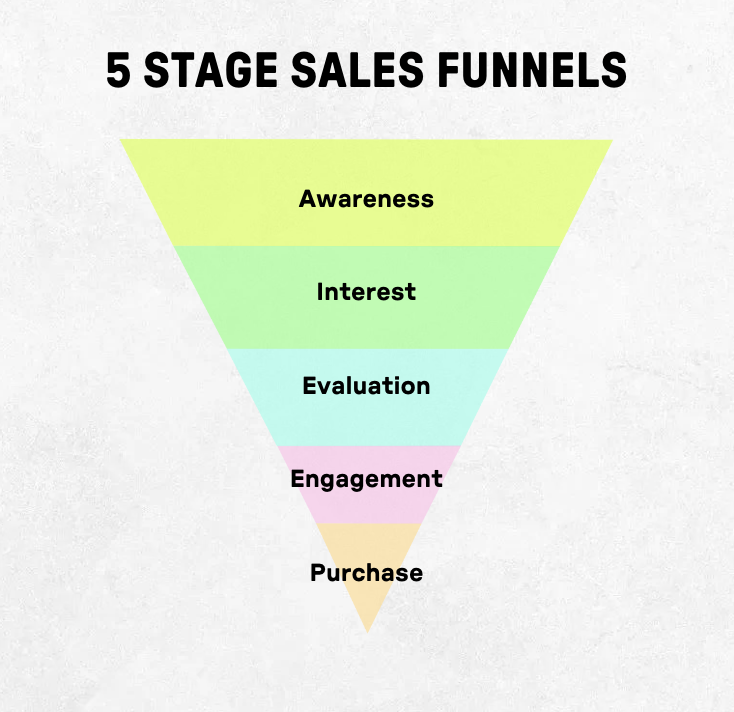
Picture a funnel. Wide at the top, narrow at the bottom. Now apply that image to the customer journey — from first discovering your brand to becoming a paying customer. That's exactly what a sales funnel (or marketing funnel) is.
The concept is simple: not every visitor to your website or ad will become a customer. Some will just browse, others will sign up for your newsletter, and a small fraction will make a purchase. The goal of the funnel is to structure this sales process to maximize how many people progress through each stage and minimize drop-off at every decision point.
🧠 Pro tip: Building an effective funnel doesn't just structure your marketing — it also helps you reach your target audience more easily and meet the expectations of your ideal customers at every touchpoint.
A sales funnel, or conversion tunnel, typically follows the TOFU / MOFU / BOFU model (Top, Middle, Bottom of Funnel) and consists of five key stages, each corresponding to a level of prospect engagement:
At each stage of the funnel, your job is to remove obstacles and guide the prospect forward with content tailored to your inbound marketing strategy.
👉 Concrete example: Netflix drives traffic through ad campaigns (awareness). It captures interest with a free trial (interest), highlights its catalogue and personalized recommendations (consideration), simplifies sign-up (decision), then retains subscribers through emails and notifications (action).
The fundamentals are the same, but the purchase cycle and decision-making phases differ depending on your audience.
B2C (business to consumer):
B2B (business to business):
Key takeaway: in B2C, you need to capture attention and convert fast. In B2B, you need to build trust, identify the ideal customer profile, and prove your value with solid content.
A poorly optimized funnel is like a badly tuned car: it burns more fuel, struggles to move, and costs you money. By refining it, you attract more customers, lower acquisition costs, and maximize sales.
A sales funnel follows a logical sequence: capture attention, engage, convince, trigger the purchase, and retain. Each stage plays a crucial role in converting a visitor into a customer within a well-defined customer journey.
If your audience doesn't know you exist, they won't buy from you. The goal is to reach your target audience and attract qualified traffic at the top of the funnel (TOFU).
Effective strategies:
👉 Example:
Edflex combined SEO, educational content, and targeted ads to generate qualified traffic and drive acquisition — a textbook example of building an effective funnel.
An interested prospect needs to be nurtured with relevant information to deepen engagement, especially in the middle of the funnel (MOFU).
Key strategies:
👉 Example:
Lingo, a blockchain real estate startup, generated 13,000 leads by producing over 100 specialized pieces of content and building an engaged community at every step of its sales process.
At this stage of the customer journey, the prospect is comparing offers and looking for reassurance. It's time to meet the expectations of your ideal customers and identify the most relevant conversion criteria.
Strategies to trigger the decision:
👉 Example:
Spotify uses personalized emails and notifications to encourage free users to upgrade to Premium, highlighting key arguments like no ads, offline listening, and better audio quality.
The prospect is close to buying. It's crucial to reassure them, address objections, and optimize this decision phase.
Strategies to maximize conversion:
👉 Example:
Addingwell optimized its acquisition funnels on Facebook and LinkedIn Ads, streamlining the customer journey all the way to purchase.
The final stage of the funnel doesn't end at purchase. The goal is to turn a customer into a loyal brand ambassador, ready to recommend your product.
Strategies to maximize retention:
👉 Example:
Comptables.com revamped its sales pages and optimized its client acquisition process, achieving a 45% conversion rate.
[rta-block=folder-cta][rta-title=h3]Want to learn more about your growth potential?[rta-title=h3][rta-btn=regular]Get a Free Audit[rta-btn=regular][rta-block=folder-cta]
Having a good sales funnel is great. But if you don't understand who your prospects are and where they are in their customer journey, you risk sending the wrong message at the wrong time. That's where analysis and segmentation come in — two essential levers for reaching your target audience and meeting the expectations of your ideal customers.
Not all leads are equal. Some are ready to convert; others are still exploring. Lead scoring is the art of identifying the ideal profile and determining conversion criteria based on engagement with your website or content.
How does it work?
Not all your prospects respond to the same messages. Segmenting your audience lets you tailor your actions to each stage and effectively guide prospects along their path to purchase.
Types of segmentation:
Precise segmentation is the key to high-performing inbound marketing, as it lets you craft tailored messages for each segment while maximizing conversion chances.
Optimization isn't done by intuition. With the right tools, you can automate, analyze, and adjust your strategies at every stage of the funnel, turning more visitors into customers and boosting sales.
CRMs and marketing automation tools let you track leads, score their engagement, and send them relevant content without manual intervention.
Recommended tools:
Winning strategy:
Even the best funnel can be improved. The secret? Test and analyze continuously.
Key actions:
Why does it matter?
A simple headline change on a sales page can double conversions. Without analysis, there's no way to know what's actually working.
💡 Goal: generate qualified prospects for a real estate agent or agency.
Example: a Paris real estate agency implemented an interactive quiz to suggest properties matching prospects' needs, significantly boosting their conversion rate.
💡 Goal: acquire new business or freelance clients.
Example: an accounting firm used LinkedIn Ads and webinars to generate 150 qualified leads per month.
An optimized sales funnel is the key to sustainable growth. By understanding each stage, analyzing your data, and adjusting your approach, you can turn more prospects into customers.
.jpeg)
Lorem
Can't find what you're looking for ? Contact us here
jordan@bulldozer-collective.comGet access to playbooks and feedback from those who are shaping the next wave of marketing and AI.


Lorem ipsum dolor sit amet, consectetur adipiscing elit. Suspendisse varius enim in eros elementum tristique. Duis cursus, mi quis viverra ornare, eros dolor interdum nulla, ut commodo diam libero vitae erat. Aenean faucibus nibh et justo cursus id rutrum lorem imperdiet. Nunc ut sem vitae risus tristique posuere.