
z

The Best Techniques to Improve Your Conversion Rate

Discover proven techniques to optimize your conversion rate and turn more visitors into customers.

Table of contents
Resource
B2B Conversion Rate Benchmark 2026
Download

Wondering how to turn your visitors into loyal customers? In an increasingly competitive digital landscape, conversion rate optimization has become a critical challenge for any business looking to grow sustainably.

Improving your conversion rate can not only increase your sales, but also maximize the return on investment of your web traffic. Discover the most effective strategies to grow your sales and build customer loyalty.

Understanding Conversion Rate: The Key to Your Online Success

Definition and Importance of Conversion Rate

The conversion rate is far more than a simple number: it is the barometer of your website's effectiveness.

According to HubSpot, this key metric measures the percentage of visitors who complete a desired action, whether that's a purchase, a newsletter sign-up, or downloading a white paper. A high conversion rate means your site excels at transforming casual visitors into valuable customers or leads.

How to Calculate and Interpret Your Conversion Rate?

The conversion rate calculation is straightforward: divide the number of conversions by the total number of visitors, then multiply by 100.

In other words, the formula is:

Conversion Rate = (number of conversions / number of visitors) x 100

For example, if your e-commerce site receives 10,000 visitors per month and generates 300 sales, your conversion rate is 3%.

SLN Web notes that in B2B, a rate of 1% is considered good, while in B2C, targeting 2% to 3% is a solid objective. For landing pages in B2B, a rate of 10% to 15% is often the goal.

However, it is important to compare against your own past performance and seek continuous improvement rather than focusing solely on industry averages.
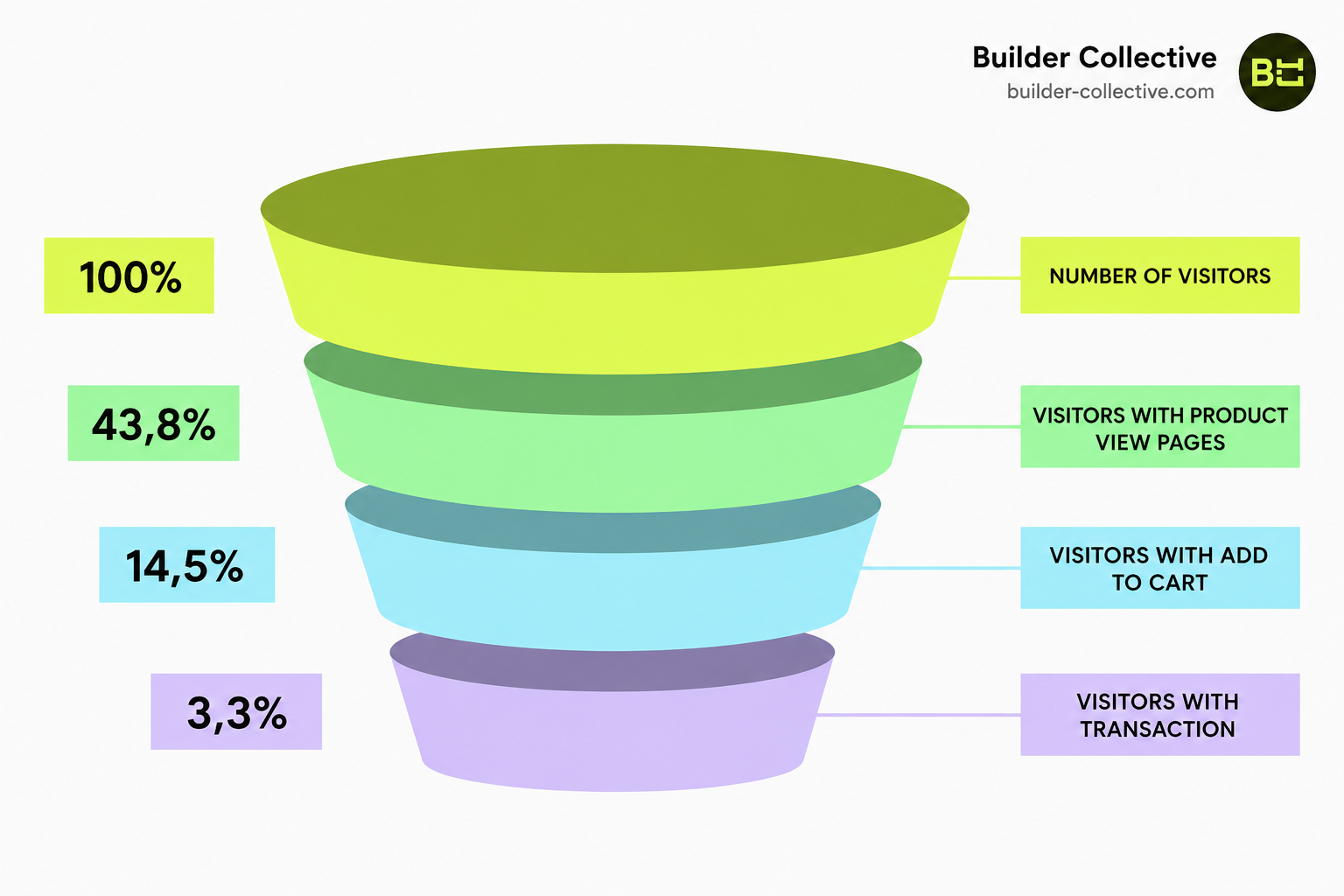
Analyzing Your Performance: The Starting Point for Optimization

__wf_reserved_inherit

Leverage the Power of Analytics Tools 

To optimize your conversion rate, start with a thorough analysis of your current performance. Google Analytics remains the go-to tool, but other solutions like Hotjar, Mixpanel, or Kissmetrics offer valuable complementary features.

We strongly recommend using heat maps to visualize the most engaging areas and identify where your visitors interact most with your website. 

Identify and Eliminate Friction Points

Analyzing your data will reveal the obstacles limiting your conversions. These friction points take many forms: overly complex forms, slow-loading pages, or a lack of critical information.

Stripe highlights that the checkout process is often the Achilles' heel of e-commerce sites, where many potential customers abandon their cart. Identify these bottlenecks and make them your optimization priority.

[rta-block=folder-cta][rta-title=h3]Want to learn more about your growth potential?[rta-title=h3][rta-btn=regular]Get a Free Audit[rta-btn=regular][rta-block=folder-cta]

Optimizing Key Pages: The Core of Your Conversion Strategy

Create Effective Landing Pages

Your landing pages are the cornerstone of your conversion strategy. They must be clear, concise, and focused on a single objective (capturing attention, increasing time on site, highlighting your competitive advantage…). Here are some best practices:

  • a compelling headline that clearly summarizes your offer;
  • relevant, high-quality visuals;
  • concise content highlighting user benefits;
  • testimonials or social proof to build trust;
  • a simple, easy-to-fill form.

Optimize Your CTAs for Maximum Impact

Call-to-Action (CTA) elements are the conversion triggers on your site. To make them irresistible:

  1. Use clear, direct action language (e.g., "Start your free trial" rather than "Sign up").
  2. Choose contrasting colors that catch the eye.
  3. Test different wording and placements to find the most effective combination.
  4. Make sure your CTAs are visible on all devices, especially on mobile.

Simplify the User Journey for a Seamless Experience

An intuitive user journey is essential for maintaining visitor engagement through to conversion. Don't hesitate to simplify the checkout process by reducing the number of steps and offering options like guest checkout.

Every additional click is an opportunity for the visitor to disengage, so aim for simplicity and efficiency at every step.

Optimize Your Mobile Presence

With the constant rise in smartphone traffic, mobile optimization has become essential. To maintain a strong conversion rate across all devices, it's best to offer:

  • a mobile-responsive website;
  • simplified forms for mobile;
  • easily tappable buttons.

Neglecting the mobile experience can significantly impact your overall conversion rate.

Testing and Iteration: The Key to Continuous Improvement

Master the Art of A/B Testing

A/B testing is your ally for continuous conversion rate optimization. This technique involves comparing two versions of a page or element to determine which performs better. For example, you might test two versions of a headline on your homepage:

  • Version A: "Increase your sales by 50% with our solution" — Version B: "Discover how our clients doubled their revenue"

By measuring the conversion rate of each version, you can identify which resonates best with your audience.

Analyze, Adjust, and Repeat

Rigorous analysis of your test results is crucial. Freshworks recommends going beyond raw numbers and trying to understand the "why" behind each result.

Use these insights to refine your strategy, then launch new tests. Conversion rate optimization is a continuous improvement process.

Advanced Techniques to Supercharge Your Conversions

Personalize the User Experience for Maximum Impact

Personalizing the user experience (UX) can significantly improve your conversion rate. Here are some advanced techniques:

  • Behavioral segmentation: Adapt content based on the user's browsing behavior.
  • Personalized recommendations: Use purchase history to suggest relevant products.
  • Dynamic content: Modify page elements based on the visitor's profile.
  • Personalized retargeting: Create targeted campaigns based on the visitor's previous interactions with your site.

Leverage the Power of Marketing Automation

Marketing automation can radically transform your conversion strategy. Here's how to use it effectively:

  • automated follow-up emails for abandoned carts;
  • intelligent chatbots to instantly answer visitor questions;
  • personalized email sequences based on user behavior;
  • push notifications to re-engage visitors at the right moment.

Conversion rate optimization is essential for achieving your growth objectives. Analysis, personalization, and continuous improvement techniques allow you to significantly enhance your website's performance and maximize return on investment.

Remember that every site is unique. What works for one may not work for another. The key to success lies in constant testing, rigorous analysis, and agile adaptation of your strategies.

Ready to transform your site into a true conversion machine? Start today by applying these proven techniques. And remember, the Bulldozer Collective team is here to support you at every step of your optimization journey. Together, let's propel your online presence to new heights! 

Book a free consultation to discover our solutions.

Lorem ipsum

Charlotte Nowak
Charlotte Nowak
Content Marketing Manager
August 10, 2024

Lorem ipsum dolor sit amet, consectetur adipiscing elit. Duis quis iaculis est. Nulla ac ligula feugiat, cursus turpis volutpat, ultricies eros.

Read more from this author

See more

To go further

12 No-Code Tools to Build and Automate Online Without Writing a Line of Code
May 16, 2025
Growth
Killian Drecq
12 No-Code Tools to Build and Automate Online Without Writing a Line of Code
TOFU, MOFU, BOFU: How to Optimize Your Marketing Funnel?
July 11, 2024
Growth
Killian Drecq
TOFU, MOFU, BOFU: How to Optimize Your Marketing Funnel?
B2B Growth Hacking: Strategy, Techniques and Concrete Examples (2026)
June 17, 2024
Growth
Charlotte Nowak
B2B Growth Hacking: Strategy, Techniques and Concrete Examples (2026)

Frequently asked questions

Can't find what you're looking for ? Contact us here

jordan@bulldozer-collective.com
What is the conversion rate and how do you measure it on your website?
The conversion rate represents the proportion of visitors who complete a desired action on your website. This metric is calculated by dividing the number of conversions by the total number of visitors, then multiplying by 100. For example, if your e-commerce site receives 10,000 visits and generates 300 transactions, your conversion rate is 3%. This statistic is essential for assessing the effectiveness of your online business.
How do you use data to optimize bounce rate and improve performance?
To optimize your site, you need to analyze the data from your traffic in real time. Analytics software lets you track customer behavior, measure the time spent on each page, and identify friction points. By modifying your page code and testing different marketing campaigns, you can significantly boost your results. The effect of these optimizations is measured over a given period to reach a higher level of performance.
What is the relationship between currency exchange rates and e-commerce conversions?
In international e-commerce, currency exchange rates (EUR, CAD, pound sterling, Swiss franc) can directly impact your conversions. Customers often compare prices according to their reference currency. An integrated currency converter improves the user experience and can increase the number of transactions. The European Commission and the European Central Bank regularly publish reference rates for the European Union.
How do you evaluate and adjust a marketing campaign for a large number of customers?
Evaluating a marketing campaign relies on several indicators: click-through rate, cost per acquisition, and return on investment. For a company targeting a large number of customers, it is crucial to use tracking tools that allow you to analyze the data in a first pass. Modifying campaign elements (visuals, messaging, targeting) should be done gradually, testing each change over a defined period to measure its real impact.
What is the optimal response time for converting a prospect into a customer?
Response time is a key conversion factor. Studies show that responding within the first hour considerably increases the chances of conversion. In a highly competitive world, the ability to respond quickly to a customer request can make all the difference. It should be noted that this processing speed must be maintained over a long period to be effective and represents a major competitive advantage.
How do you measure and improve the reach of your online marketing efforts?
The reach of your online marketing efforts is measured by the number of people reached and the engagement generated. To improve it, you first need to know your target audience and use the right channels. An ROI calculator can help you assess the effectiveness of your advertising investments. Optimal performance requires constant monitoring of metrics and real-time adjustment based on the results recorded.
Newsletter

Join those who are redefining AI-driven growth.

Get access to playbooks and feedback from those who are shaping the next wave of marketing and AI.


Thank you! Your submission has been received!
Oops! Something went wrong while submitting the form.
Leo Lacoste
Léo Lacoste
Sales Manager

Heading

Lorem ipsum dolor sit amet, consectetur adipiscing elit. Suspendisse varius enim in eros elementum tristique. Duis cursus, mi quis viverra ornare, eros dolor interdum nulla, ut commodo diam libero vitae erat. Aenean faucibus nibh et justo cursus id rutrum lorem imperdiet. Nunc ut sem vitae risus tristique posuere.