
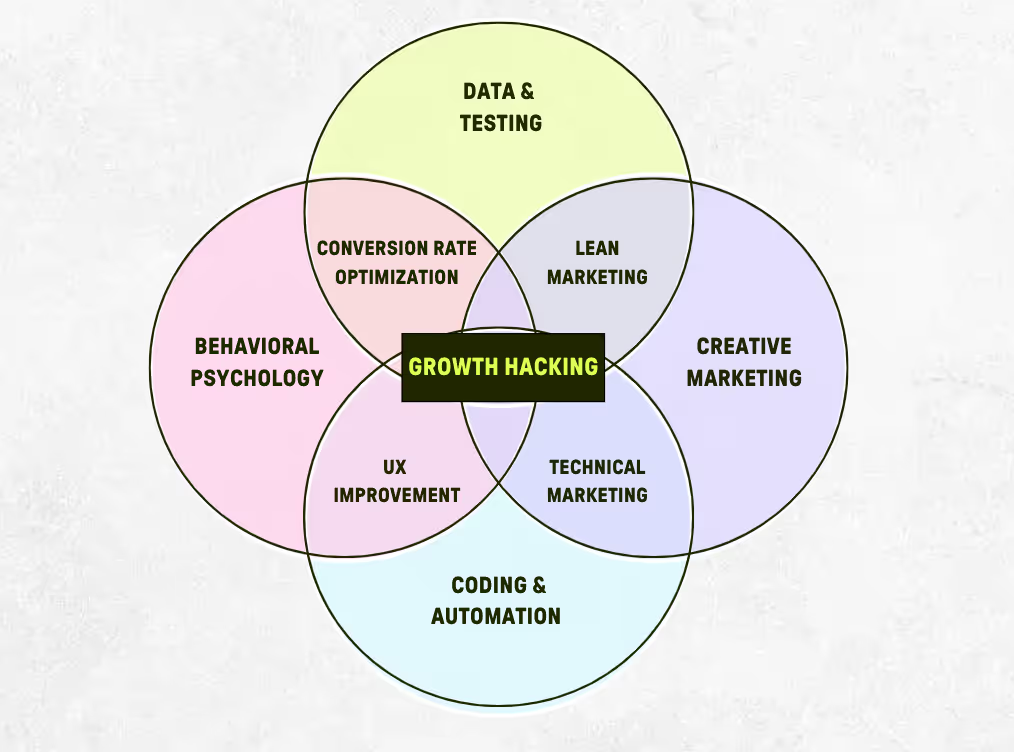
Growth hacking is a methodology designed to rapidly accelerate company growth through low-cost, highly creative experiments. Coined by Sean Ellis in 2010, this approach combines marketing, product, and data analysis to identify the most effective growth levers.
Unlike traditional marketing, growth hacking focuses on rapid, measurable experiments based on the AARRR model (Acquisition, Activation, Retention, Referral, Revenue). The goal: find scalable and repeatable strategies to generate sustainable growth.
Growth hacking emerged in Silicon Valley as a response to a simple question: how do you grow a startup rapidly with limited resources? The answer: by combining creativity, data, and product to find unconventional but highly effective growth levers.
Today, growth hacking is no longer reserved for startups. B2B SaaS companies, scale-ups, and even large enterprises have integrated this methodology into their marketing strategies. Here are the 10 techniques that will dominate in 2026.
Before diving into specific techniques, it's essential to understand the AARRR model, the backbone of any growth hacking strategy:
The key: identify the weakest link in your AARRR funnel and focus 80% of your efforts there. A company losing 50% of its users at activation has a much bigger problem than its acquisition.
Before launching any experiment, map out your AARRR funnel with hard data:
Your North Star Metric (NSM) is the single number that best captures the value you deliver to your users. Examples:
All your growth experiments must be evaluated based on their impact on the NSM.
Generate 20-30 growth hypotheses per quarter using the format: "If we [action], then [metric] will increase by [X%] because [reason]." Prioritize using the ICE framework (Impact, Confidence, Ease).
Each experiment follows a strict cycle:
Target: 5-10 experiments per month minimum. The companies that win are those that run the most experiments, not those that run the biggest ones.
[rta-block=folder-cta][rta-title=h3]Want to learn more about your growth potential?[rta-title=h3][rta-btn=regular href="/prendre-rendez-vous-typeform" target=_blank]Get a free audit[rta-btn=regular][rta-block=folder-cta]
The most famous example of B2B growth hacking remains Airbnb's Craigslist hack. In 2010, Airbnb built a tool that automatically cross-posted their listings to Craigslist, which had millions of users looking for accommodation. Result: explosive growth with near-zero acquisition cost.
The lessons to apply in B2B:
A B2B growth hacker in 2026 must master:
The profile is no longer a "hacker" in a garage. It's a T-shaped marketer: broad in all digital disciplines, expert in one (SEO, paid, product, data).
At Bulldozer, we don't sell growth hacking as a magic formula. We structure it as a rigorous methodology:
The result: our clients average 3x pipeline growth in 6 months with the same budget. Not because we found a magic trick, but because we run more experiments, faster, with better measurement.
Lorem ipsum

Content Marketing Manager at Bulldozer, she writes about content strategy, editorial systems and distribution.
Can't find what you're looking for ? Contact us here
jordan@bulldozer-collective.comGet access to playbooks and feedback from those who are shaping the next wave of marketing and AI.