
Across paid advertising audits conducted in 2025, one pattern keeps coming up: most teams are activating on the right channels — but at the wrong point in the buyer journey.
In many cases, 60–80% of budget is reaching audiences that aren't ready to buy.
The result: high advertising costs, low conversion rates, and volatile return on investment.
The issue isn't the channel. It's the marketing strategy and how messages are distributed based on intent.
In this article, we detail how to structure a B2B programmatic marketing strategy built on the 5 stages of awareness — with a performance-driven approach, precise targeting, and ROI optimization.
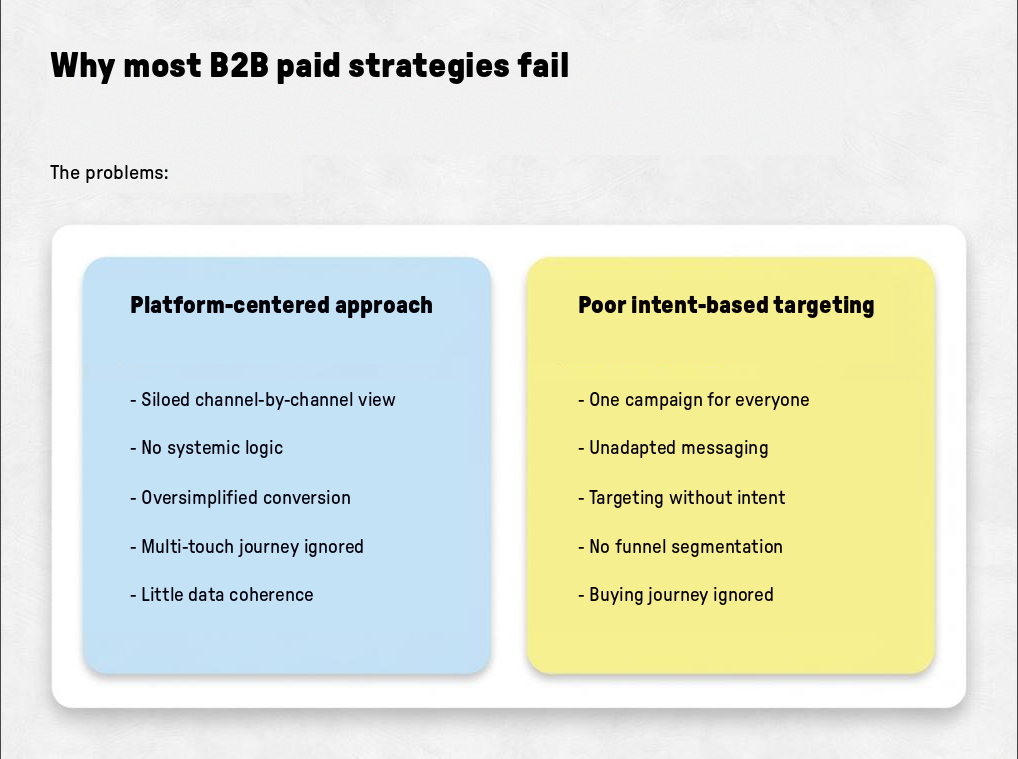
Many teams think about advertising as a stack of platforms: paid social, search engine, display ads.
But a B2B digital advertising strategy doesn't work channel by channel in isolation. It works as a connected, data-driven system.
A user doesn't convert after a single ad impression. They interact with multiple touchpoints, across multiple websites, networks, and formats. This is exactly what our growth marketing guide shows: high-performance acquisition is built on orchestrated levers, not a single channel.
One campaign for the entire target audience.
The same message for a cold audience and one that's actively comparing solutions.
In programmatic advertising, targeting (audience targeting, demographic targeting, targeting criteria) is everything. But without segmentation by intent level, even the best demand-side platform (DSP) won't save you.
According to Google Think with Google, more than 70% of the B2B journey happens without any direct interaction with a sales team.
That journey is progressive. Campaigns need to follow that progression.
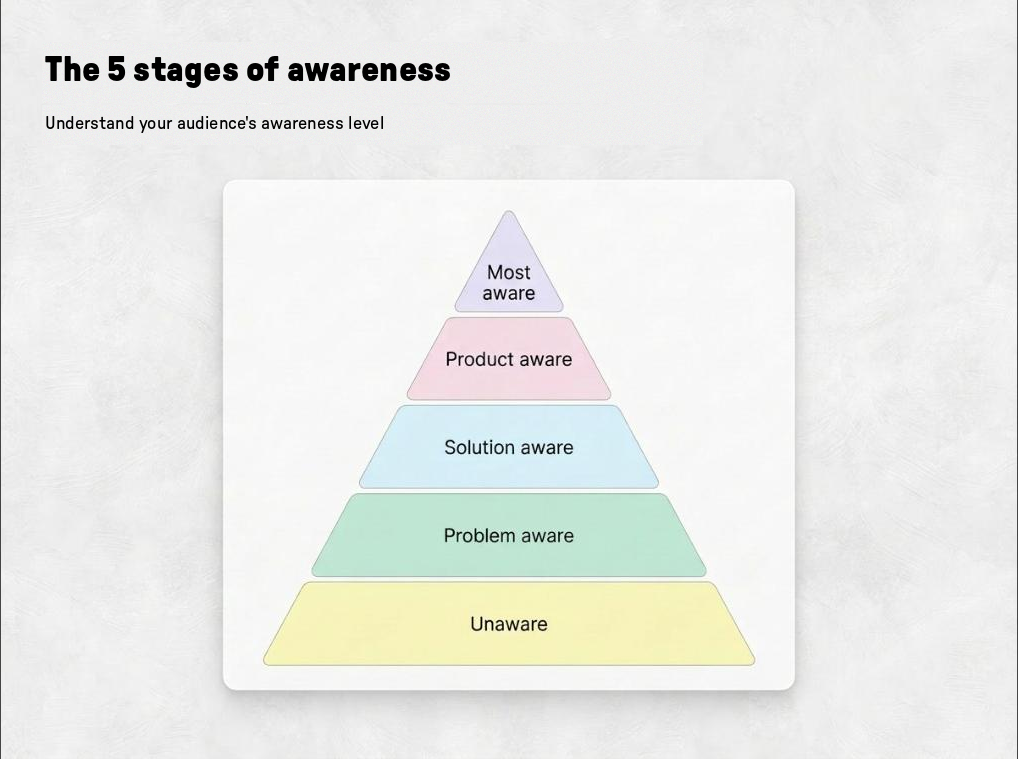
The model comes from Eugene Schwartz, theorized in Breakthrough Advertising (1966) and now a cornerstone reference in copywriting and paid strategy.
It structures a programmatic advertising campaign strategy around the level of buyer consciousness. Think of it as a more granular version of the TOFU / MOFU / BOFU model — five levels instead of three:
At this stage, the user isn't searching yet.
Create awareness.
Programmatic advertising uses contextual signals, third-party data, and platforms like demand-side platforms (DSPs) or supply-side platforms to distribute messages at scale.
This is programmatic media buying — an automated process for purchasing ad inventory. It's also the stage where building brand awareness in parallel with paid creates a multiplier effect on the stages that follow.
According to the LinkedIn B2B Institute, awareness campaigns generate significantly higher brand recall than direct conversion campaigns targeting cold audiences.
Once attention is captured, the objective shifts.
Clarify the problem and introduce analytical frameworks.
This is where B2B content marketing and digital marketing connect with paid.
The goal is to provide useful information that advances the buyer's understanding.
According to the HubSpot State of Marketing 2024, teams that produce top-of-funnel educational content generate 3x more qualified leads and reduce their cost per acquisition on subsequent stages.
💡 Structuring your B2B paid strategy? Book an audit to identify your gaps by awareness stage.
[rta-block=folder-cta][rta-title=h3]Want to explore your Programmatic Paid potential?[rta-title=h3][rta-btn=regular href="/prendre-rendez-vous-typeform" target=_blank]Get a free audit[rta-btn=regular][rta-block=folder-cta]
At this stage, the problem has been identified.
The question becomes: which solution should I choose?
Help buyers understand the available options.
Comparing different approaches helps structure the decision — particularly between programmatic, paid social, and search advertising. The logic mirrors MOFU: the prospect is looking for proof, not promises.
According to Gartner, The B2B Buying Journey (2023), B2B buyers spend 27% of their decision-making time comparing solutions with each other — before ever contacting a salesperson.
The prospect knows the solutions.
Now they need to reduce uncertainty.
Showcase your offer through proof and results.
Retargeting uses behavioral data (data management, campaign tracking) to re-expose prospects across different ad placements.
This includes the display network, social networks, and programmatic display. Our Fundora use case illustrates this logic exactly: creatives segmented by awareness stage, with retargeting activated as soon as an intent signal is detected.
According to Meta Ads Research, retargeting campaigns show conversion rates 2–3x higher than cold prospecting campaigns, with cost per acquisition reduced by 30–50%.
Intent is strong.
The role of paid is to remove friction and facilitate the decision.
Turn intent into conversion.
Reducing friction in the user journey at this stage is the primary lever.
This is where KPIs like cost per acquisition, cost per mille, and cost per impression become decisive.
According to McKinsey, The B2B Pulse Survey (2024), simplifying the buying journey increases conversion rates by 20–30% in B2B mid-market and enterprise segments.
An effective strategy relies on combining:
The whole system runs on real-time bidding — purchasing an impression based on the estimated value of the user at that moment.
Each stage feeds the next. That connection is what drives performance.
B2B programmatic advertising works when it's structured.
Aligning message, audience, and moment improves return on investment and reduces media spend. The 5 stages of awareness aren't a theory — they're an operational filter for deciding which campaign to launch, to which audience, with which content.
It's not about the tool. It's about the sequencing.
Lorem ipsum

Content Marketing Manager at Bulldozer, she writes about content strategy, editorial systems and distribution.
Can't find what you're looking for ? Contact us here
jordan@bulldozer-collective.comGet access to playbooks and feedback from those who are shaping the next wave of marketing and AI.