Voir nos cas clients
Allez plus loin avec nos ressources gratuites
La newsletter de Bulldozer
Êtes-vous prêt à accélérer ?



After working with more than 120 companies, I've noticed two recurring patterns.
On one side, projects with steady, progressive SEO growth. On the other, projects where growth was exponential.
I applied the same framework to these companies. Yet I was classifying these projects fairly quickly.
In this article, we explore the recurring patterns between these companies. Then, we'll look at how to move from one to the other.
Recognizing a Plane
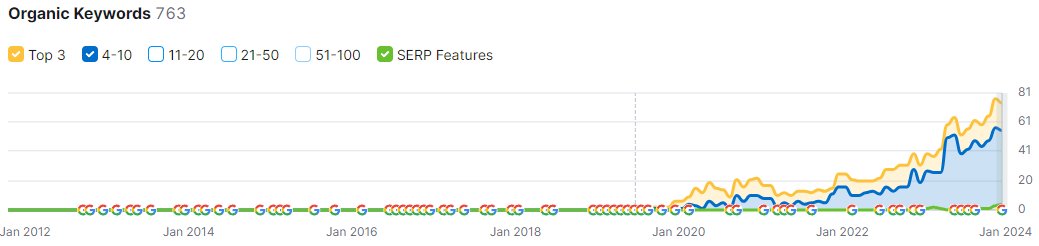
The plane represents a website that grows slowly but steadily in search engines.
Concretely, a monthly SEO traffic growth of 5 to 10% is fairly typical for a plane.
Here's an example of a plane:
Recognizing a Rocket
The rocket is a website where every piece of content you publish seems blessed by the gods.
SEO traffic growth reaches 50 to 100% every month after publishing the main pages.
You quickly get your first keywords ranking on the first page.
Everything falls into place once Google understands your website is worth ranking.
You can start targeting the biggest industry keywords very quickly.
Every SEO who works on a rocket says the same thing: "A job well done."
Here's an example of a rocket:
.png)
The Paradigm Shifts Facing SEO
Historically, SEO has been optimized around 3 well-known pillars:
- Technical: relates to load speed and how easily Google can crawl your website.
- Content: defined by two key criteria — relevance and originality.
- Backlinks: represent your site's popularity across the web, materialized by links pointing to your website.
These 3 pillars are interconnected.
However, I see several problems with this:
- Your SEO growth will be respectable without being exceptional;
- Conversions on your content will also be respectable without being exceptional;
- Your short-term investment will be high compared to the results.
A lot of effort for little short-term results.
Here are some examples of major developments in the world of SEO.
Building the Launch Pad
Google Chrome Is Now Used to Collect Satisfaction Data
Numerous tests conducted by SEO professionals show that external traffic to Google impacts SEO rankings.
It's often observed that a page driven by social advertising sees an impact on its ranking.
Why? Because Google sees that a previously invisible page is getting a traffic spike in Google Chrome.
That page might therefore be more interesting than it initially appeared.
Behavioral data is collected through the browser:
- Bounce rate
- Time spent on the page
- Interactions performed on the site
- Number of pages visited
- etc.
Google then increases the visibility of this page to test its relevance.
If the behavioral data is poor, you'll see a balloon effect. If it's exceptional, you'll gain positions.
As Paul Sanches, a recognized SEO consultant, recently put it: "Traffic is the new backlink".
Key insights:
- A site without traffic isn't trustworthy for Google. Get your first sales outside of Google before launching your SEO.
- The on-page experience must be good enough that visitors actually interact.
Backlinks Are Still Important. Buying Them Is a Complement.
Buying backlinks used to be a gold rush. It allowed brands to take off quickly in SEO.
Thanks to this technique, many brands made it their primary traffic source.
As soon as content was published, you bought links. Those links let you rank quickly and claim top spots on keywords.
That's still partly true today.
Today, backlinks are just as important. However, making this investment alone will no longer set you apart. You'll be just like everyone else.
You need to be smarter — buy backlinks as a complement to other strategies.
The foundation of your site's popularity needs to be built more intelligently.
Here's how a website should be visible before buying backlinks:
- Press mentions.
- Business partnerships (including link exchanges).
- Presence in directories.
- Forum citations.
- Guest contributions in specialized media.
- Industry study content that naturally attracts backlinks.
- Build tools useful to your audience or industry so they embed them on their sites. Trustpilot or TripAdvisor's embeddable review widgets are great examples.
- Identify links pointing to your competitors and try to get listed on those same pages.
- Ask suppliers for links and get listed in their references.
- Ask friends and industry peers for links.
- Identify broken links on sites in your industry and offer your content as a replacement.
Buying backlinks is useful in these specific cases:
- Competitive industries.
- Targeting authority for specific keywords.
- Filling a gap in organic authority.
To get back to basics: a site that's invisible everywhere else on the internet has no reason to be promoted by Google. It's unfair, but SEO is a trust game.
Key insights:
- Build an organic presence before diving into advanced techniques. You'll save budget and avoid the frustration of wasted effort.
- Build visibility and credibility through press coverage. You'll optimize both your credibility and your visibility.
Your Content Must Make People Want to Know More About Your Offer
By producing average-quality content, you penalize your SEO performance.
Average content means average conversions.
Examples of low-quality content:
- Fully AI-generated content: if an AI can produce your content from start to finish, all your competitors have already published it for years. ChatGPT literally took it from them and reformulated it;
- Low-value-added content — no precise data, no sources, no industry expert quotes. Your clients and peers learn nothing by visiting your site.
To know if your content measures up, the test is simple. If your target audience is CMOs with 20 years of experience at large corporations — will they learn something from reading it?
If not, there's little chance they'll browse more pages on your site. You've given them the same content as 100% of your competitors.
If you do land on the first page, your joy will be short-lived when you generate zero conversions.
Accelerating Your First SEO Revenue Through SEA
SEO is a long-term channel — it's not the right one for experimentation.
I've seen very strong results when pushing site content with SEA (paid search).
With a small SEA budget, you can test conversion and navigation signals.
If your content doesn't resonate on paid traffic, it won't perform better on organic traffic either.
By combining SEA with SEO, you find out in just a few days which keywords convert.
This way, you identify your "money keywords" to prioritize. You generate your first revenue from paid traffic and then reduce acquisition costs through SEO.
I recently worked with a client who wanted to reduce their paid budget by gradually replacing it with SEO.
In 5 months, we were already generating the equivalent of €5,000+ in paid traffic value. Traffic has been doubling every month for 3 months and there are still many positions left to capture.
Winning strategy.
Reading these words, you might feel discouraged:
- I don't have the time.
- I don't have the in-house skills.
- I don't have the budget.
- It sounds way too complex.
Let me offer a different perspective:
Google has been enriching itself for years with your target audience's browsing data.
Its expectations are actually much closer to those of your customers than those of a simple machine.
SEO growth used to be the end goal. Now it's the consequence of well-executed marketing.
- A well-built, differentiated offer.
- A strong brand.
- A deep understanding of your target's needs.
- A clear and confident positioning.
- A reassuring presence on social media.
- A brand experience — and therefore a satisfying browsing experience.
- Credibility in your market.
- Trust signals on your website:
- Customer reviews.
- A reassuring legal ecosystem (legal notices, T&Cs, etc.).
- A company that projects seriousness.
- Partners.
- Coverage in specialized or mainstream media.
- High-quality content.
- Visitors who become readers, then prospects, then customers.
You now have the method to launch a rocket.


.avif)