
HubSpot — long held up as the gold standard of B2B SEO — lost between 70 and 80% of its organic traffic between November 2024 and early 2025. A company that has staked its entire business model on SEO content for fifteen years. This isn't a glitch. It's a signal.
Since Google's mass rollout of AI Overviews in May 2024, organic CTRs on informational queries dropped by 61% (Seer Interactive study, September 2025, across 3,119 queries and 25 million impressions). On those same queries, paid CTRs fell by 68%. Traffic isn't disappearing — it's reorganizing around AI systems that synthesize answers without the user ever clicking.
For B2B CMOs and Heads of Growth, the question isn't whether SEO is dead — it isn't. It's about understanding that the rules have changed, that success metrics are shifting, and that a new discipline has become essential alongside SEO: GEO (Generative Engine Optimization). In this article, we break down that shift and walk through the Bulldozer methodology for staying visible wherever your buyers are looking for answers.
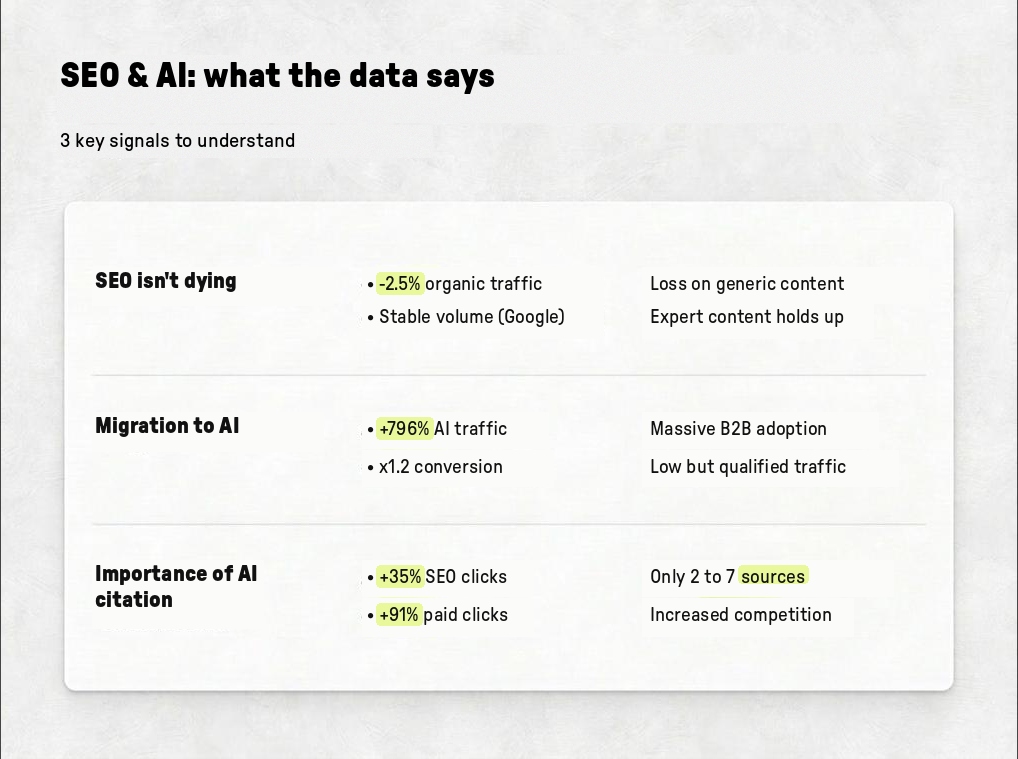
The dominant narrative over the past 18 months has been that "SEO is dead." The data tells a more nuanced story. A Graphite analysis of 40,000 US websites shows that overall organic traffic declined just 2.5% year over year (Search Engine Land, January 2026). Google itself acknowledges that organic click volumes are "relatively stable" in 2025.
The reality is more targeted: losses are concentrated in generic informational content — definitions, tutorials, basic comparisons — that AI Overviews now absorb directly. High-value content grounded in real-world experience and rigorously sourced is holding up better.
For a B2B SaaS targeting queries like "how to choose a CRM tool" or "outbound benchmarks 2025," the risk is real. For content that takes a clear position, features proprietary data, and carries genuine expert perspective, AI tends to cite it rather than replace it.
Forrester Research finds that B2B buyers are adopting AI-powered search at three times the rate of consumer audiences ("Messaging for a Zero-Click World," June 2025). Gartner predicts that by 2026, the majority of B2B buyers will use generative AI tools to research, evaluate, and shortlist vendors.
This isn't a consumer trend. These are your procurement directors, your CIOs, your CEOs — querying ChatGPT or Perplexity before they ever call a salesperson. According to a WebFX analysis of 2.3 billion sessions, traffic from generative AI grew 796% between 2024 and 2025, and those visitors convert at 1.2x the rate of traditional organic traffic.
AI-sourced traffic is still small in absolute volume (0.18% of sessions). But its quality is already superior — and its growth is exponential.
The Seer Interactive study confirms that brands cited in AI Overviews generate 35% more organic clicks and 91% more paid clicks compared to brands that are absent. A citation in an AI response isn't a brand awareness signal — it's a direct commercial advantage.
The challenge: LLMs cite only 2–7 domains on average per response, versus the 10 blue links on a traditional Google page. Competition for AI answer placement is structurally harder than competing for page one rankings.
The majority of B2B SEO strategies are still built around keyword volume. The standard brief: "find the 50 keywords with the best volume-to-difficulty ratio and create content around them." That logic worked. It's now showing its limits.
AI search engines don't rank on volume. They select sources that have demonstrated authority on a topic — consistently and with documented depth over time. A piece that covers 100 queries at a surface level will rarely beat content that treats 10 subjects in depth, with original data and a clear point of view.
Across our B2B SEO engagements, one pattern recurs: sites with a well-structured topic cluster built around their areas of expertise are more resilient to algorithm fluctuations and appear more frequently in AI responses.
B2B SEO can no longer be optimized in a silo. B2B buyers validate their research across multiple channels — Google, LinkedIn, ChatGPT, Perplexity — and the consistency of your presence across all those surfaces determines your perceived credibility in the eyes of AI systems.
Well-structured content on your site, amplified on LinkedIn by your subject-matter experts, cited in industry publications, referenced in third-party research — that combination is what LLMs recognize as an authority signal. Each action in isolation has little impact. Together, they build the authority that AI engines capture and surface.
On our B2B full-funnel engagements, integrating SEO + outbound + LinkedIn content produces compounding effects that SEO alone never generates.
LLMs process content differently from Google. They don't count backlinks. They evaluate semantic clarity, the density of named entities, the presence of structured data (schema.org), and the content's ability to be extracted as a direct answer.
A 3,000-word article without clear H2s, without definitions of key terms, without paragraphs that directly answer a question — it may rank on Google, but it won't be cited by ChatGPT. SEO writing needs to integrate these requirements from the editorial brief stage.
→ Download the Bulldozer white paper: SEO vs GSO, strategies in the AI era
Before writing a single article, we map the thematic clusters that correspond to your buyers' real problems at each stage of the decision cycle. In B2B, cycles run 3–12 months. Your content needs to cover the discovery phase ("I understand my problem"), the evaluation phase ("I'm comparing solutions"), and the decision phase ("I'm validating a vendor").
Each cluster anchors to a pillar page that concentrates authority. Cluster articles reinforce the pillar page and cover high-intent long-tail queries. This architecture is both Google-indexable AND LLM-interpretable — because it creates coherent thematic blocks that AI systems can attribute to a source.
Every piece of content is structured to answer a question directly within its first 60 words. No three-paragraph intro before getting to the point. Answer first, context second.
This format satisfies both Google featured snippet criteria AND LLM citation criteria. LLMs use retrieval-augmented generation (RAG) — they search in real time for the most relevant sources to compose their answer. Content that surfaces its answer clearly, in a structured and easily extractable form, will consistently be favored over narrative content that buries the answer in prose.
AI Overviews have killed the value of generic content. An article titled "10 B2B SEO best practices for 2026" that compiles widely available information won't be cited — it will be replaced by the AI's own synthesis.
What gets cited: data from your own analyses (number of clients, measured results, observed patterns), documented case examples, clearly defended positions backed by evidence. On our engagements, we systematize the collection of field data and integrate it into strategic content — it's what creates the editorial differentiation that both Google and LLMs reward.
Experience, Expertise, Authoritativeness, Trustworthiness: Google's criteria for evaluating content quality have become the citation criteria for LLMs. In practice:
This isn't technical SEO for its own sake. It's the prerequisite for an LLM to consider your content worthy of citation to its 800 million weekly ChatGPT users.
The "organic traffic" KPI is insufficient for running a SEO+GEO strategy. A brand can lose 20% of its sessions and gain 40% visibility in AI responses — translating into more qualified leads and a shorter sales cycle.
The metrics to track in 2026: share of voice in AI responses (ChatGPT, Perplexity, Gemini, AI Overviews), citation frequency on strategic queries, conversion rate of sessions from AI engines, and position movement on commercial-intent queries.
Across our SEO engagements, we've systematically integrated these indicators into monthly reporting since early 2025.
[rta-block=folder-cta][rta-title=h3]Want to explore your SEO potential?[rta-title=h3][rta-btn=regular href="/prendre-rendez-vous-typeform" target=_blank]Get a free audit[rta-btn=regular][rta-block=folder-cta]
Orus is an insurance platform serving freelancers and SMBs. When they came to Bulldozer, their SEO was nonexistent: no editorial roadmap, an unoptimized site architecture, and no standardized content production. The professional insurance market online is competitive but still underinvested in content depth by most players — a clear window of opportunity.
The strategy deployed: building an editorial calendar structured around the search intent of their target audience (tradespeople, consultants, freelancers), restructuring the site architecture for better indexing, optimizing slugs and internal linking, and establishing a production process to publish 10 pieces of content per week at scale.
Results: +60% monthly organic traffic growth, +400 keywords in the top 10 search results. According to Marvin Cadoret, Head of Growth at Orus: "Their SEO method and expertise genuinely boosted our online presence. With their help, we were able to properly structure our content strategy and put durable processes in place."
This case illustrates a counterintuitive point: the B2B insurance market still holds real SEO opportunities for players who create quality content, while most competitors aren't investing seriously in the channel. See the Orus case study →
BeTomorrow is a digital application and transformation agency with over 20 years of history — that had never invested in digital marketing. No structured SEO strategy, unoptimized PPC campaigns, and a cost per qualified lead too high to sustain.
The Bulldozer approach: full SEO + SEA audit, implementation of a search roadmap, support for content creation optimized for positioning, and parallel optimization of paid campaigns with dedicated landing pages and continuous testing. One key characteristic of this engagement: BeTomorrow kept copywriting, design, and development in-house — Bulldozer intervened exclusively on SEO/SEA strategy and execution.
Results within a few months: CTR up 26%, organic visits doubled, impressions tripled, and most notably, cost per qualified lead reduced by 71% compared to the previous half-year. The SEO + SEA coordination produced a compound effect: keyword optimizations on the SEO side reduced paid competition on the same queries, compressing CPC while consolidating organic position. See the BeTomorrow case study →
Both cases illustrate what we call "invisible SEO": a Google presence that is nonexistent or underexploited, translating into neither pipeline nor competitive advantage. The Bulldozer SEO methodology is built to fix exactly that — aligning every SEO action with a measurable business indicator, not traffic for traffic's sake.
Google deploys its AI Mode at scale across Europe and B2B markets. The distinction between "organic results" and "AI responses" fades. Brands with strong topical authority and content structured for LLMs capture the majority of citations. Sites that continued producing generic content without E-E-A-T signals see their positions erode on informational queries.
Corollary: high commercial-intent queries remain less affected by AI Overviews, because Google has a financial interest in preserving paid clicks. B2B SEO investment shifts toward these queries — harder to target, more expensive to produce for, but more directly tied to pipeline.
AI Overviews show their limits on complex queries (errors, hallucinations, incorrect citations) and B2B users shift to a hybrid navigation mode — AI for discovery, traditional search for validation. Traditional SEO regains some weight, but on a different query profile: longer-tail, more technical, more grounded in specific use cases.
In both scenarios, the conclusion is the same: SEO fundamentals (clean technical foundation, topical authority, internal linking, quality content) don't disappear. They apply to a more fragmented distribution environment, where SEO tools and performance metrics need to evolve accordingly.
B2B SEO isn't dead. But the 2020 playbook — publish regularly, target the right keywords, build backlinks — is no longer enough to stay on your buyers' radar. Generative AI has redistributed the rules of visibility: what matters today is the authority you've built on your topics, the clarity with which your content answers substantive questions, and your ability to produce data no one else can replicate.
Marketing teams that internalize this reality now are building an advantage that will compound as AI search engines gain share. Those who wait risk being absent from the conversations that precede their sales — without even knowing it.
→ Book your free SEO audit — we analyze your Google visibility AND your presence in AI responses on your key queries, and deliver a concrete action plan within 3 weeks.
Lorem ipsum

Content Marketing Manager at Bulldozer, she writes about content strategy, editorial systems and distribution.
Can't find what you're looking for ? Contact us here
jordan@bulldozer-collective.comGet access to playbooks and feedback from those who are shaping the next wave of marketing and AI.