
In a market where competition is intensifying and every communication touchpoint counts, the marketing audit has become a non-negotiable strategic tool. It helps companies step back, assess strengths and improvement areas, understand competitors, and adjust strategy to gain efficiency and commercial performance.
This structured analytical process answers one core question: how do you maximise the ROI of your marketing activities? Whether you're a French SMB or an internationally ambitious scale-up, a rigorous audit gives you a clear diagnosis and a foundation for targeted, effective marketing actions.
In this guide, discover the 10 essential tools to run your digital marketing audit effectively — with concrete recommendations to sharpen your strategy, optimise your actions, and support durable business growth.
A marketing audit is a systematic evaluation process that analyses the effectiveness of your commercial strategy. It examines every component of your marketing mix — product, price, distribution, and promotion — as well as your communication channels.
An effective strategic audit must cover several areas:
Several types of marketing audit exist depending on your business and objectives:
The SEO audit examines your organic search performance, page load speed, and site structure. This analysis frequently uncovers conversion rate improvement opportunities.
The social media audit evaluates your presence across social platforms, your brand image, and the effectiveness of your content in reaching your target audience.
The brand audit analyses your positioning against competitors and identifies your added value in the market.
In digital marketing, companies must continuously adapt their business model and go-to-market approach. User experience and bounce rate have become key performance indicators.
Specialist consultancies use sophisticated software to deliver deep analyses. But many free tools also allow marketing professionals to run their own strategic diagnostics.
To effectively evaluate your marketing performance, here are the essential characteristics of a good audit tool:
Each analysis tool below addresses specific needs within your marketing team and helps you build a stronger marketing strategy.
Primary use: Understanding visitor behaviour and measuring the effectiveness of your communication channels.
Strengths: This free tool provides a comprehensive strategic analysis of your website. It identifies high-bounce pages, analyses your target audience, and measures campaign ROI.
Implementation: For an effective digital marketing audit, configure conversion goals and connect the tool to your other marketing channels.
Practical tip: Use acquisition reports to identify which competitors are capturing traffic on your strategic keywords.
Primary use: Auditing your organic search performance and analysing competitors' strategies.
Strengths: These professional platforms improve your organic positioning and identify new high-potential keywords.
Competitive analysis: Surface the most effective channels your competitors are using and the trends shaping your sector.
Practical tip: Use the "Content Gap" feature to identify topics your competitors cover that you don't.
Primary use: Analysing user experience on your website through heatmaps and session recordings.
Value added: These tools reveal why certain pages aren't converting and how to improve your conversion rate.
Implementation: Install these analysis tools on your key pages to identify friction points and usability issues.
Recommendation: Review frustration clicks on mobile to detect ergonomics problems.
Primary use: Strategic and operational marketing in a single platform.
Strengths: This tool (free at the base level) tracks the full client journey from lead generation to conversion.
Key features: Optimised client relationship management, marketing activity automation, commercial performance analysis.
Recommendation: Use workflows to improve commercial efficiency and reduce time to conversion.
Primary use: Building dashboards to evaluate performance across all your channels.
Strengths: These tools consolidate all your marketing data in one place for better decision-making.
Setup: Connect your social media, Google Ads, and other channels for a unified view.
Result: Significant time savings in report production, and improved communication across teams.
Primary use: Understanding how clients use your product or service.
Strengths: This event-and-behaviour-focused tool helps identify key moments in the client journey.
Practical application: Analyse drop-off points in your conversion funnel to improve performance.
Business value: Build a deeper understanding of your clients to adapt your offer.
Primary use: Deep marketing performance analysis with sophisticated visualisations.
Strengths: These platforms handle complex analyses on large data volumes.
Professional use: Ideal for companies that need to analyse performance across multiple markets or segments.
Recommendation: Use these tools to produce compelling executive-level reports.
Primary use: Auditing your social media presence and analysing engagement.
Strengths: Brand mention tracking, competitive social media analysis, content scheduling.
Social strategy: Develop a content approach adapted to each platform.
Performance measurement: Evaluate the ROI of your social media marketing activities.
Primary use: Analysing email campaign performance and improving deliverability.
Features: A/B testing, advanced segmentation, recipient behaviour analysis.
Optimisation: Improve email conversion rates and strengthen client relationships.
Integration: Connect with your CRM for a unified marketing approach.
Primary use: Organising your marketing activities and tracking campaign performance.
Strengths: These tools bridge strategy and operations, keeping a clear record of every initiative.
Day-to-day use: Plan campaigns, track budgets, evaluate results.
Collaboration: Improve communication between marketing and sales teams.
[rta-block=folder-cta][rta-title=h3]Want to find out where your growth potential really sits?[rta-title=h3][rta-btn=regular]Get a Free Audit[rta-btn=regular][rta-block=folder-cta]
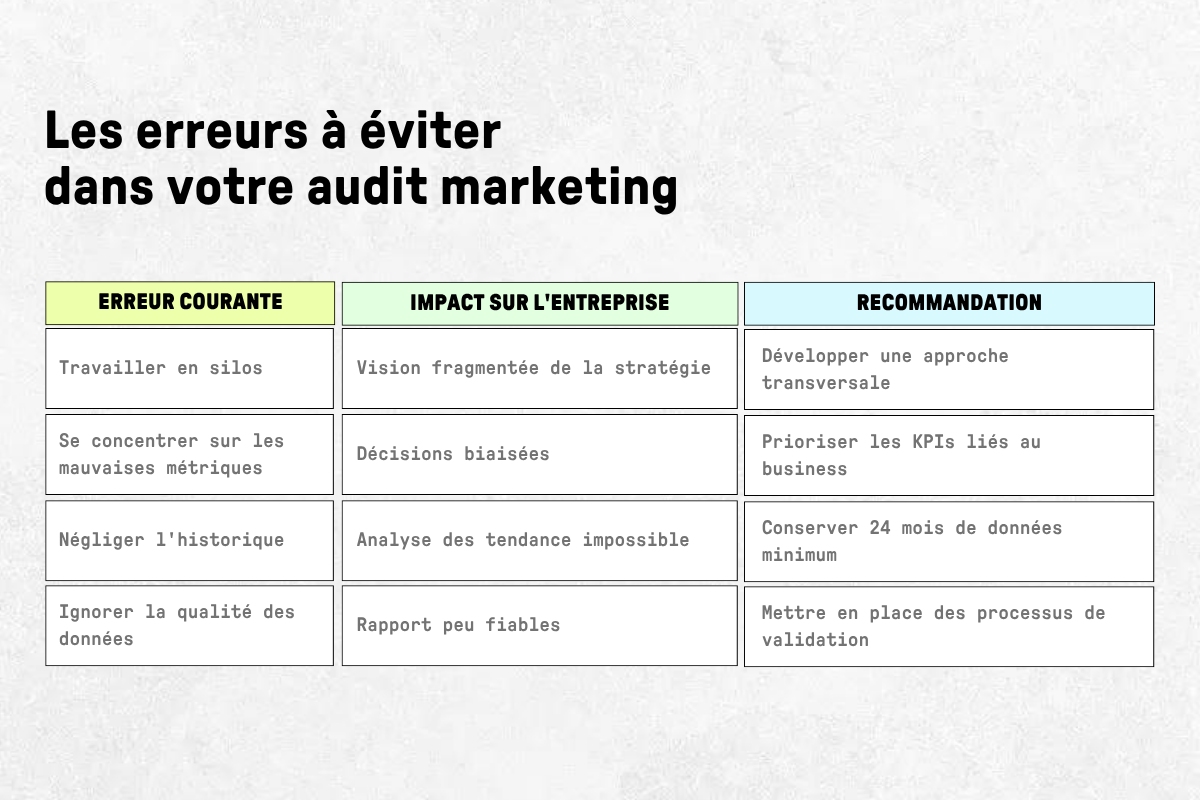
A marketing audit isn't a one-off exercise. To maintain commercial effectiveness, it needs to be a recurring practice. High-performing companies run a full audit every 6 months and partial audits each quarter.
A rigorous marketing audit lets you:
The audit frequently surfaces organisational improvement opportunities:
Every analysis should lead to testable hypotheses. Building an A/B testing culture allows you to continuously improve performance.
Understanding how your different channels work together is essential for optimising your marketing budget.
Use tools like Zapier to connect your different platforms and automate repetitive tasks.
Define clear KPIs and measure performance regularly to quickly identify what's working and what isn't.
An audit without implementation is just a document. With the 10 tools in this guide, you have a solid foundation for collecting, understanding, and — above all — acting on your marketing data.
The marketing audit is a non-negotiable process for any company that wants to improve commercial performance and build durable growth. With the right analysis tools and a systematic approach, you can identify improvement opportunities and put effective actions in place.
Book your free "Audit & Impact" diagnostic with a Bulldozer Collective consultant.
Because in 2026, only the companies that move from analysis to action will compound their growth.

Lorem ipsum dolor sit amet, consectetur adipiscing elit. Duis quis iaculis est. Nulla ac ligula feugiat, cursus turpis volutpat, ultricies eros.
Can't find what you're looking for ? Contact us here
jordan@bulldozer-collective.comGet access to playbooks and feedback from those who are shaping the next wave of marketing and AI.


Lorem ipsum dolor sit amet, consectetur adipiscing elit. Suspendisse varius enim in eros elementum tristique. Duis cursus, mi quis viverra ornare, eros dolor interdum nulla, ut commodo diam libero vitae erat. Aenean faucibus nibh et justo cursus id rutrum lorem imperdiet. Nunc ut sem vitae risus tristique posuere.