

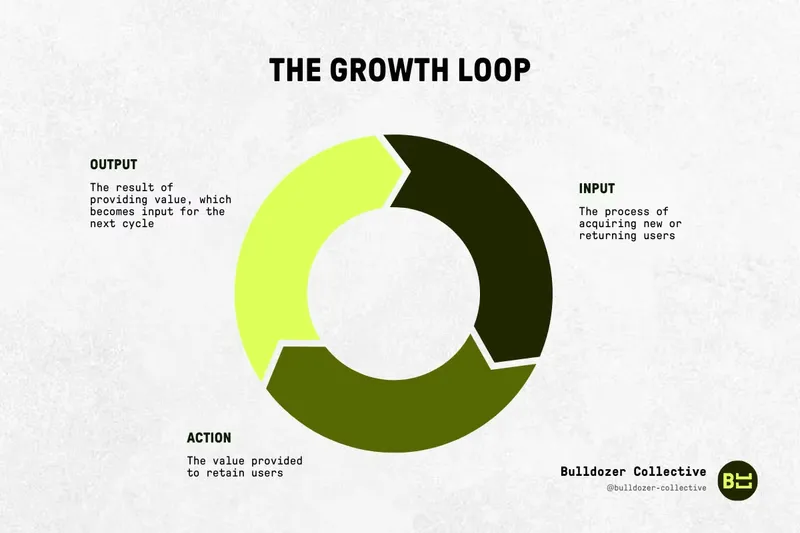
A growth loop is a system where every user fuels the arrival of the next one. The AARRR funnel loses momentum the moment you stop pouring budget into it. A growth loop gets stronger with every use. The difference between pushing a rock up a slope and rolling a snowball.
Instagram, Airbnb, PayPal, Linear, Clay, Lovable: very different products, 7 different loop models, one shared outcome. This guide gives you all 7 models, each with its trigger, a 2025-2026 example, the key metric, and the rule for choosing.
A growth loop is a growth model in which the output of one cycle becomes the input of the next. A user produces value — content, an invitation, revenue, data — that brings in a new user, who produces value in turn. Growth is self-sustaining, non-linear, and the marginal cost drops as the loop spins.
The concept was popularized by Brian Balfour in Growth Loops are the New Funnels. It replaces the AARRR funnel (Acquisition → Activation → Retention → Referral → Revenue) as a reference frame. The funnel describes a one-way journey where every step leaks users: once the top is empty, you start over. In a growth loop, every output feeds the input.
Every growth loop is built on three pieces:
From a growth hacking standpoint, the distinction is simple: funnel tactics optimize one step at a time. A growth loop optimizes a full cycle — and that cycle repeats without marginal effort.
Seven models cover almost every B2B and B2C case. Each sub-section below gives the definition, the loop in one line, a recent example, the key metric, and the rule for activation.
Quick comparison:
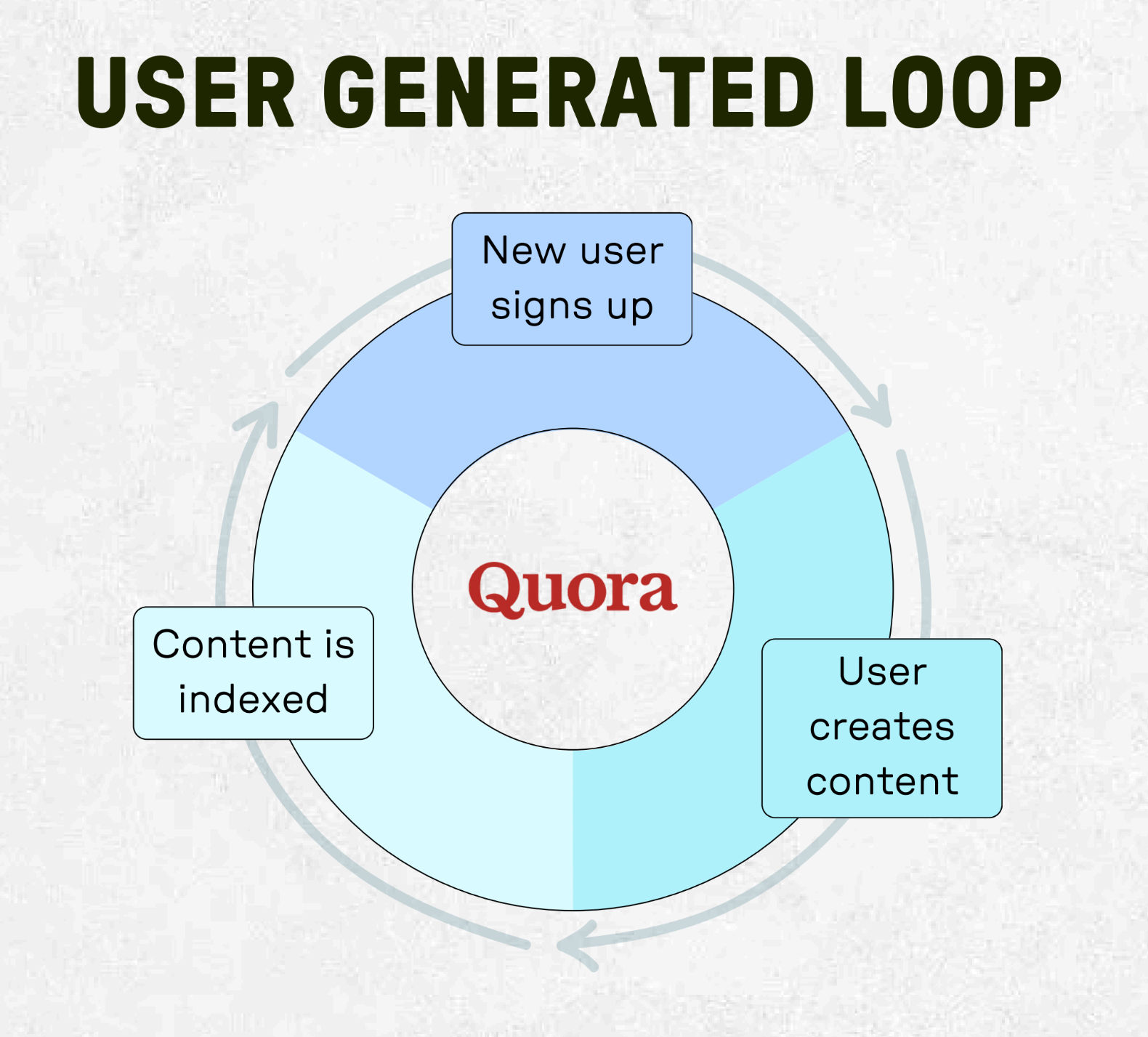
Definition: users produce the content that pulls in other users, who in turn produce content.
How it loops: a user publishes → the content gets seen through search, sharing, or discovery algorithms → new signups → new content. The larger the stock, the stronger the pull.
2024-2026 example: Reddit draws most of its traffic from content created by its members and moderators. The sheer volume of UGC let the platform sign a ~$60M/year deal with Google in 2024 to train its AI models — evidence that a stock of user-generated content is worth more than a classic editorial library.
Key metric: content pieces published per active user; share of organic traffic coming from UGC.
Activate it for: social networks, UGC platforms, forums, communities (Instagram, TikTok, Reddit, Quora, Stack Overflow).
Avoid if: niche product without social interactions (AutoCAD), or highly specialized B2B where user-generated content is nonexistent (SAP ERP, Tableau Server).
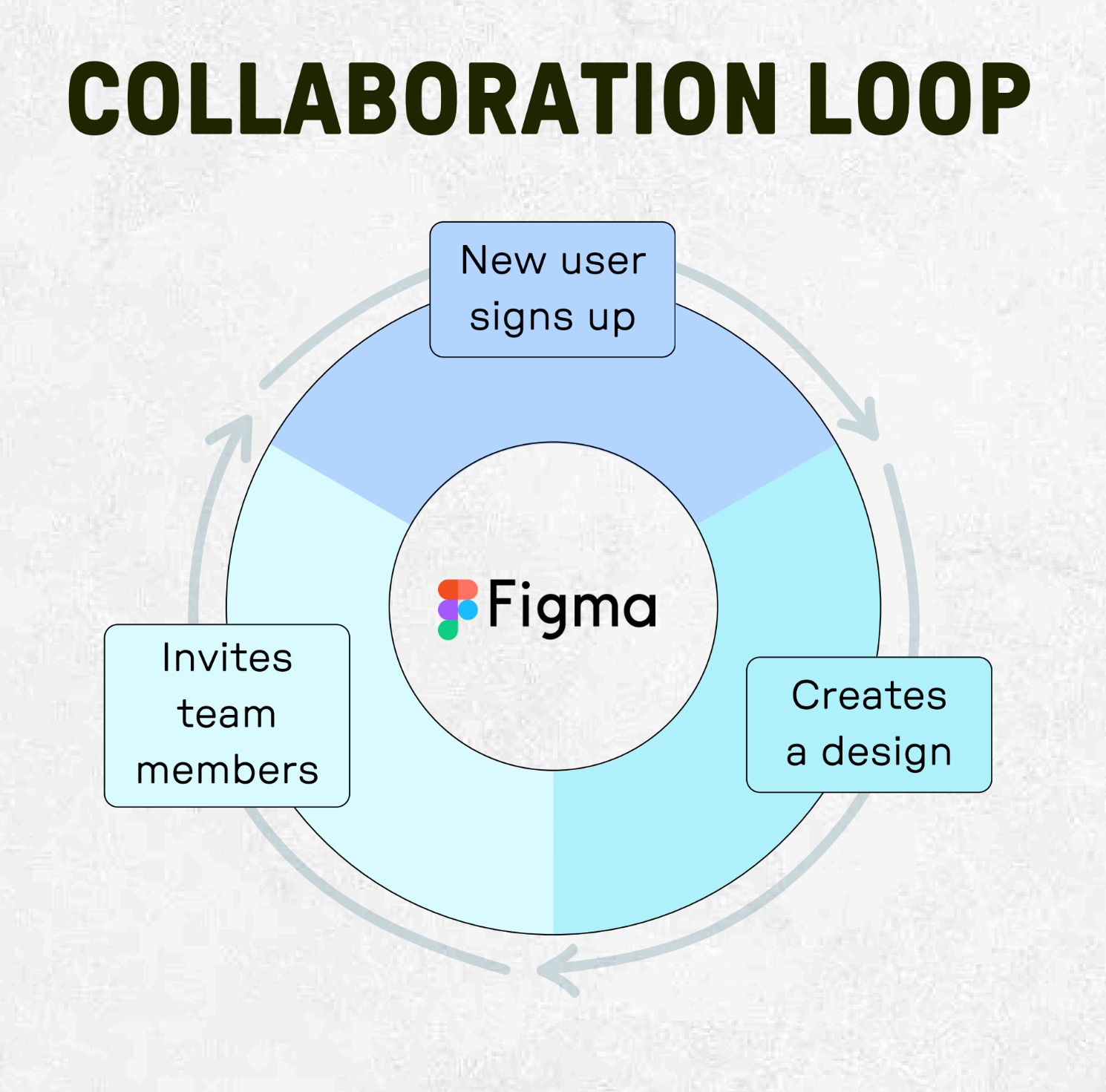
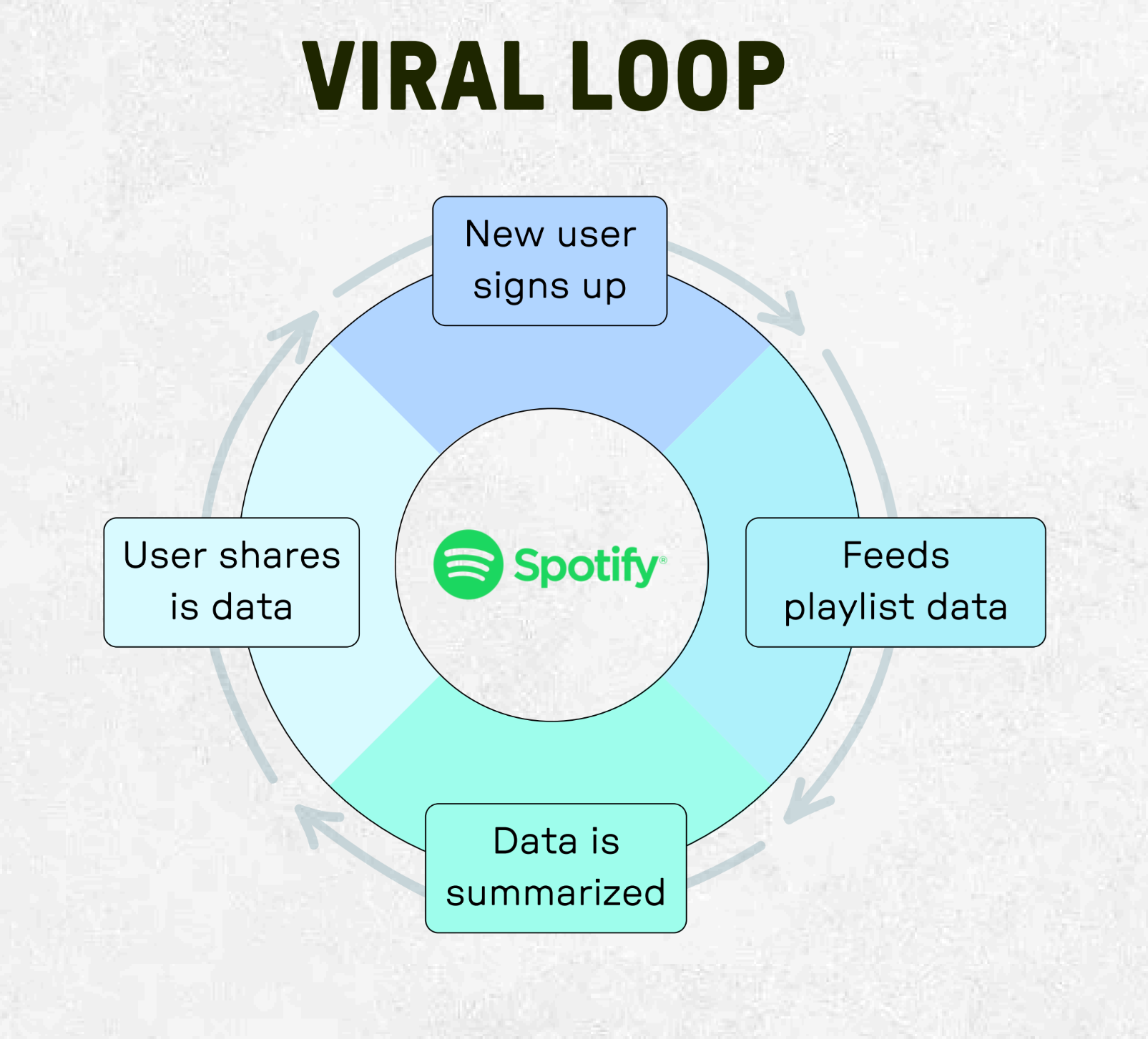
Definition: product usage naturally exposes new users to the product. Growth comes from built-in sharing, not advertising.
How it loops: a user uses the product → they share their output (public link, built-in invitation) → a new user discovers the product and repeats.
2025 example: Lovable hit $100M ARR in 8 months in 2025 — one of the fastest SaaS trajectories on record. Trigger: every app a user generates ships with a shareable link. Every link exposes the product to a prospect who vibe-codes in turn. No sales team, no massive paid spend: the viral loop alone carries growth up to the paid product.
Key metric: K-factor (average number of accepted invitations per active user); loop cycle time.
Activate it for: messaging and social apps (WhatsApp), collaboration tools with a public output (Lovable, Figma, Perplexity), freemium games (Candy Crush).
Avoid if: complex B2B product with no publicly shareable output (Oracle Cloud, Salesforce Marketing Cloud), short-lifecycle product with no ongoing engagement.
[rta-block=folder-cta][rta-title=h3]Want to find out more about your growth potential?[rta-title=h3][rta-btn=regular href="/prendre-rendez-vous-typeform" target=_blank]Get a free audit[rta-btn=regular][rta-block=folder-cta]
Definition: a reward — financial or product-based — pushes every active user to bring in a new signup.
How it loops: active user → reward triggered by referral → new signup → who becomes a referrer in turn. The reward only kicks in when the referred user completes a key action (confirmed signup, first payment).
2025 example: Revolut passed 60 million customers by end of 2025, a significant share recruited through its referral program (10 to 50 € mutual bonus depending on the market). CAC through referral stays under €15 in most countries, versus €30 to €80 through paid. The benchmark reference still holds: Dropbox's referral program, which took the company from 100,000 to 4 million users in 15 months.
Key metric: referral rate (% of customers who refer at least once), referral CAC vs paid CAC.
Activate it for: freemium SaaS with clear perceived value (Dropbox), fintech and banks (Revolut, Robinhood, PayPal), marketplaces with incentivized signup (Airbnb).
Avoid if: product with low perceived value (generic accessories, prepaid cards), product not recommendable one-to-one (professional antivirus, network security).
Definition: revenue generated by a customer funds the acquisition of the next one, with a positive ROI that scales.
How it loops: customer revenue → reinvested into ads (SEA, Meta, LinkedIn) → new customer → new revenue. You scale on cash and data, not virality.
2024-2025 example: Shopify spends roughly 23% of revenue on sales and marketing, with an LTV / CAC above 3 on its merchant segment. Every margin euro gets reinvested into SEA, Meta Ads, and affiliate partnerships. The loop holds because merchant retention is above 80% at 12 months. For high-ticket deals, pair the paid loop with an ABM strategy: targeted outbound takes over where paid hits saturation.
Key metric: LTV / CAC ratio (target > 3), payback period (target < 12 months in B2B SaaS).
Activate it for: e-commerce with margin and recurrence (Shopify, Amazon), subscription SaaS (HubSpot, Salesforce), mobile app monetized via in-app purchases (Clash of Clans).
Avoid if: pre-revenue startup with no stable cash flow, product with low conversion rates where CAC exceeds LTV.
Definition: the product experience pulls users back regularly, which strengthens retention and the value created for the next users.
How it loops: usage → reward (personalized content, progress, well-placed notification) → return → deeper usage.
2026 example: Linear sends a daily and weekly digest of assigned issues to every user. Product DAU / MAU runs above 70% — twice the average for B2B productivity tools. Result: 12-month retention on paid accounts stays above 95%. Duolingo remains the consumer-side reference — daily notification, streak, friend comparison — with a gamification loop that still holds 12 years after launch.
Key metric: DAU / MAU, weekly usage frequency, 30-day cohort retention.
Activate it for: learning (Duolingo, Strava), productivity (Linear, Notion, Trello), streaming (Spotify, Netflix).
Avoid if: occasional-use products (TurboTax, tax filing software), transactional products with no ongoing engagement (Wish).
Definition: usage generates data that improves the product, which attracts more users, which generates more data.
How it loops: usage → data and feedback → product improvement (or, for AI, model improvement) → better usage → more users.
2025 example: Clay ingests the workflows of 5,000+ B2B customers to feed its enrichment AI. Every sequence built refines confidence scores on the data, which improves the product for everyone. Clay reached a $1.5B valuation in 2025 primarily on this lever, not on marketing. Same mechanic at Notion: the most-used templates and patterns bubble up into suggestions, which shortens time-to-value for every new account.
Key metric: 30- and 90-day cohort retention, net revenue retention, actionable data volume per user.
Activate it for: continuously improving SaaS (Figma, Linear, Clay, Asana), collaborative products with user feedback (Notion, GitHub), UX-centric apps (Canva).
Avoid if: product with no direct user feedback (internal HR or payroll systems like Workday or Sage 100), long dev cycle where improvement is invisible to the user (ANSYS, OS releases).
Definition: two sides — supply and demand — feed each other. The more sellers on the platform, the more demand shows up; the more demand, the more sellers.
How it loops: denser supply → better experience on the demand side → more demand → more attractive to new sellers → denser supply.
2024-2025 example: Airbnb crossed 5 million active hosts by end of 2024, for 1.5+ billion cumulative nights booked. Every new listing opens a potential destination; every satisfied guest justifies a new host. Uber applies the same logic on the driver/passenger side, with surge pricing that rebalances the loop in real time during peaks. Universal pain: the chicken-and-egg start forces you to subsidize one side until the tipping point.
Key metric: liquidity (average time to match supply and demand), fill rate.
Activate it for: goods and services marketplaces (Amazon Marketplace, Etsy), matching platforms (Uber, Airbnb), B2B marketplaces (Alibaba, Upwork).
Avoid if: supply is naturally limited (software for orthodontists), or local user density is too low to bootstrap the network effect (BlaBlaCar Daily in rural areas).
The right question isn't "which growth loop is the best." It's: which loop can your product legitimately activate without forcing it? Here's a quick decision grid.
Rule of thumb: one loop active at a time. Stacking loops when none of them actually spins is the number-one mistake we see in growth audits.
Our team has audited several hundred companies since 2019. The same six mistakes keep coming back.
What is a growth loop? A growth system where every user fuels the arrival of the next one. The output of one cycle becomes the input of the next, in a self-sustaining way.
Growth loop vs AARRR funnel: what's the difference? The funnel is linear and leaks users at every step — you constantly refill the top with budget. A growth loop is circular: a user's output brings in a new user, with no marginal effort required.
How many types of growth loops are there? Seven models cover almost every case: content, viral, referral, paid, engagement, product, marketplace.
How do I pick the right growth loop for my business? Three parameters: product type (B2B, DTC, marketplace), natural trigger (shareable output, usage data, revenue), and your phase (pre-revenue or scale). A B2B SaaS with daily usage runs engagement + product. A DTC with margin runs paid.
Does the growth loop replace the AARRR funnel? Yes, if you aim for compounded, scalable growth. No, if you need to describe the activation journey of a single user. The two coexist: the funnel maps one user's path, the loop maps how one user brings in another.
Which growth loop for a B2B SaaS? Engagement loop first, product loop second, referral if perceived value is high. No viral until usage is daily. No paid until 90-day cohort retention is proven.
To frame your growth loop, start with a marketing audit of your current retention and activation signals. It's the only way to arbitrate between the 7 models without wishful thinking.

Writer at Bulldozer, he covers web scraping, UGC and no-code, mixing data, storytelling and SEO.
Can't find what you're looking for ? Contact us here
jordan@bulldozer-collective.comGet access to playbooks and feedback from those who are shaping the next wave of marketing and AI.