

Publié par
Photo d'un membre de l'équipecurve whitecurve white
Charlotte Nowak
Content Manager
Blog
/
SEO
/
Semantic Cocoon: The Key to Boosting Your SEO and Dominating the SERPs

Semantic Cocoon: The Key to Boosting Your SEO and Dominating the SERPs

You've worked on your SEO, published content consistently on your website… but still no clients? What if the problem is the very architecture of your site? The semantic cocoon is the SEO growth technique that structures your site hierarchy so every page targets a primary query and helps search engines understand the value of your offer. Here's how to implement it — no unnecessary jargon, but with a real user experience built for the reader.

Ressource en lien
Dernière mise à jour :
18
/
06
/
2026

How the Semantic Cocoon Works (and Why It's Powerful)

The semantic cocoon isn't just another SEO buzzword. It's an editorial architecture and internal linking method that organizes a website into groups of pages clustered by semantic proximity. In plain terms, it's an SEO technique that aligns your website with search engine logic and visitor expectations.

The goal? Create a coherent overall structure where each page is linked to others, placed in the right thematic group, to strengthen organic search rankings. It improves both semantic optimization (in Google's eyes) and the human experience: a page no longer lives in isolation — it becomes a link in a high-value chain.

The semantic cocoon concept is also an excellent starting point for the full implementation process: keyword research, structuring, internal linking, and performance tracking. Used well, this SEO technique helps your content rank higher in the SERPs on a given topic.

Parent, Child, and Sibling Pages: The Cocoon Structure Explained

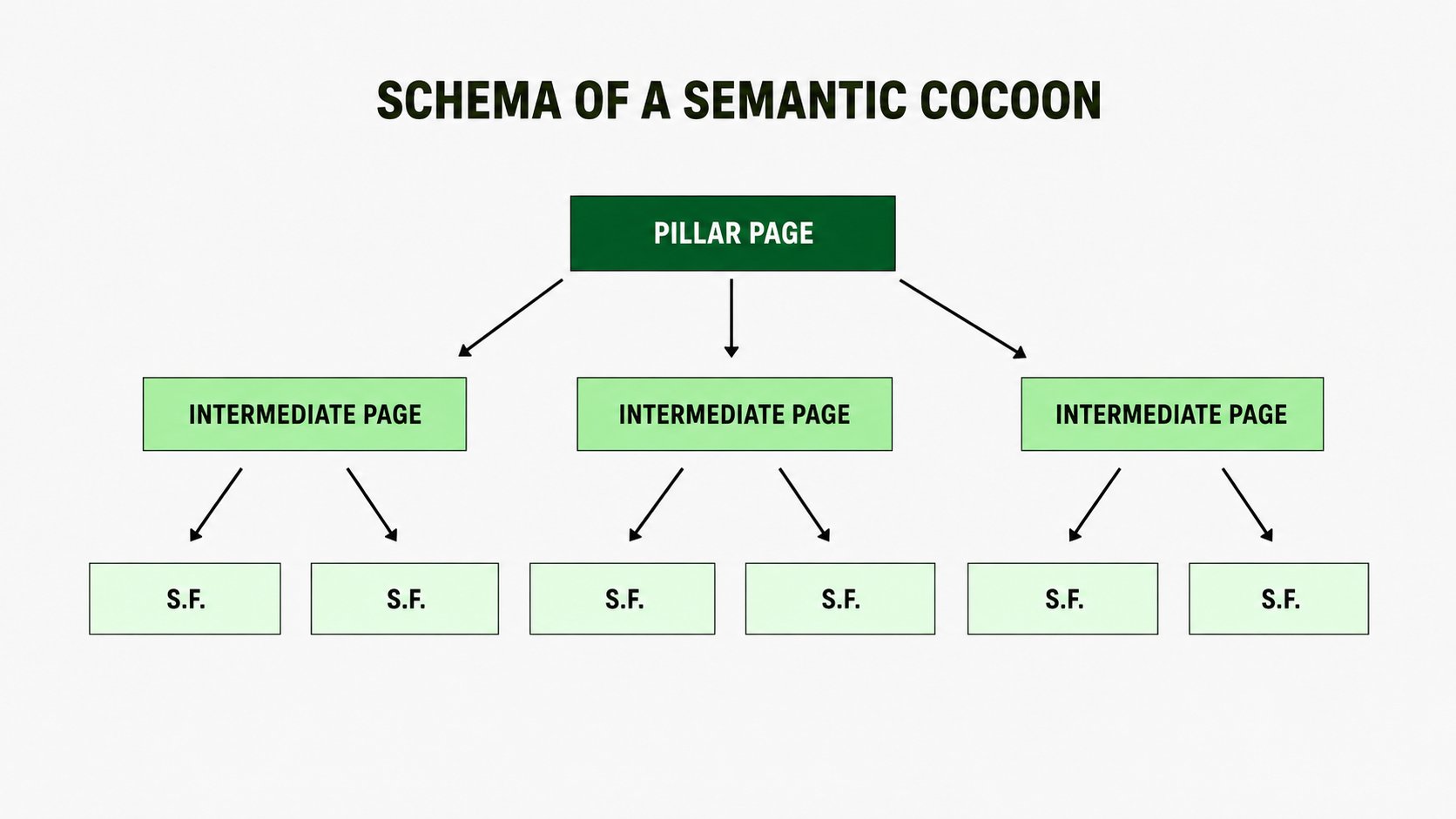
A semantic cocoon relies on a tree structure of hierarchical, interconnected pages. It's a smart way to organize your pages so Google better understands your site, and visitors can navigate it easily.

The structure breaks down as:

  • Parent page: the main page that covers a primary topic (e.g., running shoes).
  • Child pages: sub-pages covering variations or sub-topics (e.g., road running shoes, trail running shoes).
  • Sibling pages: pages at the same depth level, connected to enrich the semantic universe (e.g., fitness shoes).

This structure serves two purposes:

  • Create a cocoon where each page helps the others rank better, avoiding semantic drift.
  • Give users a clear overview: at a glance, they understand how the subject is organized and where they are in the structure.

In practice, many teams map this structure with a mind map: each node represents a parent, child, or sibling page. It's easy to read, easy to explain internally… and very useful when building an effective semantic cocoon.

__wf_reserved_inherit

A French-Born Concept (Still Very Much Relevant)

The semantic cocoon was theorized by Laurent Bourelly, a French SEO expert, as a response to the limitations of classic site architectures and simple thematic siloing. Where a thematic silo groups content into airtight compartments, the semantic cocoon is more flexible: it links pages whenever they share genuine semantic proximity, even if they're in different folders.

The approaches can be summarized as follows:

  • A thematic silo uses a rigid structure: well-separated categories with few links between them. Clean, but you sometimes miss useful connections.
  • A topic cluster starts from a pillar page and adds satellite content, often blog-focused. Good for covering a topic, but can stay surface-level.
  • A semantic cocoon goes further: pages are connected by meaning, with precise, contextual internal linking oriented toward both organic rankings and user experience.

Unlike siloing, the cocoon doesn't prohibit cross-links — it intelligently directs them to avoid semantic drift. Unlike topic clusters, it creates a dense network built for the semantic web, sending clear signals to search engines about the quality and value of your content.

Why the Semantic Cocoon Actually Boosts Your SEO

Google no longer settles for scattered keywords: it wants meaning, connections, and consistency. It wants to see how each page relates to a given topic, fits into your site's overall universe, and what value it delivers to the reader.

  • From an organic search perspective, your pages are better understood, crawled, and indexed. A well-designed cocoon can push your strategic pages higher in the SERPs, especially with quality content (articles, videos, case studies, webinar demos).
  • From a user experience perspective, navigation is fluid, logical, and structured: visitors feel everything is in its right place, reinforcing brand authority over time.
  • From a business perspective, each page becomes an entry point toward a high-value offer, with well-placed CTAs and internal linking designed as a genuine conversion driver.

In short, an effective semantic cocoon blends semantic optimization, clear structure, and useful content — a combination that appeals to both search engines and humans.

Building a Semantic Cocoon from Scratch (Without Getting Lost)

You don't need to be an AI engineer to build a solid semantic cocoon. But you do need method, rigor, and a lot of common sense. Here's how in 3 steps:

1. Finding the Right Keywords and Search Intent

Before writing a single line, understand what your future visitors are looking for. Cocoon success depends on precise search intent mapping.

Best practices:

  • List long-tail keywords: more specific, less competitive, often higher-converting. Example: instead of "shoes," go for "women's overpronation running shoes."
  • Explore related semantic fields: synonyms, frequently asked questions, related entities.
  • Useful tools: YourText.Guru, SEOQuantum, Answer the Public.
  • Segment by intent:
    • Informational → "what is a semantic cocoon"
    • Navigational → "semantic cocoon tool"
    • Transactional → "create semantic cocoon wordpress", "seo cocoon agency"

The goal: cover all intents around a given topic to become the go-to reference.

2. Mindmapping, Silos, and Internal Linking: Bring Order to Your Site

Once your topics and sub-topics are identified, map them out. Create a clear hierarchy understandable by Google and intuitive for humans.

Standard structure:

Parent page: /running-shoes/
├── Child page: /mens-running-shoes/
│ └── Sibling page: /mens-overpronation-running-shoes/
├── Child page: /womens-running-shoes/
└── Child page: /kids-running-shoes/

Tips:
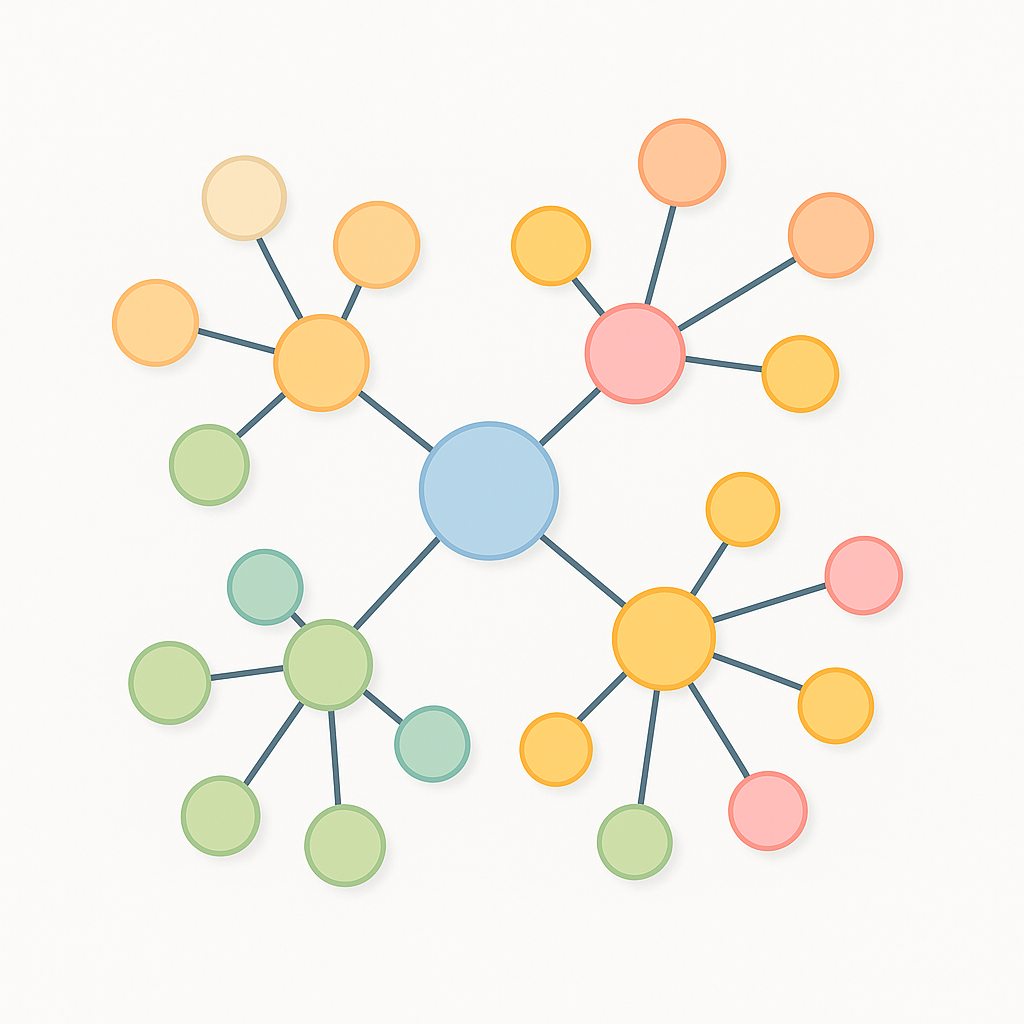
  • Use a mindmapping tool (Xmind, MindMeister) to visualize your architecture.
  • Don't duplicate keywords across competing pages.
  • Think in terms of a living architecture: every new piece of content should integrate naturally into the cocoon.
__wf_reserved_inherit

3. The Right Content Distribution for SEO Performance

This is where the cocoon comes to life.

  • Parent page (or pillar): the central, rich, structured page. It introduces the broad topic, guides navigation, and captures generic queries.
  • Child pages: they dig into a specific aspect of the topic with targeted, useful, well-optimized content.
  • Sibling pages: they reinforce the cocoon's authority through cross-linking, without cannibalizing other pages.

Key rules:

  • Each child page must justify its SEO existence (traffic potential, complementarity).
  • The parent page must link to its children without overwhelming them: not 50 links, but a useful selection.
  • Child pages must link back to their parent to reinforce central authority.

4. Internal Linking Best Practices

Internal linking is the nerve of the cocoon. Done poorly, it can break everything. Done well, it's a turbo boost for your SEO.

Do this:

  • Use optimized, natural anchor textBad: click here | Good: learn more about overpronation running shoes
  • Build contextual links: links should extend the reading experience, not redirect it.
  • Ensure no page is orphaned: every page must be reachable through at least one internal link.
  • Limit off-cocoon links: unless truly relevant (blog, partner, external tool).
  • Check for broken links: run regular crawls with Screaming Frog or Ahrefs.

Want to find out more about your SEO potential? 

Demander un audit gratuit
Carte ou profil utilisateur central mis en évidence, entouré d’autres profils en arrière-plan, suggérant une sélection ou une mise en avant d’un utilisateur.
bulldozer

3 Concrete Semantic Cocoon Examples for Your Business

SEO Blog or Niche Media: Capturing Qualified Long-Term Traffic

Imagine a blog specializing in SEO or digital marketing. The goal: generate steady, qualified traffic by becoming an authority on a specific lexical field.

Example cocoon structure:

Parent page: /seo-semantic-cocoon/
├── /seo-internal-linking/
├── /seo-crawl-budget/
├── /seo-silo-vs-cocoon-structure/
└── /seo-netlinking-vs-internal-links/

Why it works:

  • Each page targets a different sub-intent while pointing back to the central topic.
  • The cocoon captures ultra-targeted searches (e.g., "difference between cocoon and silo", "SEO crawl budget") and converts them into leads via downloadable resources or forms.

E-commerce: Turning SEO Into Real Sales

Here the cocoon becomes a product structuring tool — especially useful with large catalogs. It improves navigation, boosts long-tail rankings, and guides visitors toward purchase.

Example for a running store:

Parent page: /running-shoes/
├── /nike-running-shoes/
│ ├── /nike-overpronation-running-shoes/
│ └── /nike-competition-running-shoes/
├── /asics-running-shoes/
├── /running-shoes-by-foot-type/

Results:

  • Improved conversion rate through clear user orientation.
  • Higher organic traffic on specific searches ("best overpronation running shoes").
  • Lower bounce rate through logical, segmented navigation.

SaaS / B2B: Generating Ultra-Qualified Leads

Here the cocoon becomes an acquisition and education engine. It answers prospect questions throughout the conversion funnel, aligning with the marketing funnel structure.

Example around growth marketing:

Parent page: /growth-marketing-strategy/
├── /aaarrr-growth-funnel/
│ ├── /growth-hacks-activation/
│ └── /saas-user-retention/
├── /data-and-growth/
├── /growth-and-revenue-operations/

Specific advantages:

  • Alignment with the B2B buying journey (awareness > consideration > decision).
  • Creation of nurturing loops through linked content.
  • Natural insertion of contextual CTAs: demo request, audit, download.

The Best Tools for Building Your Cocoon

Finding the Right Keywords: Our Favorite Tools

Before building your semantic cocoon, the first step is thorough keyword research and semantic analysis of your website. The goal: understand which primary query and semantic universe to compete in, so you can build a cocoon that delivers real value to readers and organic rankings.

  • YourText.Guru: a genuine semantic analysis tool. Identifies expressions related to a primary query, co-occurrences, and terms Google associates with a topic. Perfect for producing quality content that precisely meets what search engines expect.
  • SEOQuantum: focused on global semantic analysis of a given topic. Shows how your content compares to competitors and which areas of your semantic universe remain uncovered.
  • Semji: built for marketing teams wanting a broader view. Offers an editorial plan, quality scores, and page-level optimization recommendations.
  • 1.fr: practical for checking whether a page covers its topic correctly. In seconds, see if your text answers the primary query or if key notions are missing.
  • Answer The Public: ideal for understanding real questions people ask online. A goldmine of ideas for child pages, FAQs, video scripts, and webinar content.

Structuring and Linking Tools: Give Shape to Your Cocoon

Once keywords are validated, move to the visual part: building the site architecture. The goal is to visualize the structure and see how each page connects to others.

  • Cocon.se: built specifically for Laurent Bourelly's method. Helps generate an effective semantic cocoon, organize page groups, and propose coherent internal linking.
  • MindMeister or Xmind: perfect for creating a clear mind map. Each bubble represents a parent, child, or sibling page — excellent working material for teams and SEO agencies.
  • Plezi: connects content structuring with marketing automation. Links each page to a stage of the user journey, then automates email nurturing and lead-generation scenarios.

⚠️ Note: even if you use a CMS like WordPress, these tools remain relevant for preparing the groundwork before integration.

Mistakes to Avoid (Your SEO Will Thank You)

Too Many Links, Not Enough Meaning

A cocoon relies on the semantic coherence of internal links. Too many links to unrelated pages weaken the structure.

❌ Link to an unrelated e-commerce category | ❌ Generic "read also" link with no thematic connection | ❌ Internal links added for purely technical reasons

Consequences: dilution of thematic authority, weak signal to Google on relevance, loss of readability for users.

Right reflex: limit yourself to contextual links with a genuine semantic connection. If you can't justify a link with a natural sentence, it doesn't belong there.

Orphan Pages = Lost Traffic: Think in Terms of Journeys

A page with no inbound links is an invisible page. Neither users nor Google can easily find it.

Two common causes: (1) page published in a rush, without integration into the existing cocoon; (2) content created without considering its target search intent.

Before publishing, verify that each page is linked to a parent or sibling page and always write with an explicit user intent in mind.

Choosing the Right Pillar Page (Not Too Broad, Not Too Niche)

The parent page is the pillar of the cocoon. Too broad = a catch-all page, poorly positioned. Too narrow = blocked sub-topic expansion.

What to aim for: a page that's generic but targeted (e.g., local SEO strategy), that naturally opens to sub-topics, and can serve as a traffic entry point.

Confusing Cocoon, Siloing, and Topic Clusters

In short: siloing = compartmentalize (clean but rigid), topic cluster = radiate around one pillar page (good authority-building), semantic cocoon = weave a coherent web connected by meaning that serves both SEO and business.

__wf_reserved_inherit

At Bulldozer, We Structure to Sell, Not Just to Rank

Every page, every link, every piece of content must serve a clear business objective. That's where the semantic cocoon becomes far more than an editorial architecture: it becomes a genuine conversion funnel.

Cocoon + Funnel = Growth

An effective cocoon is a smooth journey: attract, inform, then push toward action.

  1. Discovery → useful content (child page)
  2. Consideration → concrete solution (parent or sibling page)
  3. Decision → call to action (landing page, form…)

Along the way: well-placed CTAs, smart pop-ups based on visitor behavior, and lead scoring to identify who's ready to convert.

Cocoon + Automations + Retargeting

Great content attracts. A great system re-engages, nurtures, and converts automatically.

Our approach: connect the cocoon to automation scenarios based on pages viewed, time spent, or topics browsed.

  • A reader explores multiple B2B growth pages → receives a guide + targeted email sequence
  • A prospect leaves without converting → reached again with calibrated retargeting
  • A content download → sales team notified, lead added to the CRM

Measurement, Analysis, and Tracking in a Unified Dashboard

We connect your cocoons to analytics tools, behavioral analysis, and your CRM to see what's performing and what's blocking.

Tools we systematically integrate: GA4 (traffic, events, conversions), Hotjar / Clarity (scroll, clicks, user journeys), CRM (HubSpot, Notion, Salesforce — leads, opportunities, content revenue), Looker / Data Studio (cross-referencing SEO data and business results).

The goal: not just "it drives traffic," but proving that your semantic cocoon actually impacts business.

Need a hand? We'll walk you through it from strategy to implementation.

FAQ

A semantic cocoon is a way of organizing a website into groups of pages connected to one another by strong semantic proximity. You start from a main page, often a strategic page on a main theme, then build your site's architecture with a main page at the top, sub-pages and supporting content organized like a thematic silo but finer and more focused on user experience. This structure aims to answer a main query and the whole semantic universe around it, in order to help each search engine, and more broadly all search engines, better understand the added value of your offering or product in a given field. The semantic approach is a technique that lets you create a coherent overall structure, where each page is connected to another and placed in a logical group that is easy to crawl, index and push to the top of the SERPs.

In a semantic cocoon in SEO, you work much more on semantic optimization and on the visitor's overall experience. An SEO silo or thematic silo organizes a website into closed folders, whereas an effective semantic cocoon embraces cross-links between pages connected by meaning, what is sometimes called semantic siloing. This avoids semantic drift: each page stays connected to a given theme while still allowing smooth navigation. In terms of organic search ranking, this semantic-web approach sends strong signals to search engines and improves the indexing of high-value pages.

The steps to create a semantic cocoon always begin with a first phase of keyword research and semantic analysis. You identify the main keyword, the main theme, the secondary queries and related topics using an analysis tool, SEO software or a solution like Yooda Insight. This starting point lets you visualize the semantic universe with a mind map: each bubble represents a strategic page or a future main page, connected to the others by semantic proximity. Next comes the building stage: you create a site architecture organized into content clusters, you decide where to place a semantic cocoon relative to the other silos, and you add pages that bring quality content and high value to the visitor. Finally, you check the title tags, the Hn headings, the metas, the internal linking and, if needed, you use a dedicated plugin to successfully implement the SEO technique on the website.

An effective semantic cocoon acts as an essential SEO technique for your organic search ranking: it structures information in an organized way, improves indexing and strengthens your website's overall popularity. By grouping your pages by given theme, you clearly show search engines which query each page is meant to answer. The result: more chances of appearing at the top of the SERPs, especially if the quality content is supplemented with video, a webinar, a case study or even a software demo. Combined with clean link building, the cocoon becomes real added value for an SEO agency or an in-house marketing team.

The main page must cover the main theme without becoming a simple catch-all page. It should present the offering or product clearly, with a good framing of the visitor's problem and the benefits for them. Each linked page must stay within the same semantic universe: if you're talking about a specific topic, you avoid adding content that has no semantic proximity. This is essential to avoid semantic drift and keep an organized structure. For example, you can create a sample semantic cocoon for a given theme, then use it as a template for the rest of your site's architecture.

To succeed with a semantic cocoon in SEO, you can combine several tools. An analysis tool like Yooda Insight helps with keyword research and semantic analysis. Mind-mapping software makes it easier to visualize the structure, and WordPress plugins handle internal linking or the management of title tags. Some tools are free or have a limited free version, others are paid, but the advantage is saving time on building and on semantic optimization. You can also work with an SEO agency that masters the notion of the semantic cocoon and knows the market's leading tools well.

A semantic cocoon does not only serve search engines: it directly improves the visitor's experience and the user experience. By structuring navigation around a main theme, with a strategic page as the starting point and pages connected by strong semantic proximity, you offer a smooth journey where every click makes sense. The visitor quickly finds quality content that answers their main query, then discovers other high-value content connected to the same given theme. This organized experience builds trust, increases time spent on the website and, ultimately, helps your business account convert better.

No, it is possible to set up a semantic cocoon yourself, especially if you have a good grasp of the definition of a semantic cocoon and the steps to create one. That said, an SEO agency familiar with this kind of SEO technique, sometimes directly inspired by Laurent Bourrelly, will be better at prioritizing high-value pages, spotting strategic pages, avoiding thematic siloing mistakes and optimizing tags. It can also recommend which pages deserve a specific plugin, where building an SEO silo is sufficient, and where a semantic cocoon in SEO will provide a decisive advantage. In many cases, calling on an agency speeds up indexing, improves popularity and ensures that the semantic approach is a technique genuinely aligned with your business goals online.

Pour aller plus loin

seo-b2b-strategies

B2B SEO in 2026: The Strategies That Still Work

B2B
SEO
Charlotte Nowak
Top agences SEO à Marseille

Top SEO Agencies in Marseille for 2026

SEO
Charlotte Nowak
meilleures agences SEO à Lyon

Top 5 Best SEO Agencies in Lyon for 2026: Our Comparison

SEO
Charlotte Nowak

Let's talk.

Full-funnel
500+ clients
300+ membres
Prendre un rdv stratégique