
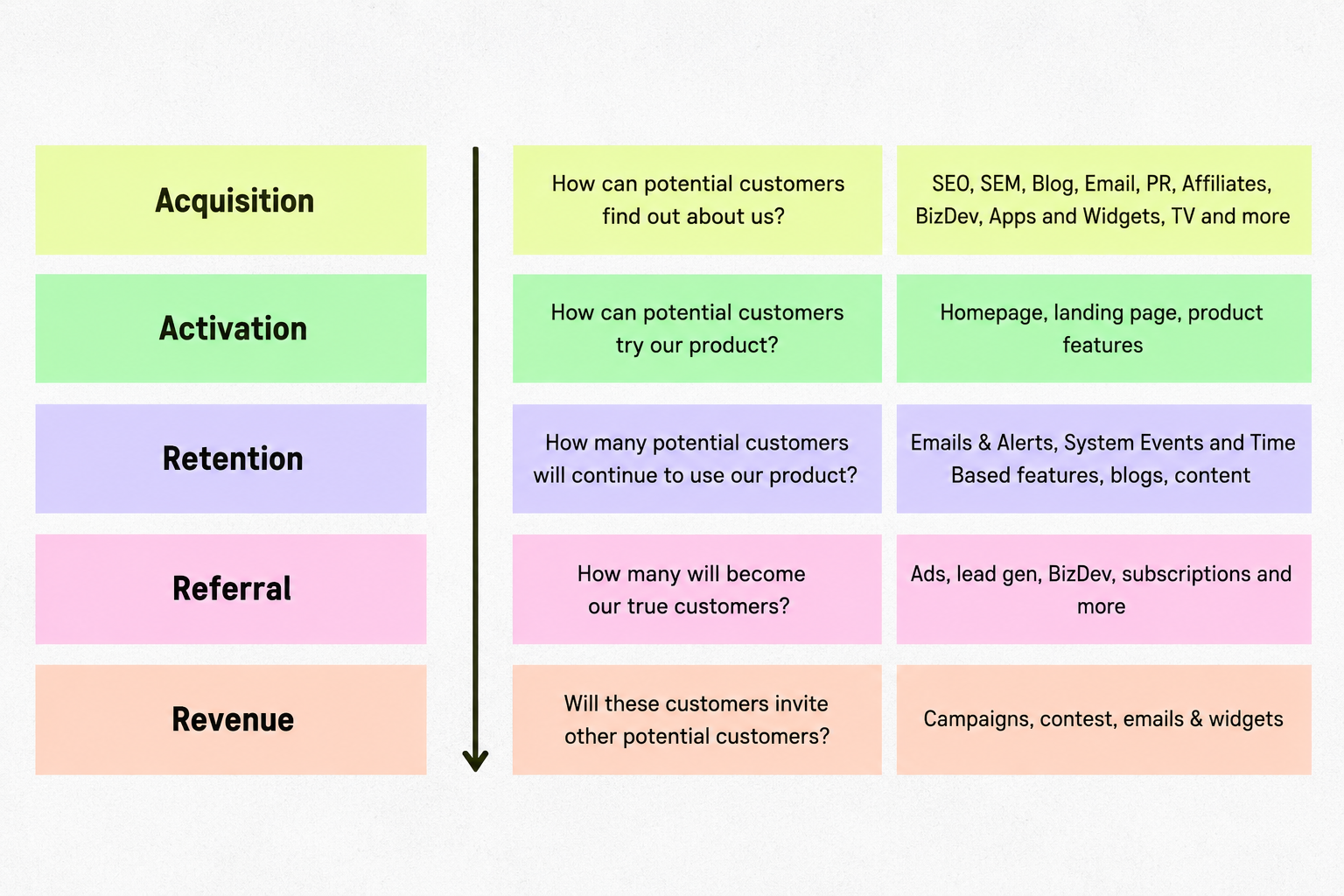
The AARRR framework — also known as the AARRR model or Pirate Metrics — is the growth management system invented by Dave McClure in 2007. Its name comes from the initials of its 5 stages: Acquisition, Activation, Retention, Referral, Revenue.
AARRR metrics allow any growth team to precisely diagnose where friction exists in their conversion funnel — and act on the right lever rather than optimising blindly.
In B2B, the model applies with some adaptations: sales cycles are longer, Referral takes the form of customer references or partnerships, and Retention often carries more weight than Acquisition in the overall customer economics.
The AARRR model is essentially the north star for startups and growth hacking. It helps you identify where your funnel is leaking and how to optimise each stage to attract, convert, and retain users. In this article, we cover how to apply it with concrete, actionable examples.
The AARRR model, also known as the AARRR funnel, AARRR framework, or AARRR marketing model, is a structured method for analysing each stage of the customer lifecycle. Developed in 2007 by Dave McClure, investor and founder of 500 Startups, the model helps businesses steer their growth strategy using clear, actionable indicators.
The AARRR framework breaks the conversion funnel into five key stages, also called pirate metrics:
This marketing funnel applies equally to startups, SaaS products, e-commerce sites, mobile apps, and marketplaces. It aligns with growth hacking logic and KPI-driven management, relying on tools like dashboards, CRMs, and performance indicators.
The primary objective of the AARRR methodology is to provide a holistic view of user behaviour, identifying friction points and growth opportunities at each stage of the funnel.
Unlike a purely linear model, this framework encourages continuous data analysis to adapt strategy in real time and improve performance.
Why use the AARRR model in your marketing strategy?
✅ Optimise user experience: refine onboarding, navigation, and key interactions.
✅ Improve marketing KPIs: track the right indicators at each funnel stage.
✅ Reduce churn and increase customer lifetime value (CLV): boost retention and profitability.
✅ Align marketing, product, and sales: unify teams around a shared performance dashboard.
✅ Support your business model: identify the right growth levers to maximise ROI.
The AARRR model is now a cornerstone of digital marketing. It gives businesses a clear, measurable way to structure their strategy around the customer journey.
It's particularly useful for:
🚀 Startups: rapidly test a business model and identify the most effective acquisition channels.
🛒 E-commerce: refine the conversion funnel and optimise the value proposition.
📱 Mobile apps: improve onboarding and engagement through automated user tracking.
💻 SaaS: reduce churn, improve customer retention, and grow lifetime value.
🎯 B2B companies: better understand their personas, automate follow-ups, and build a data-driven marketing strategy.
👉 By applying the AARRR model to your digital marketing strategy, you move from gut feel to data-driven management. That's the difference between reactive growth and controlled growth.
Each stage of the customer lifecycle corresponds to a strategic objective, supported by specific AARRR KPIs grouped in a marketing dashboard. That's what makes it such a powerful funnel optimisation tool.
Acquisition is the entry point of the marketing funnel. It encompasses all the levers for driving users to your site, app, or tool.
Objective: generate qualified traffic at the lowest possible customer acquisition cost (CAC).
Example acquisition strategies:
KPIs to track in your dashboard:
💡 Tip: rather than spreading across every channel, focus on those generating the best conversion rates and a qualified audience.
Activation is the moment when the user takes a meaningful action: sign-up, add to cart, account creation, etc.
Objective: help users quickly grasp the value proposition of your product.
Examples of activating actions:
Performance indicators (KPIs):
💡 Growth hack: improve activation by reducing the time it takes to reach the "aha moment" — the moment users truly understand the value of your service.
Retention is the ability to maintain engagement over time. A strong retention rate signals that your value proposition addresses a recurring need.
Objective: prevent churn and grow lifetime value (LTV).
Retention strategies to test:
AARRR KPIs to monitor:
💡 Best practice: use a CRM or marketing automation tool to segment your user base and trigger the right messages at the right time.
Referral transforms satisfied users into brand advocates. It's a powerful organic growth engine.
Objective: reduce overall CAC and amplify virality.
Examples of viral activation:
Key KPIs:
💡 Key takeaway: people share what makes them look good or what genuinely helps them. Make your product do both.
The final stage of the AARRR framework, monetisation consists of converting active usage into revenue, directly or indirectly.
Objective: maximise average revenue per user (ARPU) and lifetime value (LTV).
Revenue strategy examples:
KPIs to add to your marketing dashboard:
💡 Key insight: strong retention is often the most cost-effective strategy for generating more revenue.
The AARRR model should not be treated as a simple sequential checklist. It's a strategic management tool for identifying the most profitable growth levers and concentrating effort where it will have the greatest impact.
The goal isn't to optimise every stage simultaneously, but to spot the bottlenecks in your conversion funnel. Careful data analysis reveals the critical stage that's holding back overall performance — and that's where you focus first.
Every company, product, and target audience has its own dynamics. That's why the AARRR framework should be treated as a modular, adaptive system, adjusted based on:
Often, a single underperforming stage is enough to drag down the entire funnel. For example:
The AARRR model can be applied across sectors and business types. Here are some concrete application examples by domain.
Startups & Growth Hacking
The primary objective is to accelerate growth and identify blockers. Key strategies include testing multiple acquisition channels to find the most effective, optimising onboarding for fast activation, and integrating virality mechanisms to maximise referral. KPIs to track: CAC, activation rate, and retention rate.
E-commerce
The goal is to optimise the purchase funnel and loyalty. Recommended approaches: improve UX with detailed product pages, implement abandoned cart re-engagement, and build a loyalty programme to drive repeat purchases. Relevant KPIs: conversion rate, average order value, and number of repeat orders.
SaaS (Software as a Service)
The main goal is to maximise subscriber acquisition and retention. Strategies include implementing a free trial with effective onboarding, sending personalised emails and notifications to encourage usage, and adapting pricing plans to user needs. KPIs to track: activation rate, churn rate, and LTV.
Mobile apps
The goal is to improve engagement and monetisation. Recommended strategies: optimise UI/UX for a smooth experience, use intelligent push notifications based on user activity, and test different monetisation models (freemium, in-app purchases, ads). KPIs to monitor: 7-day and 30-day retention, sessions per user, and conversion rate to paid.
💡 Key advice: whatever the industry, the AARRR model must be driven by precise data to optimise performance at each funnel stage.
To fully leverage the AARRR framework, adopt a structured, data-centric approach with flexibility in execution. This model isn't a magic formula — it's a continuous optimisation framework for the user lifecycle.
💡 The AARRR model is above all an iterative process. More than a method, it's a continuous learning mindset. The goal isn't to get everything right immediately, but to test, measure, learn, and adjust until you've built a high-performing, sustainable marketing funnel.
[rta-block=folder-cta][rta-title=h3]Want to learn more about your growth potential?[rta-title=h3][rta-btn=regular href="/prendre-rendez-vous-typeform" target=_blank]Get a free audit[rta-btn=regular][rta-block=folder-cta]
In recent years, a recurring question has emerged in discussions around the AARRR model: should a sixth stage be added before Acquisition, called Awareness?
The idea is simple: before attracting users to a site or app, they need to know the product or service exists. This phase precedes Acquisition and aims to build visibility with a target audience.
In a saturated market, being visible isn't enough — you need to exist in consumers' minds before they take action. That's where Awareness comes in, defined as:
Common Awareness strategies include:
Brand identity and branding strategy: build a strong, distinctive image that leaves a lasting impression. This often goes hand in hand with PR and influencer relations, which build credibility and visibility through trusted opinion leaders.
Brand awareness advertising — via display, YouTube, TV, or out-of-home — aims to quickly capture a broad audience's attention. In parallel, SEO content leverages articles, videos, and guides to rank on Google before users are actively seeking a solution.
Social media and community building allow you to grow an engaged community that naturally amplifies the brand. Finally, strategic partnerships offer the chance to leverage other companies' or events' visibility to strengthen your own presence.
Concrete example: an innovative sneaker brand doesn't just build a website and run Facebook ads. It invests first in branding and inspiring content on TikTok and Instagram to build anticipation before acquisition even begins.
Some growth marketing experts consider Awareness already embedded in the Acquisition phase, since becoming visible is part of acquisition itself. Others argue these two concepts are clearly distinct:
In Awareness, the primary goal is to build lasting presence in the audience's mind. Expected output: increased brand recognition. This plays out over a medium-to-long-term horizon and is measured through KPIs such as recall rate, social media mentions, or branded Google search volume.
Conversely, Acquisition focuses on generating qualified traffic. Results are concrete and near-term — visitors arriving, leads generated. This has a much shorter time horizon, measured via KPIs like visitor count or conversion rate.
The debate remains open: should these two stages be truly separated, or should Awareness simply be seen as a strategy that fuels Acquisition?
Awareness is especially valuable for:
✅ Innovative products or new categories → You need to create the need before acquiring.
✅ Highly competitive markets → A strong brand differentiates from the very start.
✅ Long decision-cycle products (B2B, premium, tech) → Awareness smooths future conversion.
Conversely, for a product addressing an immediate need (e.g., emergency repair), focus directly on Acquisition.
The AARRR model is an essential tool for optimising growth by identifying friction at each stage of the user journey. Rather than improving everything at once, prioritise the highest-impact actions and adjust strategy based on data.
The key: analyse, test, optimise. Now it's your turn.
Lorem ipsum
.jpeg)
Writer at Bulldozer, he covers web scraping, UGC and no-code, mixing data, storytelling and SEO.
Can't find what you're looking for ? Contact us here
jordan@bulldozer-collective.comGet access to playbooks and feedback from those who are shaping the next wave of marketing and AI.