
Publié par
curve whitecurve white
Killian Drecq
Rédacteur
Blog
/
Growth
/
How to Build and Optimize Your Sales Funnel: A Guide with Real-World Examples

How to Build and Optimize Your Sales Funnel: A Guide with Real-World Examples

In an increasingly competitive digital environment, mastering your sales funnel has become essential for any business looking to convert website visitors into customers. This marketing concept — which maps the complete journey of a prospect from first awareness of a need to the act of purchase — helps structure your sales activities and improve performance at every stage. Whether you're a startup in launch mode or an established company looking to optimize your conversion funnels, this guide offers a practical approach to defining, building, and perfecting your strategy. With the right tools, the right techniques, and an implementation tailored to your business, you'll discover how to turn prospects into loyal customers while reducing your acquisition costs.

Dernière mise à jour :
05
/
06
/
2026

How to Build and Optimize Your Sales Funnel: A Guide with Real-World Examples

Having an effective sales funnel is essential, whether you're a fast-growing startup or an established company. This process guides a prospect through multiple stages, from the first interaction to conversion as a customer.

A well-designed funnel lets you maximize your conversion rate, optimize marketing efforts, and efficiently turn prospects into buyers. In this guide, we'll look at how to structure and optimize your sales funnel, with concrete strategies and industry-specific examples for real estate and accounting.
What Is a Sales Funnel and Why Does It Matter?

__wf_reserved_inherit

Defining the Sales Funnel

Picture a funnel. Wide at the top, narrow at the bottom. Now apply that image to the customer journey — from first discovering your brand to becoming a paying customer. That's exactly what a sales funnel (or marketing funnel) is.

The concept is simple: not every visitor to your website or ad will become a customer. Some will just browse, others will sign up for your newsletter, and a small fraction will make a purchase. The goal of the funnel is to structure this sales process to maximize how many people progress through each stage and minimize drop-off at every decision point.

🧠 Pro tip: Building an effective funnel doesn't just structure your marketing — it also helps you reach your target audience more easily and meet the expectations of your ideal customers at every touchpoint.

The 5 Key Stages of a Sales Funnel

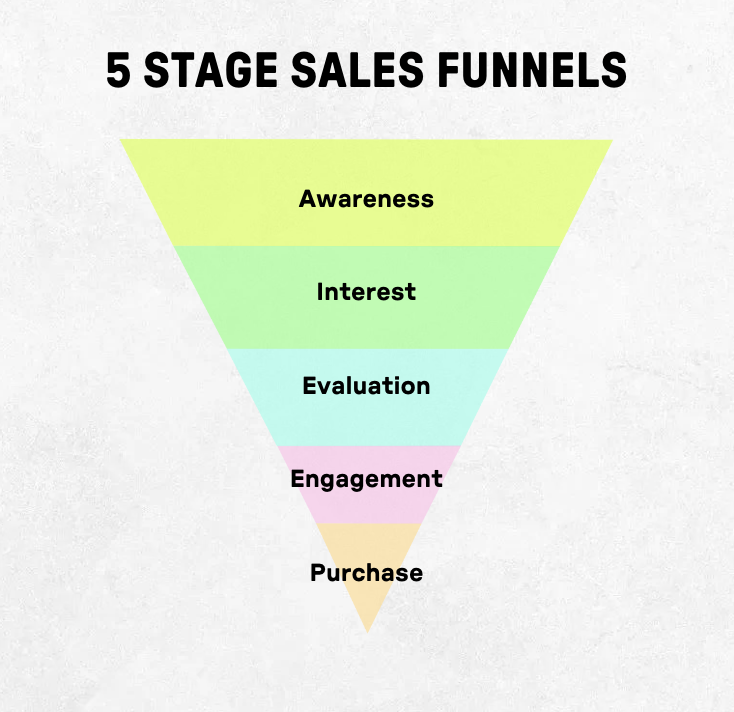
A sales funnel, or conversion tunnel, typically follows the TOFU / MOFU / BOFU model (Top, Middle, Bottom of Funnel) and consists of five key stages, each corresponding to a level of prospect engagement:

  1. Awareness → The prospect discovers your brand (TOFU).
  2. Interest → They start engaging with your product or service.
  3. Consideration → They compare your solution with alternatives.
  4. Decision → They're ready to buy and weighing you against a competitor.
  5. Action → They make the purchase and become a customer.

At each stage of the funnel, your job is to remove obstacles and guide the prospect forward with content tailored to your inbound marketing strategy.

👉 Concrete example: Netflix drives traffic through ad campaigns (awareness). It captures interest with a free trial (interest), highlights its catalogue and personalized recommendations (consideration), simplifies sign-up (decision), then retains subscribers through emails and notifications (action).

B2B vs. B2C Sales Funnels: What's the Difference?

The fundamentals are the same, but the purchase cycle and decision-making phases differ depending on your audience.

B2C (business to consumer):

  • Fast purchases, often impulse-driven.
  • Decisions based on emotion and price.
  • Strategies centered on advertising and storytelling.
  • Example: a sneaker e-commerce brand selling through Instagram Ads.

B2B (business to business):

  • Longer sales cycles involving multiple decision-makers.
  • Decisions based on ROI and concrete benefits.
  • Strategies centered on educational content, marketing automation, and targeted prospecting.
  • Example: a CRM software sold to businesses through case studies and demos.

Key takeaway: in B2C, you need to capture attention and convert fast. In B2B, you need to build trust, identify the ideal customer profile, and prove your value with solid content.

Why Optimize Your Sales Funnel?

A poorly optimized funnel is like a badly tuned car: it burns more fuel, struggles to move, and costs you money. By refining it, you attract more customers, lower acquisition costs, and maximize sales.

  1. Maximize the ROI of Your Marketing EffortsEvery euro invested should pay off. A good funnel targets the right prospects, personalizes the customer journey, and maximizes conversions.Example: a clothing e-commerce brand
    • New prospects → Facebook ad for the new collection.
    • Interested prospects → Email with a discount code.
    • Existing customers → Loyalty re-engagement.
  2. Reduce Customer Acquisition Cost (CAC)Acquiring customers is expensive. An optimized funnel cuts waste by automating certain steps, refining targeting, and eliminating friction through inbound marketing.Example: a management SaaS
    • Before: 10% of visitors leave their contact details.
    • After optimization (clearer page, improved CTA): 22%.
  3. Increase the Conversion Rate at Every StageA prospect should never be left hanging. Testing, refining, and retargeting minimize drop-off at each stage of the funnel.Example: an online fitness coach
    • Before: 1% of visitors subscribe to the newsletter.
    • After adding a video and a free bonus: 4%.
  4. Improve Customer Loyalty and Retention
  5. A retained customer costs less than an acquired one. The secret? An engaging post-purchase experience built into your funnel.
  6. Example: Amazon Prime. Free shipping, exclusive access — everything is designed to keep subscribers. Result: record retention rates.

The Key Stages of a Sales Funnel and How to Optimize Them

A sales funnel follows a logical sequence: capture attention, engage, convince, trigger the purchase, and retain. Each stage plays a crucial role in converting a visitor into a customer within a well-defined customer journey.

1. Awareness – Attract Attention

If your audience doesn't know you exist, they won't buy from you. The goal is to reach your target audience and attract qualified traffic at the top of the funnel (TOFU).

Effective strategies:

  • SEO and content marketing: blog posts, videos, and guides to boost visibility through inbound marketing.
  • Paid advertising: Google Ads, Facebook Ads, and LinkedIn Ads to capture targeted traffic.
  • Influencer marketing and PR: partnerships with industry experts and specialized media.
  • Webinars and events: interactive formats to showcase expertise.

👉 Example:

Edflex combined SEO, educational content, and targeted ads to generate qualified traffic and drive acquisition — a textbook example of building an effective funnel.

2. Interest – Engage Prospects

An interested prospect needs to be nurtured with relevant information to deepen engagement, especially in the middle of the funnel (MOFU).

Key strategies:

  • Lead magnets: ebooks, checklists, or templates in exchange for an email address.
  • Email nurturing and newsletters: automated sequences via marketing automation.
  • Webinars and interactive tutorials: educational formats to persuade.
  • Product demos: concrete proof of added value.

👉 Example:

Lingo, a blockchain real estate startup, generated 13,000 leads by producing over 100 specialized pieces of content and building an engaged community at every step of its sales process.

3. Consideration – Convince

At this stage of the customer journey, the prospect is comparing offers and looking for reassurance. It's time to meet the expectations of your ideal customers and identify the most relevant conversion criteria.

Strategies to trigger the decision:

  • Customer testimonials and social proof: case studies, reviews, and feedback.
  • Competitive comparisons: clear arguments highlighting your advantages.
  • Demos and free trials: immersing prospects in your product or service.
  • Exclusive offers and promotions: incentives to accelerate the decision.

👉 Example:

Spotify uses personalized emails and notifications to encourage free users to upgrade to Premium, highlighting key arguments like no ads, offline listening, and better audio quality.

4. Decision – Push to Action

The prospect is close to buying. It's crucial to reassure them, address objections, and optimize this decision phase.

Strategies to maximize conversion:

  • Satisfaction guarantee or money-back: reducing perceived risk.
  • Responsive customer support: live chat and fast assistance.
  • Time-limited offers: creating a sense of urgency.
  • Free trials and demos: eliminating final doubts through a strong BOFU model.

👉 Example:

Addingwell optimized its acquisition funnels on Facebook and LinkedIn Ads, streamlining the customer journey all the way to purchase.

5. Purchase – Convert and Retain

The final stage of the funnel doesn't end at purchase. The goal is to turn a customer into a loyal brand ambassador, ready to recommend your product.

Strategies to maximize retention:

  • Smooth purchase experience and optimized checkout: reducing friction at payment.
  • Confirmation emails and onboarding: post-purchase support to optimize the user experience.
  • Loyalty programs and referrals: incentives to return and refer other customers.
  • Cross-selling and upselling: suggesting complementary products to increase basket value and recurring revenue.

👉 Example:

Comptables.com revamped its sales pages and optimized its client acquisition process, achieving a 45% conversion rate.

Want to learn more about your growth potential? 

Demander un audit gratuit
Carte ou profil utilisateur central mis en évidence, entouré d’autres profils en arrière-plan, suggérant une sélection ou une mise en avant d’un utilisateur.
bulldozer

Analyzing and Segmenting Prospects for a Higher-Performing Funnel

Having a good sales funnel is great. But if you don't understand who your prospects are and where they are in their customer journey, you risk sending the wrong message at the wrong time. That's where analysis and segmentation come in — two essential levers for reaching your target audience and meeting the expectations of your ideal customers.

The Importance of Lead Scoring and Interaction Tracking

Not all leads are equal. Some are ready to convert; others are still exploring. Lead scoring is the art of identifying the ideal profile and determining conversion criteria based on engagement with your website or content.

How does it work?

  • Each action (site visit, email open, download) assigns a score to the prospect.
  • The higher the score, the more ready the prospect is to move to the next stage of the funnel.
  • A CRM (HubSpot, Salesforce, Pipedrive) can automate this scoring and optimize sales timing through marketing automation.

Funnel Segmentation for Personalized Marketing Actions

Not all your prospects respond to the same messages. Segmenting your audience lets you tailor your actions to each stage and effectively guide prospects along their path to purchase.

Types of segmentation:

  • Demographic: age, gender, profession.
  • Psychographic: interests, values, motivations.
  • Behavioral: interactions with the website and content.
  • Geographic: location and specific context.

Precise segmentation is the key to high-performing inbound marketing, as it lets you craft tailored messages for each segment while maximizing conversion chances.

Sales Funnel Optimization Tools

Optimization isn't done by intuition. With the right tools, you can automate, analyze, and adjust your strategies at every stage of the funnel, turning more visitors into customers and boosting sales.

Automation & CRM

CRMs and marketing automation tools let you track leads, score their engagement, and send them relevant content without manual intervention.

Recommended tools:

Winning strategy:

  • A lead visits your website and downloads a guide? They automatically receive a series of emails tailored to their position in the funnel.
  • After 3 email opens, they become a priority in your CRM and are passed to the sales team.

A/B Testing & Performance Analysis

Even the best funnel can be improved. The secret? Test and analyze continuously.

Key actions:

  • Test multiple variants of CTAs, landing pages, and emails to see what converts best.
  • Use Optimizely or Contentsquare for real-time A/B testing.
  • Track conversion rates, bounce rates, and email open rates to identify and resolve friction points.

Why does it matter?

A simple headline change on a sales page can double conversions. Without analysis, there's no way to know what's actually working.

Real-World Funnel Examples

Sales Funnel for Real Estate

💡 Goal: generate qualified prospects for a real estate agent or agency.

  1. Awareness: targeted Facebook ads for potential buyers.
  2. Interest: landing page with a free guide "The 10 Mistakes to Avoid When Buying Property".
  3. Consideration: connecting with an agent via chatbot or phone call.
  4. Decision: scheduling a virtual or in-person property viewing.
  5. Action: offering personalized support and signing the preliminary sale agreement.

Example: a Paris real estate agency implemented an interactive quiz to suggest properties matching prospects' needs, significantly boosting their conversion rate.

Sales Funnel for an Accounting Firm

💡 Goal: acquire new business or freelance clients.

  1. Awareness: SEO-optimized blog with articles on entrepreneurs' tax obligations.
  2. Interest: free white paper "Accounting Basics for Entrepreneurs".
  3. Consideration: offering a free 30-minute accounting audit.
  4. Decision: webinar explaining how to optimize tax planning with practical cases.
  5. Action: personalized quote request form and online appointment booking.

Example: an accounting firm used LinkedIn Ads and webinars to generate 150 qualified leads per month.

An optimized sales funnel is the key to sustainable growth. By understanding each stage, analyzing your data, and adjusting your approach, you can turn more prospects into customers.

FAQ

Un funnel de vente (ou entonnoir de conversion) est un concept marketing qui illustre le parcours des internautes depuis la prise de conscience d'un besoin jusqu'à l'acte d'achat. Il représente les étapes du tunnel par lesquelles passent vos prospects : découverte de votre offre, recherche de solutions, sélection d'options, et enfin décision d'acheter. Ce concept permet aux entreprises de définir une stratégie commerciale adaptée à chaque étape, d'améliorer les performances et de mieux aider les prospects à devenir clients en leur proposant le bon contenu au bon moment.

Pour créer un tunnel performant, commencez par attirer l'attention via des campagnes publicitaires sur les médias sociaux ou votre site internet. Cette première étape de prise de conscience doit aider l'internaute à découvrir votre solution via du contenu éducatif. Ensuite, accompagnez la phase de recherche et de sélection en proposant des options claires et en mettant en avant les avantages de votre offre. Construisez la confiance grâce aux témoignages, comparaisons et démonstrations. Enfin, mettez en place un plan d'action pour faciliter la décision avec des CTA clairs, du mailing ciblé et une expérience client optimale. Au fur et à mesure, affinez chaque étape pour mieux répondre aux besoins de votre public cible.

Le choix d'un logiciel de sales funnel dépend de vos besoins et de votre activité. HubSpot, Salesforce et Monday CRM sont des plateformes complètes pour gérer la relation commerciale et scorer les leads. ActiveCampaign et Marketo sont des logiciels d'automatisation spécialisés dans le mailing et les séquences de nurturing. Pour l'analyse et l'A/B testing, Optimizely et Contentsquare permettent d'améliorer les performances en temps réel. Ces plateformes funnel sont généralement faciles à utiliser et permettent de créer des pages de capture, d'automatiser les actions commerciales et de suivre l'entonnoir de conversion. L'objectif est de choisir un logiciel adapté à votre budget, votre gamme de produits et vos objectifs commerciaux.

Bien que ces deux expressions soient proches, elles se distinguent par leur mise en œuvre. L'entonnoir de vente ou funnel représente le concept général, c'est-à-dire les étapes que passent les prospects de la découverte à l'achat. Le tunnel de conversion automatisé désigne quant à lui la réalisation technique via un logiciel, incluant workflows, mailing automatiques, scoring et alertes commerciales. En pratique, le tunnel automatisé est la version digitale et technique du concept de funnel, utilisée pour orchestrer les actions marketing sans intervention manuelle. Cette technique permet de gérer un grand nombre de prospects et d'améliorer l'efficacité commerciale de votre entreprise.

Pour améliorer les performances de vos tunnels de vente, commencez par analyser les données disponibles : taux de conversion, liste des points de friction et comportement des internautes. Testez en continu différentes variantes via l'A/B testing sur vos pages, CTA, mails et offres. Segmentez votre audience selon les besoins, intentions d'achat et niveau de connaissance de votre solution. Proposez du contenu adapté comme des guides pour aider à la décision, des comparaisons et des témoignages clients. Facilitez l'expérience en simplifiant les formulaires, en clarifiant les prix et en mettant en avant les fonctionnalités et avantages de votre offre. Utilisez tous les leviers du marketing digital : médias sociaux, campagnes publicitaires ciblées et retargeting. L'objectif est d'éliminer les problèmes à chaque étape et de proposer une expérience fluide qui transforme l'intention en acte d'achat.

Les avantages d'un tunnel de vente bien structuré sont nombreux pour votre activité. Il permet une meilleure compréhension du parcours client et des besoins à chaque étape, facilitant ainsi l'optimisation des efforts marketing et commerciaux avec un plan d'action clair. Vous réduisez vos coûts d'acquisition grâce à un ciblage précis et à l'automatisation des tâches répétitives. Le taux de conversion s'améliore au fur et à mesure de vos optimisations, tandis que vous construisez la confiance via des contenus pertinents et une expérience personnalisée. Le pilotage est facilité grâce aux outils d'analyse et aux logiciels de CRM qui centralisent toutes les informations. Enfin, un funnel performant offre une véritable scalabilité, c'est-à-dire la capacité à gérer un volume croissant de prospects sur internet sans perdre en efficacité. C'est le moyen le plus efficace de transformer votre audience en clients fidèles et d'assurer une croissance durable à votre entreprise.

Pour aller plus loin

Defining Your ICP When You Don't Know Where to Start: The Bulldozer GTM Framework

Brand Strategy
Bulldozer
Growth
Charlotte Nowak
Tunnel de conversion : les meilleures pratiques pour convertir vos leads

Conversion Funnel: Best Practices to Convert Your Leads

Growth
Killian Drecq
buyer persona

From Buyer Persona to Sales: The Marketing Journey in 4 Steps

Growth
Charlotte Nowak

Let's talk.

Full-funnel
500+ clients
300+ membres
Prendre un rdv stratégique