
Publié par
Photo d'un membre de l'équipecurve whitecurve white
Charlotte Nowak
Content Manager
Blog
/
Growth
/
B2B Growth Hacking: Strategy, Techniques and Concrete Examples (2026)

B2B Growth Hacking: Strategy, Techniques and Concrete Examples (2026)

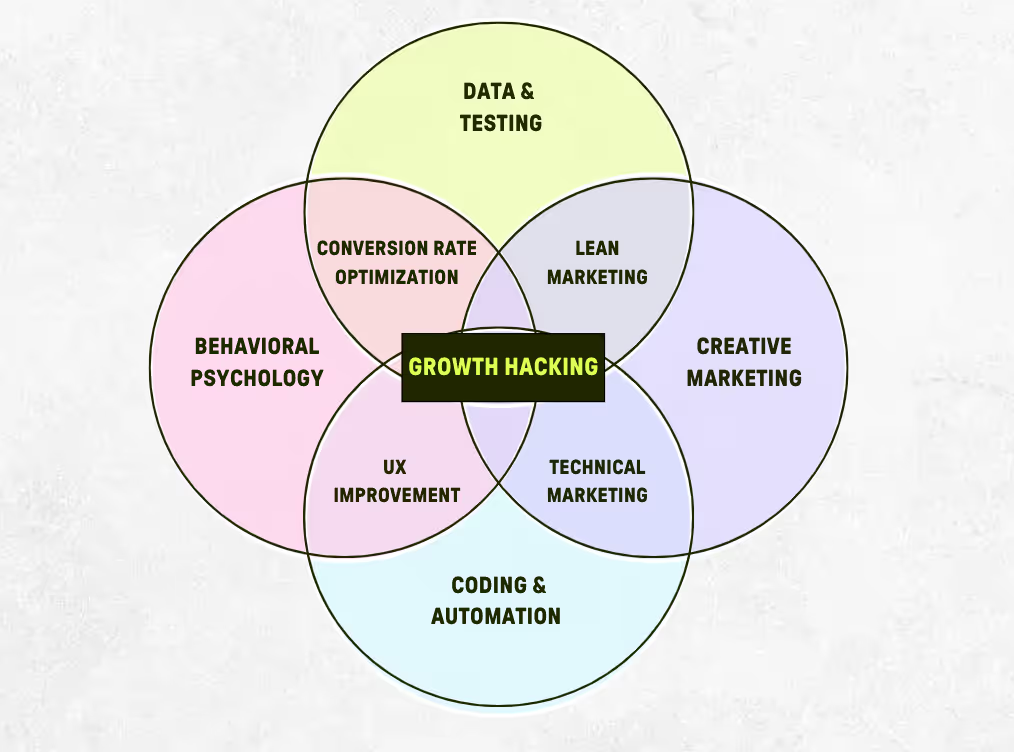
Growth hacking is a methodology designed to rapidly accelerate company growth through low-cost, highly creative experiments. Coined by Sean Ellis in 2010, this approach combines marketing, product, and data analysis to identify the most effective growth levers.

Unlike traditional marketing, growth hacking focuses on rapid, measurable experiments based on the AARRR model (Acquisition, Activation, Retention, Referral, Revenue). The goal: find scalable and repeatable strategies to generate sustainable growth.

Ressource en lien
4 Growth Loop Models
Dernière mise à jour :
16
/
06
/
2026

Top 10 Growth Hacking Techniques for B2B in 2026

TechniqueAARRR StageComplexityTime to ResultsEstimated ROI
Referral / Viral loopReferralMedium2-4 monthsVery high
Long-tail SEOAcquisitionMedium3-6 monthsHigh
Cold Outreach (LinkedIn + email)AcquisitionLow2-4 weeksHigh (if well-targeted)
PLG (Product-Led Growth)Activation + RetentionHigh3-6 monthsVery high
A/B testing systematicActivation + RevenueMedium2-6 weeksMedium to high
Programmatic SEOAcquisitionHigh3-6 monthsVery high
Scraping + enrichmentAcquisitionHigh2-4 weeksHigh (if compliant)
Retargeting hyper-segmentedActivationMedium2-4 weeksMedium to high
UGC (User-Generated Content)ReferralLow1-3 monthsHigh
Partnership / co-marketingAcquisition + ReferralMedium1-3 monthsHigh

Growth hacking emerged in Silicon Valley as a response to a simple question: how do you grow a startup rapidly with limited resources? The answer: by combining creativity, data, and product to find unconventional but highly effective growth levers.

Today, growth hacking is no longer reserved for startups. B2B SaaS companies, scale-ups, and even large enterprises have integrated this methodology into their marketing strategies. Here are the 10 techniques that will dominate in 2026.

The AARRR Model: The 5 Pillars of Growth Hacking

Before diving into specific techniques, it's essential to understand the AARRR model, the backbone of any growth hacking strategy:

  1. Acquisition: How do you attract visitors? (SEO, ads, cold outreach, partnerships)
  2. Activation: How do you convert visitors into active users? (onboarding, free trial, demo)
  3. Retention: How do you keep users? (email automation, in-app notifications, customer success)
  4. Referral: How do you turn customers into ambassadors? (referral programs, UGC, testimonials)
  5. Revenue: How do you maximize revenue per customer? (upsell, cross-sell, pricing optimization)

The key: identify the weakest link in your AARRR funnel and focus 80% of your efforts there. A company losing 50% of its users at activation has a much bigger problem than its acquisition.

Growth Hacking Methodology: 4 Steps to Structure Your Approach

Step 1: Audit Your Current Funnel

Before launching any experiment, map out your AARRR funnel with hard data:

  • Acquisition: what are your main traffic sources and their conversion rates?
  • Activation: what % of sign-ups complete the first key action ("aha moment")?
  • Retention: what is your D7, D30, D90 retention? What is your monthly churn?
  • Referral: what is your NPS? What % of customers actively recommend you?
  • Revenue: what is your ARPU? What is your CAC/LTV ratio?

Step 2: Identify Your North Star Metric

Your North Star Metric (NSM) is the single number that best captures the value you deliver to your users. Examples:

  • Slack: daily active users sending at least one message
  • Airbnb: number of nights booked
  • HubSpot: number of contacts tracked in CRM

All your growth experiments must be evaluated based on their impact on the NSM.

Step 3: Build Your Experiment Backlog

Generate 20-30 growth hypotheses per quarter using the format: "If we [action], then [metric] will increase by [X%] because [reason]." Prioritize using the ICE framework (Impact, Confidence, Ease).

Step 4: Run Rapid Experiments

Each experiment follows a strict cycle:

  1. Clear hypothesis with measurable success criteria
  2. Minimum implementation (MVP)
  3. Controlled testing (A/B or before/after)
  4. Statistical analysis of results
  5. Scale if validated, scrap if failed

Target: 5-10 experiments per month minimum. The companies that win are those that run the most experiments, not those that run the biggest ones.

Want to learn more about your growth potential? 

Demander un audit gratuit
Carte ou profil utilisateur central mis en évidence, entouré d’autres profils en arrière-plan, suggérant une sélection ou une mise en avant d’un utilisateur.
bulldozer

The Airbnb Case: Growth Hacking That Changed Everything

The most famous example of B2B growth hacking remains Airbnb's Craigslist hack. In 2010, Airbnb built a tool that automatically cross-posted their listings to Craigslist, which had millions of users looking for accommodation. Result: explosive growth with near-zero acquisition cost.

The lessons to apply in B2B:

  • Identify where your prospects already gather (communities, forums, platforms, events)
  • Build bridges rather than starting from scratch
  • Automate what can be automated
  • Measure precisely before scaling

Prerequisites for a Successful Growth Hacker in 2026

A B2B growth hacker in 2026 must master:

  • Data analysis: SQL, Google Analytics 4, Mixpanel or Amplitude
  • Automation: Make, n8n, or Zapier + Python basics
  • Copywriting: writing that converts at every funnel stage
  • SEO technical basics: understanding crawl, indexing, and Core Web Vitals
  • A/B testing: statistical methodology, sample size, significance
  • CRM & marketing automation: HubSpot, Salesforce, or equivalent

The profile is no longer a "hacker" in a garage. It's a T-shaped marketer: broad in all digital disciplines, expert in one (SEO, paid, product, data).

Bulldozer + Growth Hacking: Our Approach

At Bulldozer, we don't sell growth hacking as a magic formula. We structure it as a rigorous methodology:

  1. Funnel audit to identify the highest-leverage bottleneck
  2. North Star Metric alignment with business objectives
  3. Experiment backlog built on data, not intuition
  4. Rapid execution cycles with clear success/failure criteria
  5. Scaling only what's validated

The result: our clients average 3x pipeline growth in 6 months with the same budget. Not because we found a magic trick, but because we run more experiments, faster, with better measurement.

Talk to a Bulldozer growth expert.

FAQ

Because growth hacking relies on rapid experimentation. Without quantified and clearly prioritized objectives, tests pile up without direction and results become hard to interpret. Precise objectives make it possible to focus efforts on the levers with the highest business impact.

An overall objective must be broken down into measurable sub-objectives tied to the stages of the funnel, such as acquisition, activation, or retention. Each sub-objective must be associated with a clear indicator, a deadline, and a success threshold to guide experimentation.

The most useful indicators are those directly tied to value creation: conversion rate, acquisition cost, activation, retention, revenue per user, and return on investment of tests. A good indicator should enable a quick decision, not just reporting.

Objectives should be reviewed regularly, often at the end of each testing cycle or sprint. This reassessment makes it possible to adjust priorities based on learnings, observed results, and opportunities detected in the data.

The most common one is setting objectives that are too vague or too numerous. This dilutes efforts and makes it impossible to prioritize. An effective approach relies on few objectives, clearly measurable, directly tied to revenue or customer value.

Pour aller plus loin

Defining Your ICP When You Don't Know Where to Start: The Bulldozer GTM Framework

Brand Strategy
Bulldozer
Growth
Charlotte Nowak
Tunnel de conversion : les meilleures pratiques pour convertir vos leads

Conversion Funnel: Best Practices to Convert Your Leads

Growth
Killian Drecq
buyer persona

From Buyer Persona to Sales: The Marketing Journey in 4 Steps

Growth
Charlotte Nowak

Let's talk.

Full-funnel
500+ clients
300+ membres
Prendre un rdv stratégique