
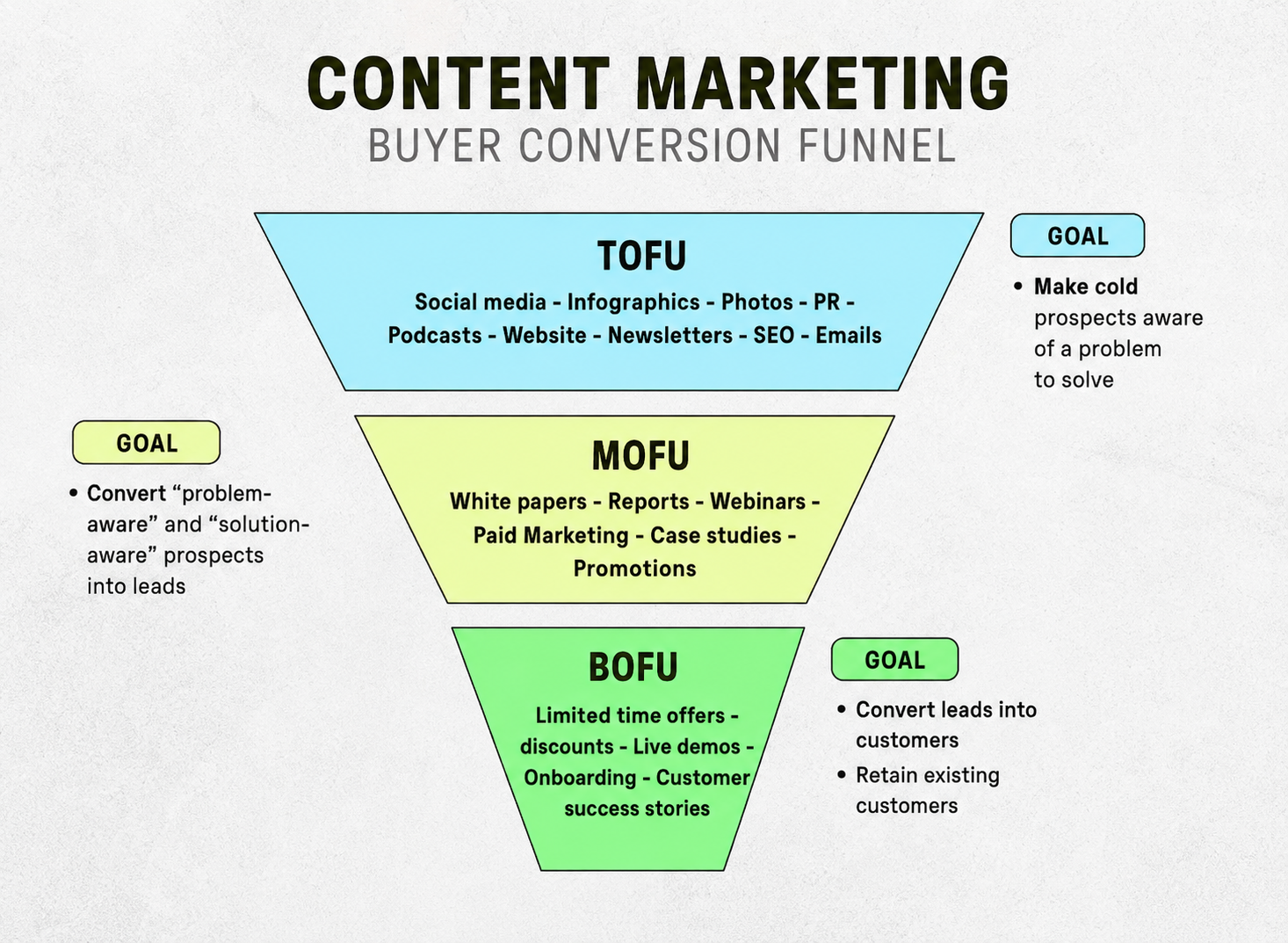
The TOFU / MOFU / BOFU model segments the conversion funnel into three stages: TOFU (Top of Funnel) attracts a broad audience through educational content, MOFU (Middle of Funnel) qualifies prospects who are comparing solutions, BOFU (Bottom of Funnel) converts buyers ready to sign. Each stage requires distinct content, a distinct channel, and distinct metrics. In B2B SaaS, a well-calibrated funnel multiplies the trial conversion rate by 3 to 6.
Behind these intimidating acronyms lie the 3 major stages of the marketing funnel. The trick to maximizing your conversion rate at each stage ? Deliver the right message, at the right time, to the right audience.
By adapting your content to your visitors' needs based on their position in the funnel, you can:
Here's a full overview of the best content tactics to apply at each stage of the funnel!
If you want to succeed in digital marketing, it will be crucial to structure what's called a marketing funnel (or conversion tunnel), which guides prospects through their entire customer journey: from discovering your brand to making a purchase — and beyond. The concepts of TOFU, MOFU and BOFU designate the three key stages of this sales funnel.
By using a content strategy tailored to each phase, combined with tools like CTAs (calls-to-action) and lead nurturing campaigns, you can improve customer acquisition, maximize conversion rates, and reinforce retention.
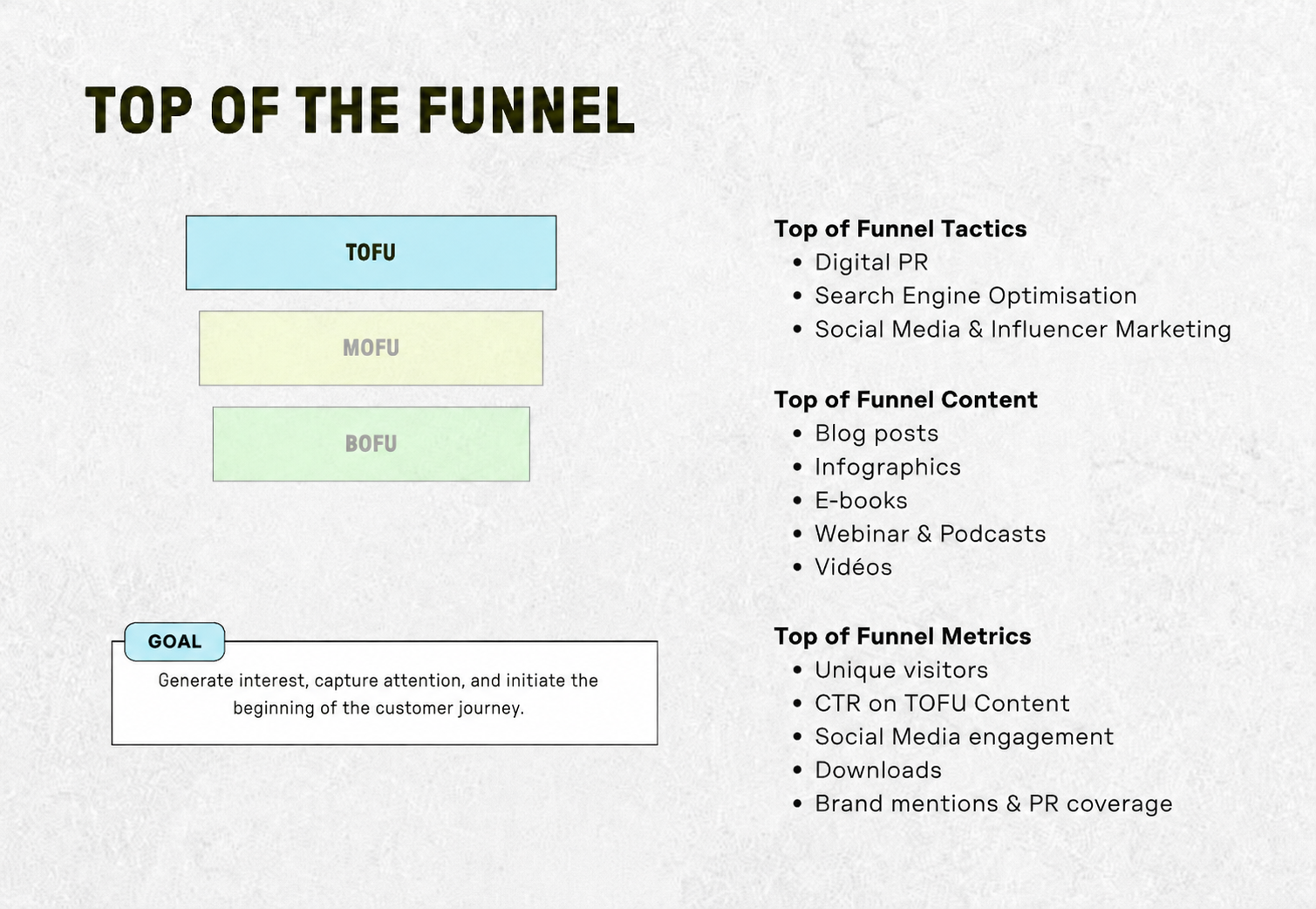
TOFU encompasses all content designed to attract a prospect who is discovering a problem, with no immediate purchase intent. The goal is not to convert. The goal is to exist in the prospect's memory for the day they become in-market.
The TOFU phase marks the prospect's entry into the marketing funnel. The main objective is to generate brand awareness and attract as much qualified traffic as possible by addressing the general challenges prospects face. At this stage, they are discovering your brand or looking for solutions to meet an emerging need, but are not yet ready to buy.
👩 Marie, 25, Googles "How can I better organize my daily tasks?". She comes across an article titled "5 simple tips to organize your projects like a pro" and discovers for the first time management tools that could help her. Thanks to this content, Marie is drawn into your funnel.
TOFU is an attraction phase, focused on informative and engaging content to reach a broad audience. Use strategic channels such as SEO, social media, and native advertising to maximize your visibility.
A well-executed TOFU strategy lays the foundation for a high-performing marketing funnel. This is where the trust relationship with your audience begins.
MOFU targets prospects who are aware of a problem, actively searching for solutions, and comparing 2-4 suppliers. The goal is to capture their email and nurture them until they show purchase intent.
👨 Paul, 35, is looking to improve collaboration within his team. After reading a TOFU article, he downloads an ebook "How to choose the best tool for your team", in exchange for his email.
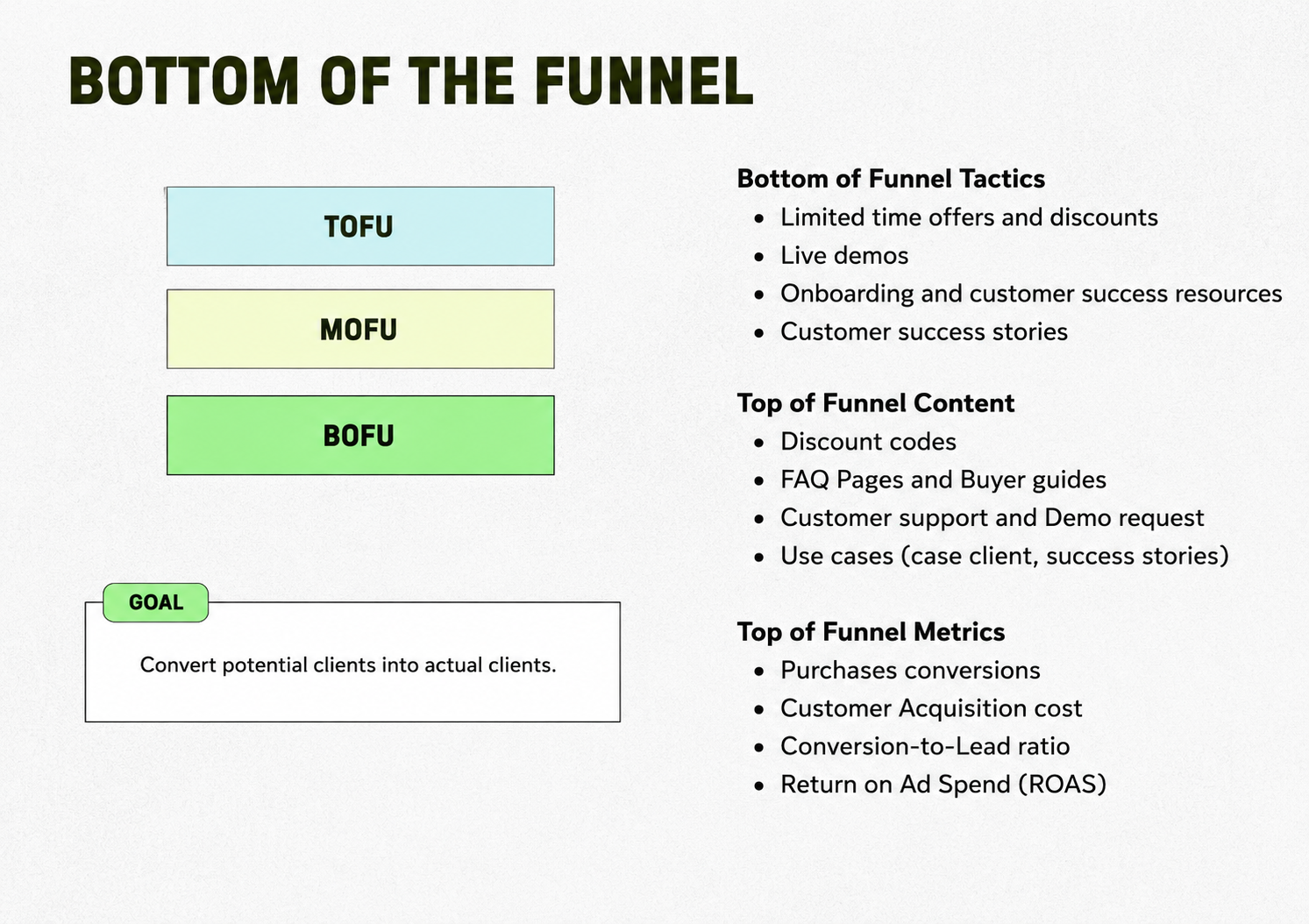
BOFU addresses in-market prospects, at 0-60 days from decision, who have identified 2-3 finalists. The goal is to overcome the last objections and facilitate the close.
👩 Julie, 40, runs an SMB. Convinced by client testimonials and attracted by a 14-day free trial offer, she decides to test your tool.
BOFU is the stage that concludes the conversion funnel. By highlighting concrete proof and giving them a chance to test your solution, you facilitate their decision, while laying the foundation for a strong, lasting customer relationship.
Each phase of the marketing funnel requires content aligned with prospects' expectations. For example, offering a free trial (BOFU) to an audience that has just discovered your brand (TOFU) can reduce engagement and muddy your message.
The TOFU, MOFU and BOFU stages integrate perfectly with inbound marketing, structuring content to meet the specific needs of prospects at each stage.
❌ You wouldn't send a TOFU email with a basic blog post titled "What is a project management tool?" to a MOFU prospect who has already downloaded a comprehensive guide on "How to optimize your project management"
[rta-block=folder-cta][rta-title=h3]Want to learn more about your growth potential?[rta-title=h3][rta-btn=regular href="/prendre-rendez-vous-typeform" target=_blank]Get a free audit[rta-btn=regular][rta-block=folder-cta]
SEA refers to paid advertising on search engines like Google, Bing, or Yahoo. This method involves creating sponsored ads that appear in search results or on other partner sites, based on targeted keywords.
A SEA (Search Engine Advertising) strategy allows you to maximize your brand's visibility at every stage of the marketing funnel by running targeted ads on search engines like Google. By integrating TOFU, MOFU and BOFU into your SEA campaigns, you can reach prospects with messages tailored to their position in the conversion funnel.
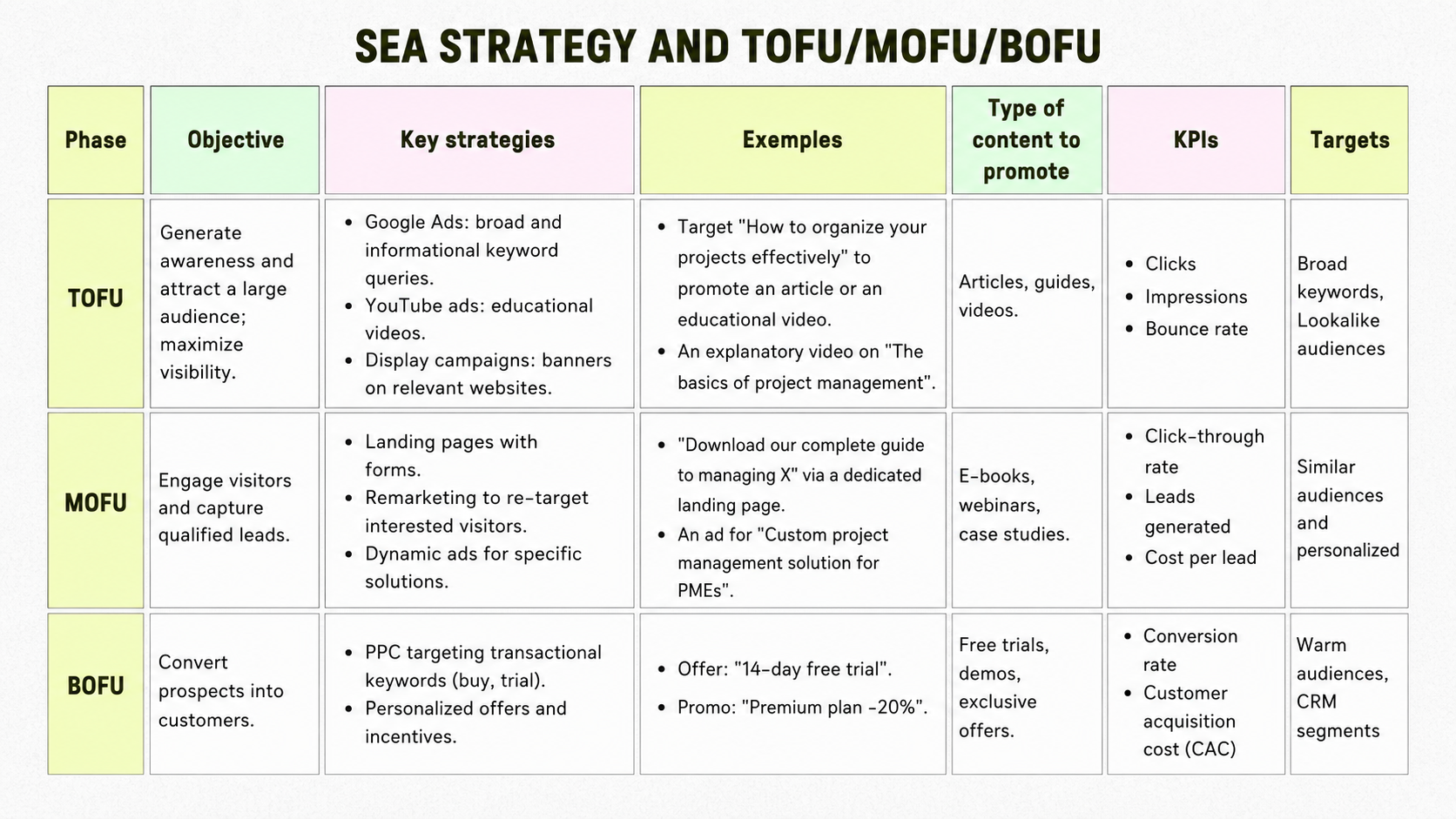
By aligning your SEA campaigns with the stages of the marketing funnel, you optimize your advertising budget by reaching the right audience, at the right time, with the right message.
Social ads are a powerful lever for reaching your prospects at every stage of the marketing funnel. By adapting your TOFU, MOFU and BOFU campaigns to the specificities of social platforms, you can capture attention, engage your audience, and maximize conversions through targeted content.
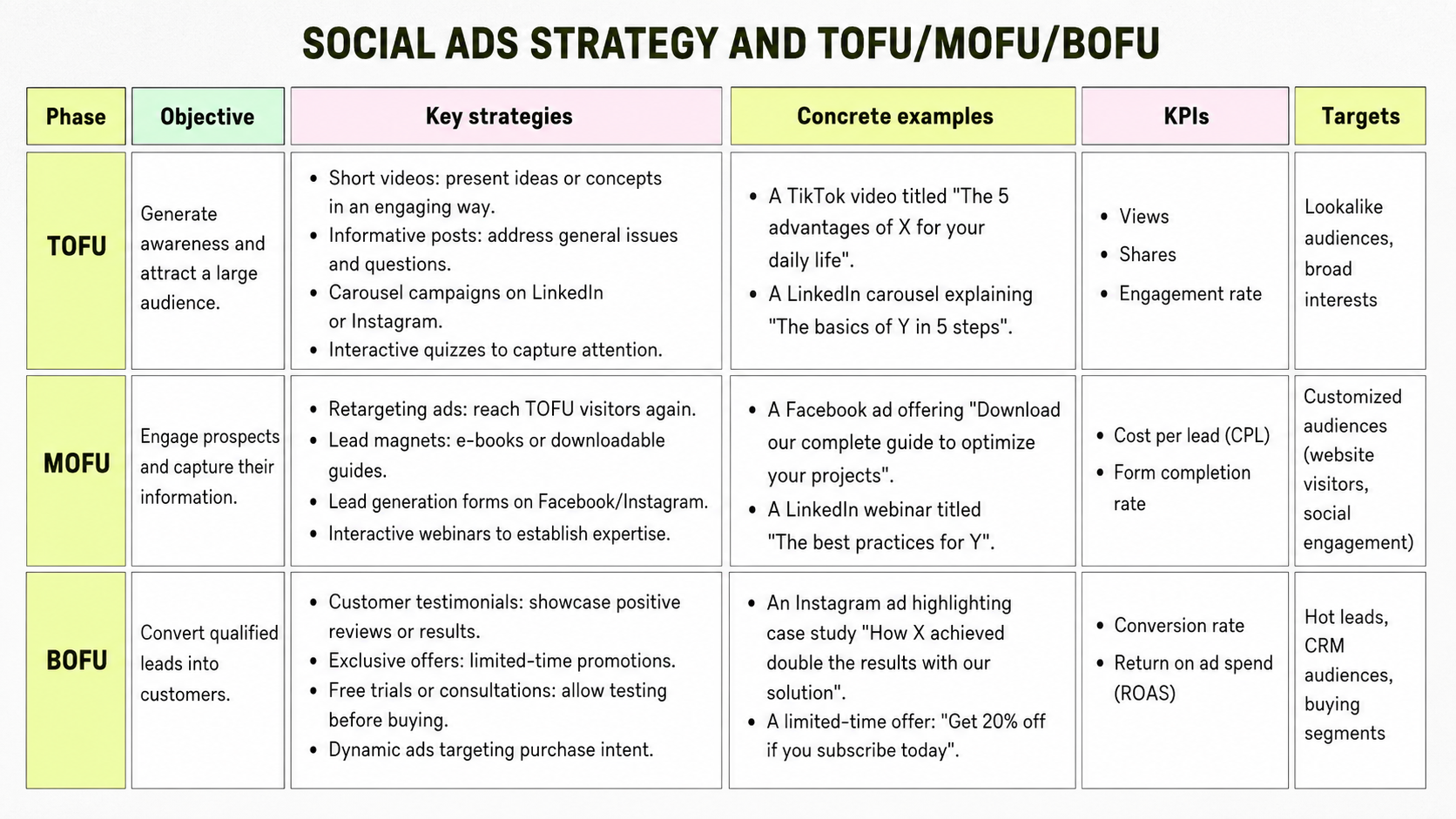
Adapt TOFU, MOFU, BOFU to Your Marketing Funnel!
The success of your marketing funnel rests on your ability to deliver content adapted to each stage: TOFU to attract a broad audience, MOFU to engage your prospects, and BOFU to convert them into customers.
Real case: How a B2B SaaS scale-up restructured its TOFU/MOFU/BOFU content
A B2B SaaS company (ARR €8M, HR/Finance target) was producing 90% of its content as TOFU: definition articles, tip lists, generic guides. Result: 40,000 visitors/month, but 0.3% trial conversion.
After restructuring:
Results at 6 months:
At Bulldozer, we freely audit the TOFU/MOFU/BOFU distribution of any B2B scale-up that requests it. Book a meeting.
Lorem ipsum
.jpeg)
Writer at Bulldozer, he covers web scraping, UGC and no-code, mixing data, storytelling and SEO.
Can't find what you're looking for ? Contact us here
jordan@bulldozer-collective.comGet access to playbooks and feedback from those who are shaping the next wave of marketing and AI.