
80% of B2B marketing budgets are concentrated on buyers who are already searching. Meanwhile, pipeline stagnates.
The problem is straightforward: companies invest heavily in demand capture — Google Ads, LinkedIn Ads, retargeting, SDR teams — but forget that demand needs to exist first. It doesn't appear from thin air. It has to be created. That's exactly what Demand Gen is for.
In 2026, B2B sales cycles are getting longer, buying committees have grown to 6 to 10 stakeholders, and 70% of the purchase journey happens before the first sales conversation (source: Gartner). Waiting for prospects to find you is no longer a strategy.
This article breaks down B2B Demand Gen as we practice it at Bulldozer: definition, difference from Lead Gen, frameworks, channels, budgets, KPIs, and how it connects to ABX — with concrete numbers and a 12-month implementation timeline.
B2B Demand Gen is the set of marketing actions designed to create awareness, curiosity, and purchase intent among audiences who don't know you yet.
Concretely: you're reaching people who haven't yet identified that they have a problem, or who aren't actively looking for you. You bring them content, ideas, and thinking frameworks. You become a resource before you become a vendor.
Demand Gen operates in PUSH mode. You push your message to your market. It's foundational work that takes 6 to 12 months before producing measurable pipeline results.
Demand Capture, by contrast, operates in PULL mode. You attract people who are already looking for you. Results come quickly — a matter of weeks — but you can only capture what already exists. And if no one knows you, there's nothing to capture.
Three concrete reasons:
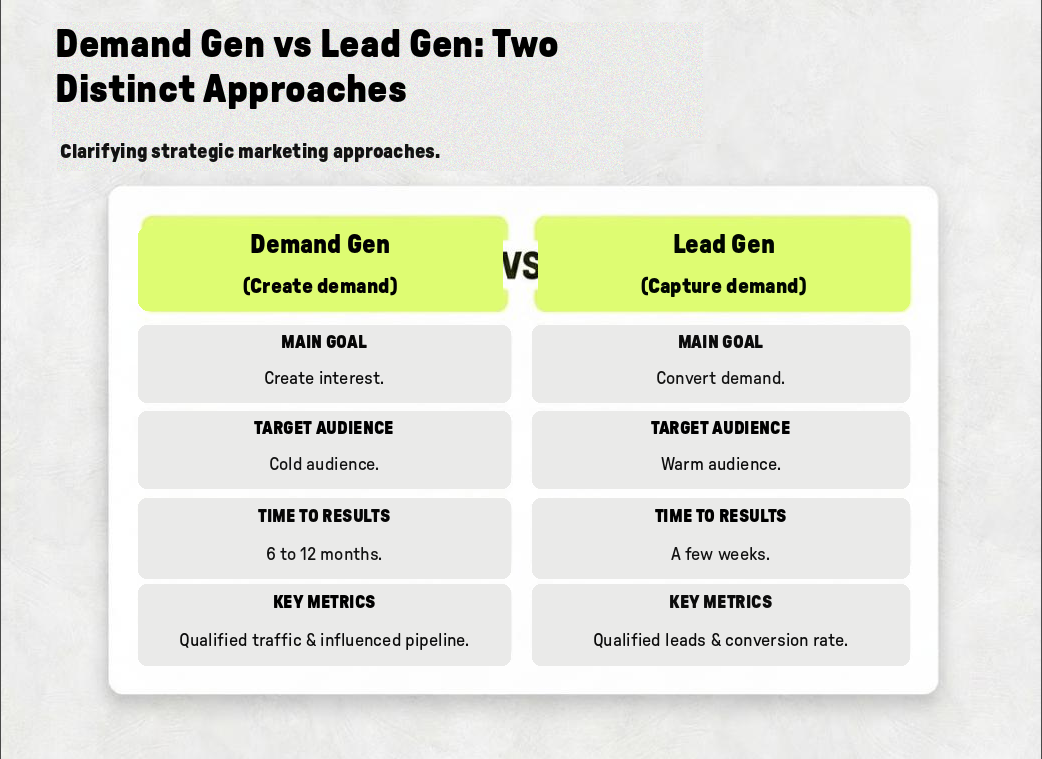
Demand Gen and Lead Gen are often confused. They're two distinct approaches, with different objectives and different metrics.
Goal: Build awareness, spark interest, position your company as a reference in the minds of your buyers.
Audience: Cold. People who don't know you, or who don't yet know they have a problem.
Typical channels:
Timeline: 6 to 12 months for measurable pipeline impact.
Recommended budget: 40–50% of total marketing budget.
KPIs: Impressions, engagement, qualified traffic, pipeline influence.
Goal: Convert people who are already looking for you. Be visible when they're searching.
Audience: Warm to hot. People in active search mode who know they have a problem.
Typical channels:
Timeline: Results within a few weeks.
Recommended budget: 50–60% of total marketing budget.
KPIs: Leads, MQLs, conversion rate, CAC, direct pipeline.
The right allocation depends on your maturity:
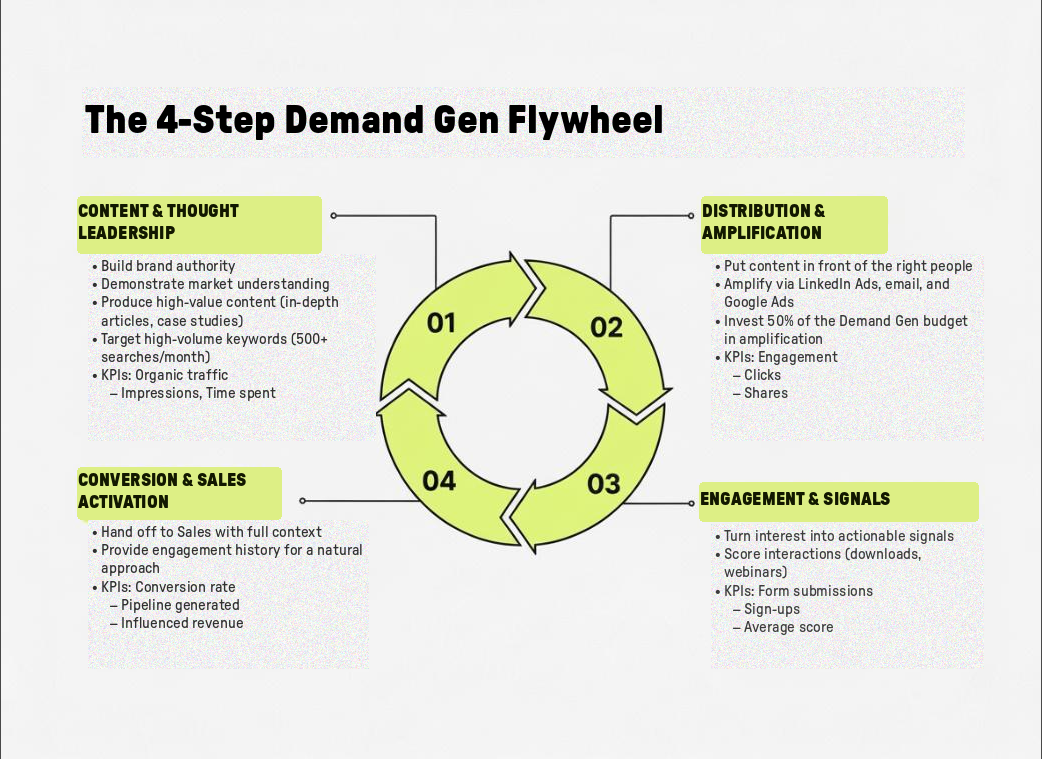
Demand Gen isn't a series of isolated campaigns. It's a self-reinforcing system. Here's how we structure it at Bulldozer.
Goal: Build authority. Demonstrate that you understand your market's problems better than anyone.
What we produce: Long-form articles (3,000+ words), whitepapers, case studies, benchmarks, videos, podcasts, LinkedIn posts.
At Bulldozer: We publish 2–4 articles per month, targeting keywords with volume (>500 searches/month) and genuine conversion intent. Every article is an entry point into the pipeline.
KPI: Impressions, organic traffic, time on page.
Goal: Get content in front of the right people. Creating content without distributing it is like opening a restaurant with no sign out front.
Amplification channels: LinkedIn (organic + paid), email to existing base, Google Ads, partnerships (newsletters, podcasts), communities.
Bulldozer rule: 50% of the Demand Gen budget goes to amplification. Not creation. It's counterintuitive, but distribution is what makes the difference between an article that gets 200 views and one that gets 20,000.
KPI: Engagement, clicks, email open rates, shares.
Goal: Turn interest into actionable signals. When someone downloads a guide, registers for a webinar, or consistently engages with your posts — that's a signal.
Tactics: Download forms, webinar registrations, LinkedIn interactions, chatbot, community engagement.
At Bulldozer, this is where scoring begins. Every interaction is weighted. A whitepaper download earns X points. Webinar attendance earns Y points. When an account crosses a threshold, it moves into commercial activation.
KPI: Form submissions, registrations, average score of engaged accounts.
Goal: Hand off to Sales with context. The buyer knows you, trusts you, and has demonstrated measurable interest.
What happens: Sales receive an account profile with full context — content consumed, signals captured, engagement history. The outreach feels natural, not cold.
KPI: MQL to SQL to Customer. Conversion rate. Pipeline generated. Marketing-influenced revenue.
The cycle restarts: satisfied clients become case studies that feed Stage 1.
Want to know where your Demand Gen stands? At Bulldozer, we start with a 2-week audit to identify gaps and opportunities. Book a Demand Gen audit
Why: Your buyers spend hours Googling their problems. If your content is there when they search, you capture qualified traffic for free — months after publication.
How we do it at Bulldozer: We target strategic keywords with long-form content (3,000+ words). We don't produce content "for SEO." We produce content that answers a real question, then optimize it for search.
Budget: 15–25% of Demand Gen budget.
Timeline: 3–6 months for initial SEO results. 12 months for meaningful organic traffic.
Why: That's where your B2B buyers spend their time. The algorithm rewards high-value content. Targeting is precise (title, industry, company size).
How we do it at Bulldozer: 5–7 posts/week (articles, carousels, videos). Paid amplification on top-performing organic content. LinkedIn Ads budget: €3–5K/month minimum to generate actionable data.
Budget: 25–35% of Demand Gen budget.
Why: A 30–45 minute webinar is high-density content that builds trust. The audience gives you their email in exchange. You build a relationship, not just a click.
How we do it at Bulldozer: 1–2 webinars/month. Announced 3 weeks out. LinkedIn + email amplification. Replay available. Nurture follow-up for both attendees and no-shows.
Budget: 15–20% of Demand Gen budget.
Why: You access someone else's audience. Sponsoring a B2B newsletter with 20K+ subscribers in your ICP is targeted Demand Gen at its most efficient.
How we do it at Bulldozer: 2–3 sponsorships/quarter. Each partnership comes with a dedicated landing page and UTM tracking. We measure traffic, leads, and pipeline influenced.
Budget: 10–15% of Demand Gen budget.
[rta-block=folder-cta][rta-title=h3]Want to explore your Demand Gen potential?[rta-title=h3][rta-btn=regular href="/prendre-rendez-vous-typeform" target=_blank]Get a free audit[rta-btn=regular][rta-block=folder-cta]
Here's a sample allocation for a total marketing budget of €500K/year.
Quarter 1: Foundations (months 1–3)
Quarter 2: Traction (months 4–6)
Quarter 3: Learning (months 7–9)
Quarter 4: Acceleration (months 10–12)
The classic mistake: measuring what's easy (impressions, clicks) and ignoring what counts (pipeline, revenue).
Here's the measurement framework we use at Bulldozer:
With a €200K/year Demand Gen budget and consistent execution:
For comparison, Demand Capture alone generates a 2–3x ROI (source: HubSpot State of Marketing 2025). Demand Gen takes longer, but the return is stronger.
Mass-market Demand Gen is valuable. But the real power emerges when you combine it with an ABX (Account-Based eXecution) approach.
ABX means concentrating all your efforts — Demand Gen, Sales, Customer Success — on the 100 to 500 accounts that represent the most value to your business.
Phase 1: Market structuring (month 1)
Phase 2: Testing and engagement (months 2–3)
Phase 3: Run and steady pipeline (months 4–12)
Result: A steady flow of qualified commercial conversations. Not volume. Quality. Deals that close.
1. Creating content without distributing it
You publish an article and wait for Google to index it. Six months later, you have 200 views. You conclude that "content marketing doesn't work." In reality, it's distribution that's missing.
Rule: 50% of your budget goes to amplification, not creation.
2. Tracking the wrong KPIs
You look at impressions and leads. But you don't know if those leads become customers. You can't prove Demand Gen's impact on revenue.
Rule: Track pipeline influenced monthly. Ask Sales which deals involve contacts who engaged with your content.
3. Putting 100% of budget into LinkedIn
LinkedIn works, but costs are rising and you're algorithm-dependent. If LinkedIn changes its rules tomorrow, your Demand Gen collapses.
Rule: Diversify. 30% LinkedIn, 25% organic content, 20% webinars, 15% partnerships, 10% tools.
4. Confusing Demand Gen with Lead Gen
You launch aggressive lead form campaigns on first contact. You generate leads — cold, unqualified ones that your Sales team hates.
Rule: Demand Gen = educate and engage first, form later. The lead form comes at Stage 3, not Stage 1.
5. Quitting after 3 months
Demand Gen is a 6–12 month game. Not 3 months. If you stop after a quarter because "it's not generating enough leads," you'll never see the results.
Rule: Commit to 12 months. The first 3–4 months are a learning phase. Results start at month 6.
Demand Gen isn't a marketing trend. It's the direct response to a B2B market where buyers do their own research, acquisition costs rise every year, and lead volume no longer guarantees pipeline.
Building a solid Demand Gen system takes time. But it's the only way to break dependence on paid, build a brand that earns trust, and create a pipeline that doesn't depend entirely on your SDR team.
At Bulldozer, we help B2B companies build this system. If you want to know where to start, an audit of your current setup is the right first step.
Lorem ipsum

Content Marketing Manager at Bulldozer, she writes about content strategy, editorial systems and distribution.
Can't find what you're looking for ? Contact us here
jordan@bulldozer-collective.comGet access to playbooks and feedback from those who are shaping the next wave of marketing and AI.