
To turn your prospects into loyal customers, your marketing funnel is the key.
The conversion funnel plays an essential role in your digital strategy. By guiding your prospects through the different stages up to purchase, it helps you structure their journey. A well-designed funnel is your best ally for increasing your conversion rate and driving your sales.
Here are our practical tips to optimize your own strategy, using the right tools and techniques: inbound and outbound marketing, nurturing, personalization, automation, data analysis…
Ready to build a marketing funnel that converts? Let's go!
The marketing funnel, also called the conversion tunnel, refers to the process that guides prospects through key stages up to the final conversion: a purchase, a sign-up, or any other desired action.
This concept is based on the idea that to convert a visitor into a customer, you need to guide them through multiple stages: from initial awareness all the way to purchase, passing through interest, consideration, and purchase intent.
The marketing funnel plays a central role in any effective digital strategy. By structuring the customer journey, you can generate more qualified leads and convert them into customers quickly. The perfect recipe to boost your revenue.
A well-built and optimized funnel becomes a real growth pipeline, automatically working to attract, convert, and retain customers.
Where some conversion strategies focus on a more direct, short-term approach, the marketing funnel takes a more progressive, holistic view of conversion.
The funnel doesn't try to convert the prospect immediately, but to guide them step by step through a considered buying journey. It combines marketing and sales actions, deployed across different channels (inbound and outbound), to gradually nurture the prospect to maturity, through to the final conversion.
This approach allows you to build a stronger relationship with prospects, delivering the right messages at the right time. The funnel thus offers a better ROI than an overly aggressive or rushed conversion strategy.
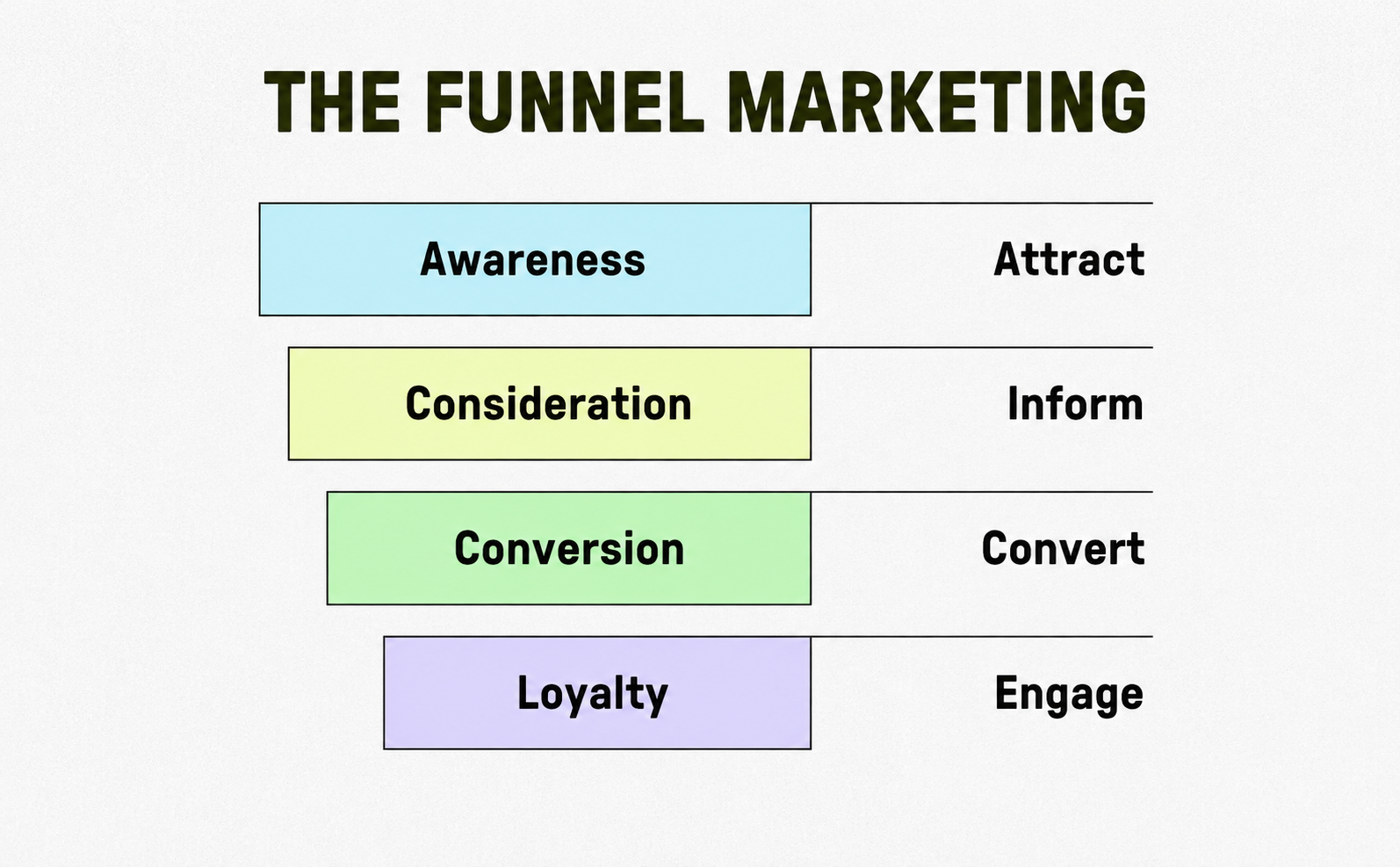
An effective marketing funnel generally consists of 6 major stages, each with its own objectives and specific techniques. You'll likely recognize the key concepts of the AARRR framework:
The goal is to make your brand, products, and services known to your target audience. The most commonly used techniques are SEO, educational content (blog posts, infographics, videos…), and advertising.
Once prospects know your brand, you need to spark their interest. For this, we use email marketing, social media, and webinars to provide high-value content.
You could, for example, schedule a series of emails containing case studies, practical guides, and invitations to exclusive webinars. This delivers very concrete content and begins to position you as THE solution to your target's need.
At this stage, the prospect is seriously considering your solution. They need reassurance about your expertise and the quality of your offer. Case studies, product demos, and comparisons are good levers. Bet on concrete content to help the prospect picture themselves using your product or service.
The prospect is almost ready to buy — they just need a small nudge. This is the time for special offers, free trials, and client testimonials to push them to act. Choose impactful messages to create a sense of urgency in your target.
The crucial conversion stage! To facilitate it, focus on a simplified payment process and flawless customer support. The winning combination to kick off a retention process.
The funnel doesn't end at purchase. The goal is to turn your customers into brand ambassadors. Loyalty programs, post-purchase follow-ups, and re-engagement campaigns all contribute to this.
Each stage therefore has its own specifics and must be carefully worked on, with the right tools and content, to optimize overall conversion. The goal is to create a seamless customer journey, from first contact to post-sale.
[rta-block=folder-cta][rta-title=h3]Want to learn more about your growth potential?[rta-title=h3][rta-btn=regular href="/prendre-rendez-vous-typeform" target=_blank]Get a free audit[rta-btn=regular][rta-block=folder-cta]
Having a marketing funnel is a crucial first step, but to get the most out of it, it's essential to optimize it continuously. Here are some best practices to achieve this:
The first step is to thoroughly audit your current funnel. Adopting a data-driven approach is essential for making informed decisions and refining your strategy over time:
Key indicators vary by funnel stage, but key ones include:
Tracking these metrics helps identify friction points and optimize overall performance. Identify what is working well and what can be improved. Analytics tools like Google Analytics are invaluable for this phase.
A generic funnel will always have limited effectiveness. The key is to personalize the experience as much as possible based on the different segments of your audience. Adapt your messages, your offer, and your content according to your prospects' characteristics and behavior.
To implement this personalization at scale, marketing automation tools (CRM, email marketing tool, reporting solution) are essential. They allow you to deliver the right message to the right person at the right time, in an automated way. Combined with data analytics tools, they also help you make fact-based decisions to optimize your funnel.
Comptables.com, an accounting recruitment marketplace, bet on massive A/B testing to identify the best campaigns and landing pages. Result: more than 300 professional accounts created, with a click-through rate of 25% and a conversion rate of 45%.
Constantin Czech, Business Owner, shared his experience: "Throughout the project, the Bulldozer team was highly available and attentive to our constraints."
Visit the Bulldozer website to learn more about our support methodology and discover our other client cases.
Regardless of company size or sector, it is possible to significantly optimize results by deploying the right strategies at the right stage of the funnel. The keys: test, measure, iterate — in an agile, data-driven mode.
If you'd like to be supported by growth marketing experts, feel free to explore our resources and methods. You can also contact us for free to learn more about our solutions.
The marketing funnel is a powerful strategy for optimizing your buying journey and increasing your conversions. By following the steps and tips presented in this article, you can transform your prospects into loyal customers and maximize your sales.
To summarize, an effective marketing funnel is built on:
With the right tools, best practices, and an experimentation mindset, you have all the cards to transform your conversion funnel into a true lead-generating machine!
Lorem ipsum

Content Marketing Manager at Bulldozer, she writes about content strategy, editorial systems and distribution.
Can't find what you're looking for ? Contact us here
jordan@bulldozer-collective.comGet access to playbooks and feedback from those who are shaping the next wave of marketing and AI.