
December 31, 2025
Web-to-Store: Turn Your Visitors into Physical Customers
Build a web-to-store strategy that turns online visitors into in-store customers: ROPO, drive to store, click and collect, e-reservation.
December 31, 2025
Build a web-to-store strategy that turns online visitors into in-store customers: ROPO, drive to store, click and collect, e-reservation.
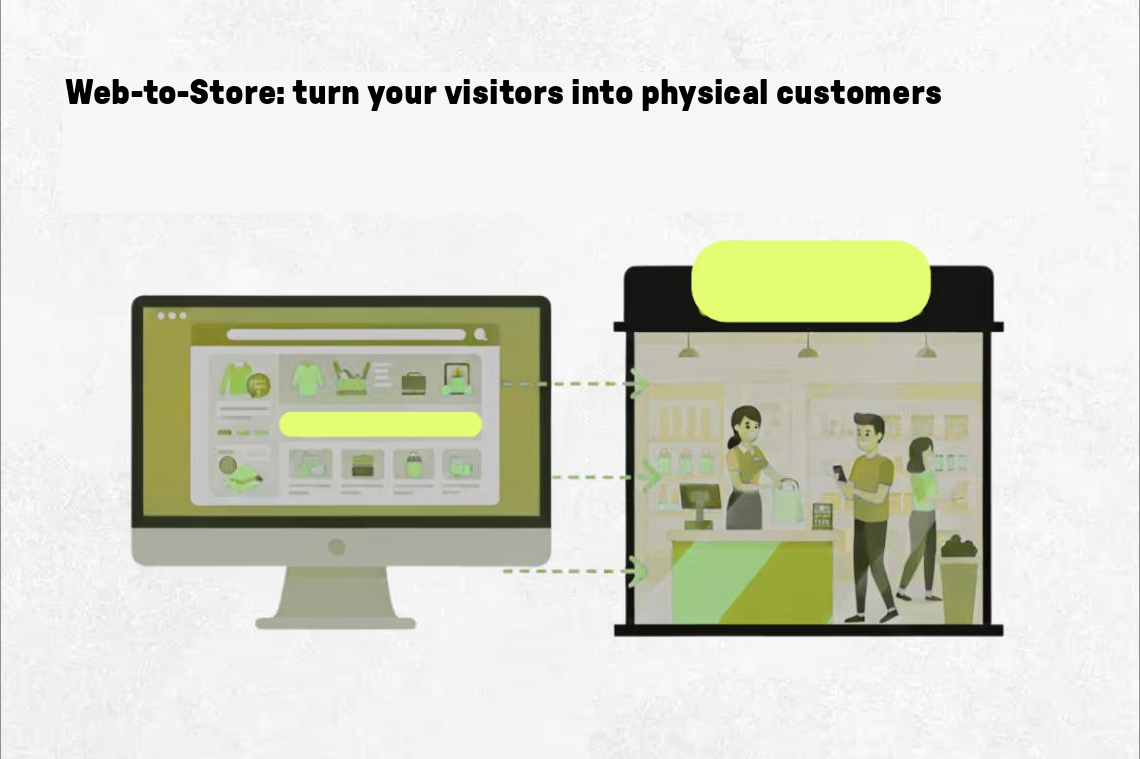
The same scenario plays out everywhere: your prospects spend hours comparing products online, reading reviews, browsing your Google listings, scrolling through your social channels — and then disappear before ever setting foot in your physical location. From the consumer's perspective, this behavior makes complete sense: they want as much information as possible before making the trip.
So the question becomes very concrete: how do you turn that digital traffic into real-world visits, boost in-store footfall, without blowing your local marketing budget or losing control of the customer experience?
That's exactly the challenge web-to-store addresses — using digital as a springboard into physical commerce, generating visits, drawing customers into your locations, and driving revenue across your network of stores, agencies, or showrooms.
We'll lay out a straightforward, actionable framework designed for both B2C retailers and B2B players with a physical presence — built around an omnichannel digital strategy and real business outcomes, not just a communication layer bolted on top.
Web-to-store is everything you do online to bring someone into a physical location and motivate them to buy in person.
Concretely, a web-to-store strategy encompasses:
The goal isn't necessarily to sell online — it's to influence customer behavior and purchasing decisions to trigger a visit to a store, agency, dealership, or showroom: the place where real value is created for the business.
Several related terms orbit this concept:
The key point: digital is not an end in itself — it's an accelerator of physical footfall.
ROPO (Research Online, Purchase Offline) describes an extremely common purchasing behavior: research happens online, the decision closes offline.
Simple examples:
Every time your prospects behave this way, there's a web-to-store opportunity at stake.
Ignoring this means letting competitors capture your ROPO traffic for free — simply because they did a better job on local visibility, content, or in-store clarity.
Why does a web-to-store strategy become a strategic priority rather than "just another thing to do"?
At Bulldozer, web-to-store is a performance topic, not just a brand awareness play: we're talking drive-to-store campaigns with measurable results, A/B tests, targeted email and SMS scenarios, geo-targeted ABM — not just "updating your Google hours."
Web-to-store is often treated as a purely B2C retail topic. That's a mistake.
In B2B, ROPO behaviors are even more pronounced:
A decision-maker will research online, compare vendors, review case studies — but they'll finalize the decision with a physical visit, an on-site demo, or a meeting at your premises.
Neglecting web-to-store in B2B means losing qualified in-person meetings that your competitors will happily pick up.
Before launching major drive-to-store campaigns, you need a clean foundation. Otherwise, you're sending traffic to a leaky vessel.
Your website should breathe web-to-store from every page. This subtly shifts the UX:
Key pages in a web-to-store strategy:
Every detail either reduces or increases the friction between web browsing and walking through the door.
Local SEO is heavily determined by your Google Business Profile (formerly Google My Business).
A simple but critical checklist:
Add customer reviews to that: they influence purchasing decisions as much as your shopfront does.
A serious web-to-store strategy always includes a review management platform (Guest Suite or equivalent) to:
Local SEO isn't just "putting the city name in the title."
A strong geo-targeted SEO strategy covers:
Ideally, a user searching "phone repair Bristol reviews" lands on:
Social media isn't just a global brand awareness channel.
A web-to-store approach leverages:
On the advertising side, drive-to-store geo-targeted campaigns can combine:
We're no longer talking about simple visibility — we're talking "I see an ad on my commute, I stop by."
At scale, the right tools become structural.
PIM (Product Information Management)
A PIM ensures product information (prices, specs, visuals, stock) is consistent across:
Without it, you're promising products online that aren't available or are mislabeled in-store — and you're sabotaging your web-to-store strategy at the source.
CRM and marketing automation
Your CRM centralizes customer and prospect data. Combined with marketing automation, it enables you to:
In-store traffic analysis
To measure a drive-to-store campaign, you need at minimum:
Crossing web analytics with in-store analytics lets you understand what actually drives profitable physical visits.
With the foundation in place, you can activate the accelerators. Here are the web-to-store classics, with concrete use cases.
Click and collect is one of the best-known formats: buy online, pick up in store.
Benefits for the customer:
Benefits for the retailer:
The key: a clear promise on lead times, and genuinely synchronized stock levels.
The store locator is often treated as a simple directory.
Done well, it's a web-to-store conversion tool:
The product locator goes further: it lets users check whether a specific product is available at a specific store.
It's a powerful trigger for ROPO purchasing behavior: if I know the item is available 10 minutes away, I'll go.
E-reservation lets customers hold a product without paying online, then finalize the purchase in store.
Very effective for:
In B2B, the same logic applies via showroom or agency time-slot booking tools: schedule online, meet face-to-face.
Competitions can become genuine drive-to-store mechanics — if designed properly.
Examples:
This combines qualified in-store footfall with data collection (emails, opt-ins, SMS consent).
A coherent web-to-store strategy aligns offers across channels:
Customers hate making the trip for a promotion they saw online — only to find it doesn't exist in store. It's the fastest way to destroy trust and the customer experience.
Geo-targeted campaigns are a cornerstone of modern drive-to-store.
Use cases:
Again, the goal is to measure the impact on in-store footfall — not just clicks.
SMS remains a highly effective web-to-store tool, especially at a local scale:
You obviously need to respect the legal framework (consent, opt-out, GDPR) and avoid over-solicitation.
Used selectively, geo-targeted SMS marketing becomes a genuine driver of qualified footfall.
Combine all of the above and a high-performing web-to-store journey might look like this:
Digital marketing's role is no longer to "drive traffic to the website" — it's to orchestrate purchasing behaviors that close in person.
[rta-block=folder-cta][rta-title=h3]Want to know more about your growth potential?[rta-title=h3][rta-btn=regular href="/prendre-rendez-vous-typeform" target=_blank]Get a free audit[rta-btn=regular][rta-block=folder-cta]
Whenever there's a physical meeting, a location, or a demonstration involved, web-to-store is relevant in B2B.
A few examples:
Every visit is potentially a large deal. Ignoring drive-to-store in these sectors means leaving revenue on the table.
In B2B, web-to-store strategy relies heavily on conversion content:
The typical scenario:
Digital prepares the physical meeting rather than replacing it.
In B2B, ABM (account-based marketing) lets you target a handful of strategic accounts with a fully customized program.
In "geo-targeted ABM" mode, you can:
Here, web-to-store becomes a premium commercial prospecting tool: digital opens the door, the physical experience closes the deal.
Between the first click and the in-person visit, several weeks may pass.
That's where structured nurturing pays off:
The sales rep's role is then to continue that journey rather than start from scratch — they know what the person has viewed, read, and requested, and can adapt accordingly.
A few traps can kill a web-to-store strategy before it has any chance of proving its value.
Broken omnichannel promises: a promotion seen online isn't available in store, conditions differ, offers are confusing. All of that destroys trust.
Unsynchronized stock: you promise in-store pickup, but the product isn't there. The customer makes an unnecessary trip, in-store staff are put in a difficult position, and your brand image takes a hit.
Poor review management: not responding, responding aggressively, ignoring recurring themes. Customer reviews are a management tool, not a necessary evil.
Internal silos: digital marketing, store managers, and sales teams aren't looking at the same metrics. Result: nobody truly owns the drive-to-store strategy.
The idea isn't to launch everything at once — it's to sequence properly.
An effective web-to-store plan typically starts with:
Then come the heavier initiatives:
Over a short horizon, a solid plan might look like this:
The challenge: test fast, learn fast, and scale what works.
At Bulldozer, we don't sell a generic "web-to-store package." We start by:
We then deploy drive-to-store and geo-targeted ABM campaigns, connect the right tools, and track the metrics that matter: in-store traffic, conversions, and profitability.
Web-to-store isn't just another digital transformation buzzword.
It's a very concrete way to reconnect your digital marketing to what actually keeps your business running: visits, meetings, and sales at your physical locations.
By working on your local visibility, local SEO, ROPO journeys, CRM tools, and drive-to-store campaigns, you can:
The question is no longer "should we do web-to-store?" — it's "how much longer are we willing to leave this to our competitors?"
Lorem ipsum
.jpeg)
Writer at Bulldozer, he covers web scraping, UGC and no-code, mixing data, storytelling and SEO.
Can't find what you're looking for ? Contact us here
jordan@bulldozer-collective.comGet access to playbooks and feedback from those who are shaping the next wave of marketing and AI.