

You've worked on your SEO, published content consistently on your website… but still no clients? What if the problem is the very architecture of your site? The semantic cocoon is the SEO growth technique that structures your site hierarchy so every page targets a primary query and helps search engines understand the value of your offer. Here's how to implement it — no unnecessary jargon, but with a real user experience built for the reader.
The semantic cocoon isn't just another SEO buzzword. It's an editorial architecture and internal linking method that organizes a website into groups of pages clustered by semantic proximity. In plain terms, it's an SEO technique that aligns your website with search engine logic and visitor expectations.
The goal? Create a coherent overall structure where each page is linked to others, placed in the right thematic group, to strengthen organic search rankings. It improves both semantic optimization (in Google's eyes) and the human experience: a page no longer lives in isolation — it becomes a link in a high-value chain.
The semantic cocoon concept is also an excellent starting point for the full implementation process: keyword research, structuring, internal linking, and performance tracking. Used well, this SEO technique helps your content rank higher in the SERPs on a given topic.
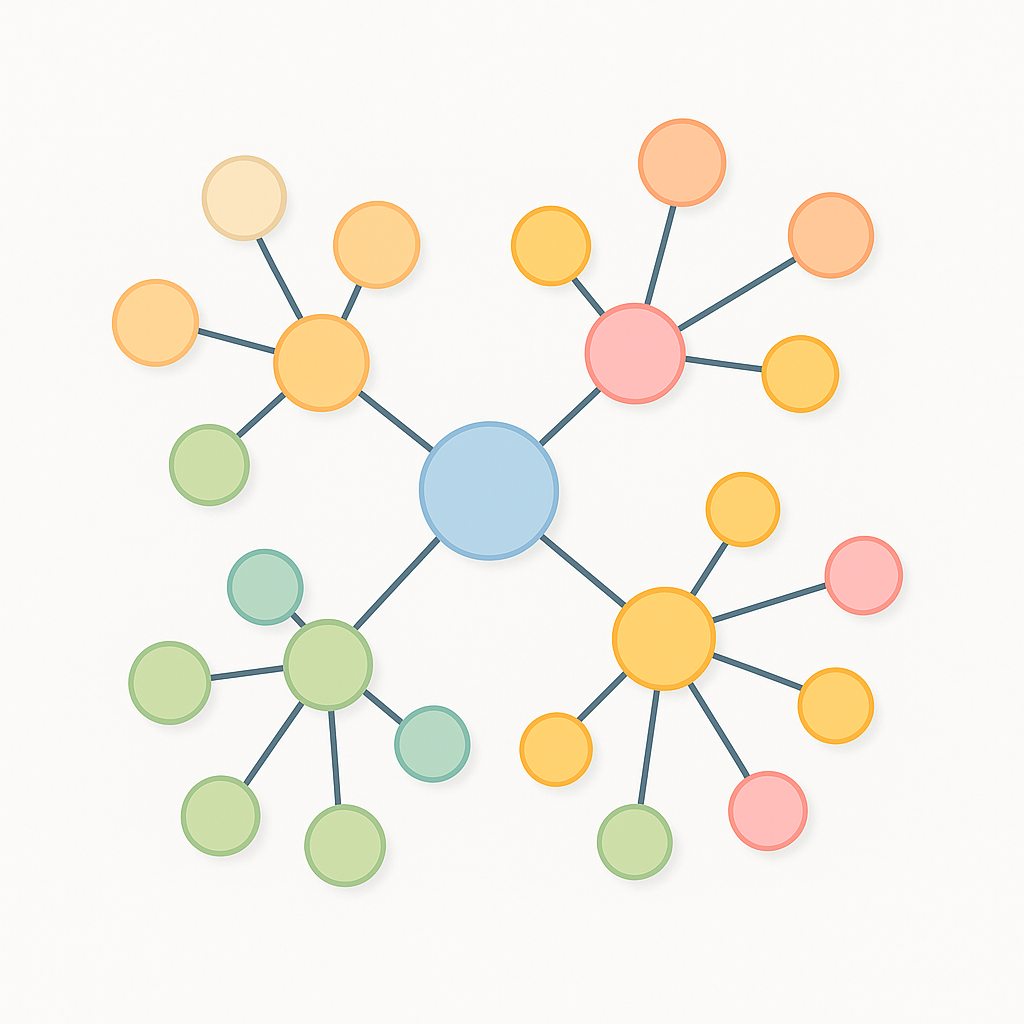
A semantic cocoon relies on a tree structure of hierarchical, interconnected pages. It's a smart way to organize your pages so Google better understands your site, and visitors can navigate it easily.
The structure breaks down as:
This structure serves two purposes:
In practice, many teams map this structure with a mind map: each node represents a parent, child, or sibling page. It's easy to read, easy to explain internally… and very useful when building an effective semantic cocoon.

The semantic cocoon was theorized by Laurent Bourelly, a French SEO expert, as a response to the limitations of classic site architectures and simple thematic siloing. Where a thematic silo groups content into airtight compartments, the semantic cocoon is more flexible: it links pages whenever they share genuine semantic proximity, even if they're in different folders.
The approaches can be summarized as follows:
Unlike siloing, the cocoon doesn't prohibit cross-links — it intelligently directs them to avoid semantic drift. Unlike topic clusters, it creates a dense network built for the semantic web, sending clear signals to search engines about the quality and value of your content.
Google no longer settles for scattered keywords: it wants meaning, connections, and consistency. It wants to see how each page relates to a given topic, fits into your site's overall universe, and what value it delivers to the reader.
In short, an effective semantic cocoon blends semantic optimization, clear structure, and useful content — a combination that appeals to both search engines and humans.
You don't need to be an AI engineer to build a solid semantic cocoon. But you do need method, rigor, and a lot of common sense. Here's how in 3 steps:
Before writing a single line, understand what your future visitors are looking for. Cocoon success depends on precise search intent mapping.
Best practices:
The goal: cover all intents around a given topic to become the go-to reference.
Once your topics and sub-topics are identified, map them out. Create a clear hierarchy understandable by Google and intuitive for humans.
Standard structure:
Parent page: /running-shoes/
├── Child page: /mens-running-shoes/
│   └── Sibling page: /mens-overpronation-running-shoes/
├── Child page: /womens-running-shoes/
└── Child page: /kids-running-shoes/
Tips:
This is where the cocoon comes to life.
Key rules:
Internal linking is the nerve of the cocoon. Done poorly, it can break everything. Done well, it's a turbo boost for your SEO.
Do this:
[rta-block=folder-cta][rta-title=h3]Want to find out more about your SEO potential?[rta-title=h3][rta-btn=regular]Get a Free Audit[rta-btn=regular][rta-block=folder-cta]
Imagine a blog specializing in SEO or digital marketing. The goal: generate steady, qualified traffic by becoming an authority on a specific lexical field.
Example cocoon structure:
Parent page: /seo-semantic-cocoon/
├── /seo-internal-linking/
├── /seo-crawl-budget/
├── /seo-silo-vs-cocoon-structure/
└── /seo-netlinking-vs-internal-links/
Why it works:
Here the cocoon becomes a product structuring tool — especially useful with large catalogs. It improves navigation, boosts long-tail rankings, and guides visitors toward purchase.
Example for a running store:
Parent page: /running-shoes/
├── /nike-running-shoes/
│   ├── /nike-overpronation-running-shoes/
│   └── /nike-competition-running-shoes/
├── /asics-running-shoes/
├── /running-shoes-by-foot-type/
Results:
Here the cocoon becomes an acquisition and education engine. It answers prospect questions throughout the conversion funnel, aligning with the marketing funnel structure.
Example around growth marketing:
Parent page: /growth-marketing-strategy/
├── /aaarrr-growth-funnel/
│   ├── /growth-hacks-activation/
│   └── /saas-user-retention/
├── /data-and-growth/
├── /growth-and-revenue-operations/
Specific advantages:
Before building your semantic cocoon, the first step is thorough keyword research and semantic analysis of your website. The goal: understand which primary query and semantic universe to compete in, so you can build a cocoon that delivers real value to readers and organic rankings.
Once keywords are validated, move to the visual part: building the site architecture. The goal is to visualize the structure and see how each page connects to others.
⚠️ Note: even if you use a CMS like WordPress, these tools remain relevant for preparing the groundwork before integration.
A cocoon relies on the semantic coherence of internal links. Too many links to unrelated pages weaken the structure.
❌ Link to an unrelated e-commerce category | ❌ Generic "read also" link with no thematic connection | ❌ Internal links added for purely technical reasons
Consequences: dilution of thematic authority, weak signal to Google on relevance, loss of readability for users.
Right reflex: limit yourself to contextual links with a genuine semantic connection. If you can't justify a link with a natural sentence, it doesn't belong there.
A page with no inbound links is an invisible page. Neither users nor Google can easily find it.
Two common causes: (1) page published in a rush, without integration into the existing cocoon; (2) content created without considering its target search intent.
Before publishing, verify that each page is linked to a parent or sibling page and always write with an explicit user intent in mind.
The parent page is the pillar of the cocoon. Too broad = a catch-all page, poorly positioned. Too narrow = blocked sub-topic expansion.
What to aim for: a page that's generic but targeted (e.g., local SEO strategy), that naturally opens to sub-topics, and can serve as a traffic entry point.
In short: siloing = compartmentalize (clean but rigid), topic cluster = radiate around one pillar page (good authority-building), semantic cocoon = weave a coherent web connected by meaning that serves both SEO and business.

Every page, every link, every piece of content must serve a clear business objective. That's where the semantic cocoon becomes far more than an editorial architecture: it becomes a genuine conversion funnel.
An effective cocoon is a smooth journey: attract, inform, then push toward action.
Along the way: well-placed CTAs, smart pop-ups based on visitor behavior, and lead scoring to identify who's ready to convert.
Great content attracts. A great system re-engages, nurtures, and converts automatically.
Our approach: connect the cocoon to automation scenarios based on pages viewed, time spent, or topics browsed.
We connect your cocoons to analytics tools, behavioral analysis, and your CRM to see what's performing and what's blocking.
Tools we systematically integrate: GA4 (traffic, events, conversions), Hotjar / Clarity (scroll, clicks, user journeys), CRM (HubSpot, Notion, Salesforce — leads, opportunities, content revenue), Looker / Data Studio (cross-referencing SEO data and business results).
The goal: not just "it drives traffic," but proving that your semantic cocoon actually impacts business.
Need a hand? We'll walk you through it from strategy to implementation.

Lorem ipsum dolor sit amet, consectetur adipiscing elit. Duis quis iaculis est. Nulla ac ligula feugiat, cursus turpis volutpat, ultricies eros.
Can't find what you're looking for ? Contact us here
jordan@bulldozer-collective.comGet access to playbooks and feedback from those who are shaping the next wave of marketing and AI.


Lorem ipsum dolor sit amet, consectetur adipiscing elit. Suspendisse varius enim in eros elementum tristique. Duis cursus, mi quis viverra ornare, eros dolor interdum nulla, ut commodo diam libero vitae erat. Aenean faucibus nibh et justo cursus id rutrum lorem imperdiet. Nunc ut sem vitae risus tristique posuere.