
May 27, 2025
AIDA method: the 4 copywriting steps that convert
AIDA framework in one page: the 4 steps (Attention, Interest, Desire, Action), 5 copy-paste examples and the KPIs that show it actually works.
May 27, 2025
AIDA framework in one page: the 4 steps (Attention, Interest, Desire, Action), 5 copy-paste examples and the KPIs that show it actually works.
Is your content getting overlooked? Struggling to convince prospects and turn them into customers? The AIDA model is a powerful framework for structuring persuasive communication and maximizing its impact. Used in advertising, copywriting, and digital communication, this strategic framework rests on four essential stages: capturing attention, sparking curiosity, creating desire, and driving action.
In this article, discover how to apply the AIDA method in practice, with real-world examples, copy-paste templates by channel, and the KPIs to measure your conversions. Ready to make your content irresistible and boost your results?
⚡ AIDA in 30 seconds. The AIDA method is a four-step copywriting framework designed to turn a reader into a customer: Attention, Interest, Desire, Action. You use it to structure an ad, an email, a landing page, or a post, and maximize its impact.
The AIDA method is a four-step copywriting grid — Attention, Interest, Desire, Action — that structures a message to move a stranger from reader to customer. It's also called the AIDA model or AIDA framework: same grid of copywriting. Its job is to catch the reader's eye, hold their attention, create desire, and push them to click, buy, or sign up.
💡 This framework is nothing new. It was conceived at the end of the 19th century by Elias St. Elmo Lewis, a marketing pioneer, long before the digital age. At the time, it was primarily used to make advertising and sales more effective. Today, you find it everywhere: in advertising campaigns, on websites, in marketing emails, and even in well-crafted LinkedIn posts.
AIDCA, AIDMA, AIDAS: variants of the model. Over time, the model has been extended. AIDCA adds a Conviction step between Desire and Action (useful when doubt holds back the decision: long-cycle B2B, considered purchases). AIDMA, popularized in Japan by Dentsu, inserts a Memory step to cover deferred purchases (real estate, auto). AIDAS adds a final Satisfaction step, which closes the loop on retention and word-of-mouth. All keep the same A-I-D-A core: the original version remains the most used in short-form copywriting (ad, email, landing).
The goal of the AIDA method stays simple: structure a communication to maximize its impact and guide a potential client toward a purchase. Whether you want to sell a product, generate leads, or captivate a reader, the AIDA model is an invaluable ally for writing persuasive, effective content.
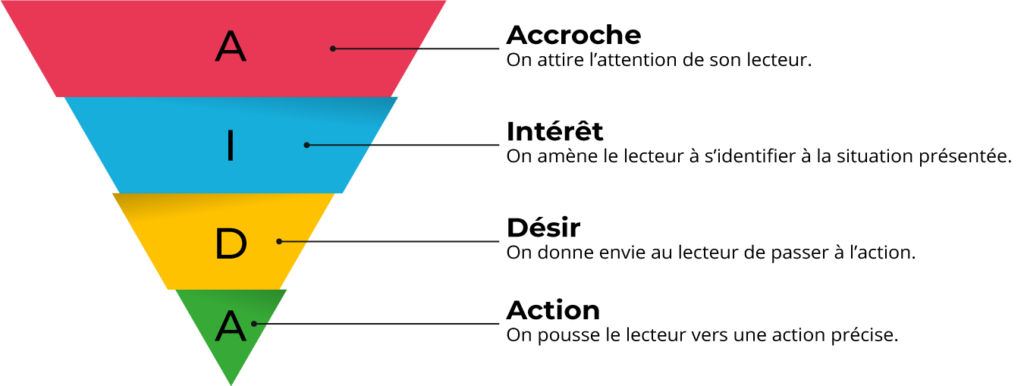
Source: https://www.joptimisemonsite.fr/modele-aida-tunnel-conversion/
Think of the AIDA model like a recipe: each ingredient has its role, and if one is missing, the dish falls flat. To convince a prospect, you need to follow these four essential steps.
The first step is cutting through the ambient noise. Every day, we're bombarded by ads, emails, notifications... If your content doesn't make an immediate impact, it's already forgotten.
A great example: the most-watched entertainment YouTubers. Whether you watch them or not, these are creators who routinely rack up millions of views per video. They know how to stand out, and they keep doing it.
You've caught the eye. But without an engaging hook, your potential client risks switching off. The objective here is to nurture their curiosity by proving that your content speaks directly to them. This is where the AIDA model comes into its own: capture, engage, and convince.
At this stage, your prospect is hooked. But engagement alone isn't enough: you need to trigger a genuine motivation to act. The idea is to make your offer attractive by connecting it to your audience's emotions and deep needs.
Trustpilot Reviews: discover the power of customer testimonials
This is the key moment: without this step, all the preceding work counts for nothing. You need to prompt the prospect to respond, in the simplest and most obvious way possible.
By applying these four stages, you build a fluid, effective strategy that naturally guides your prospect toward a final decision. Simple, right?
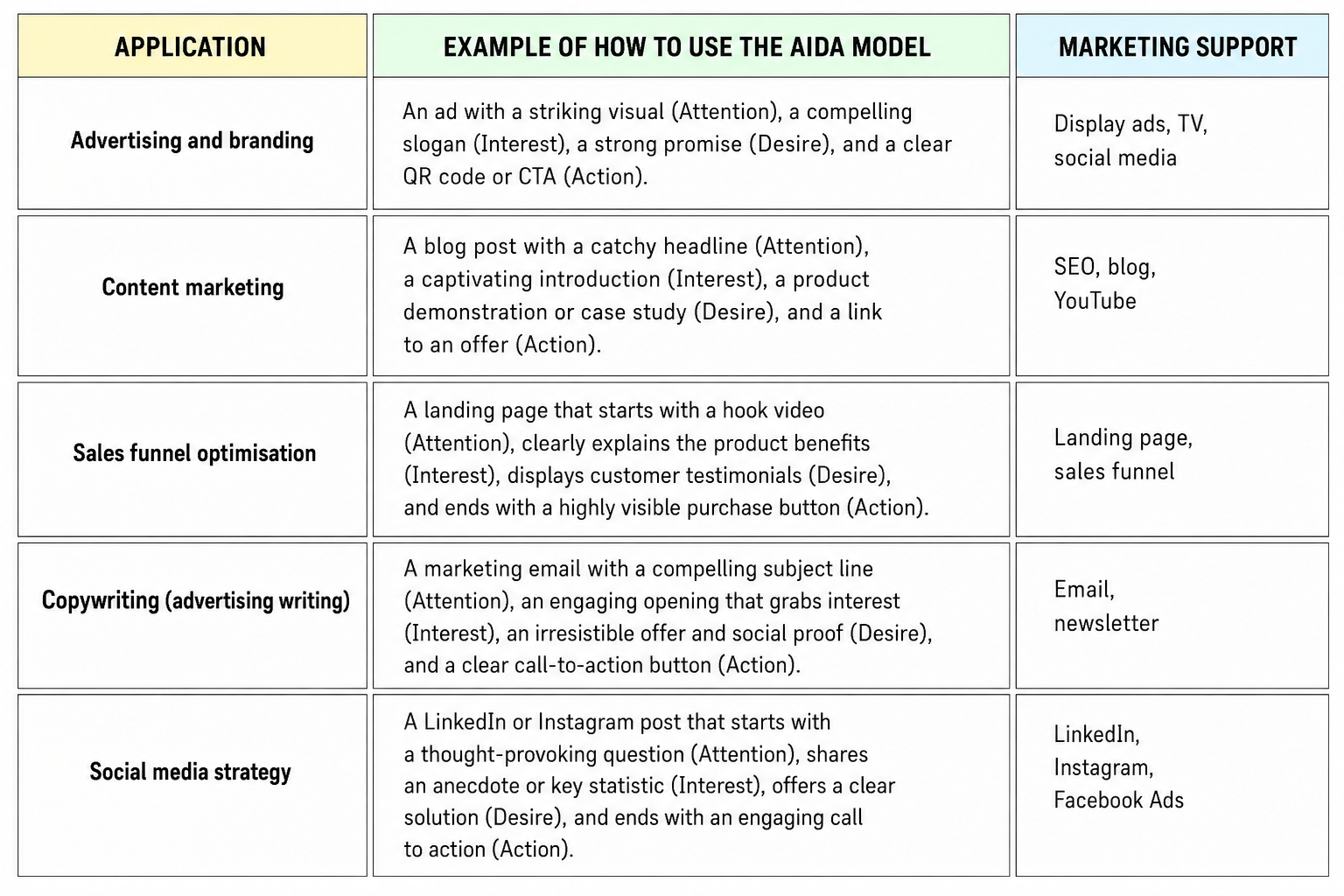
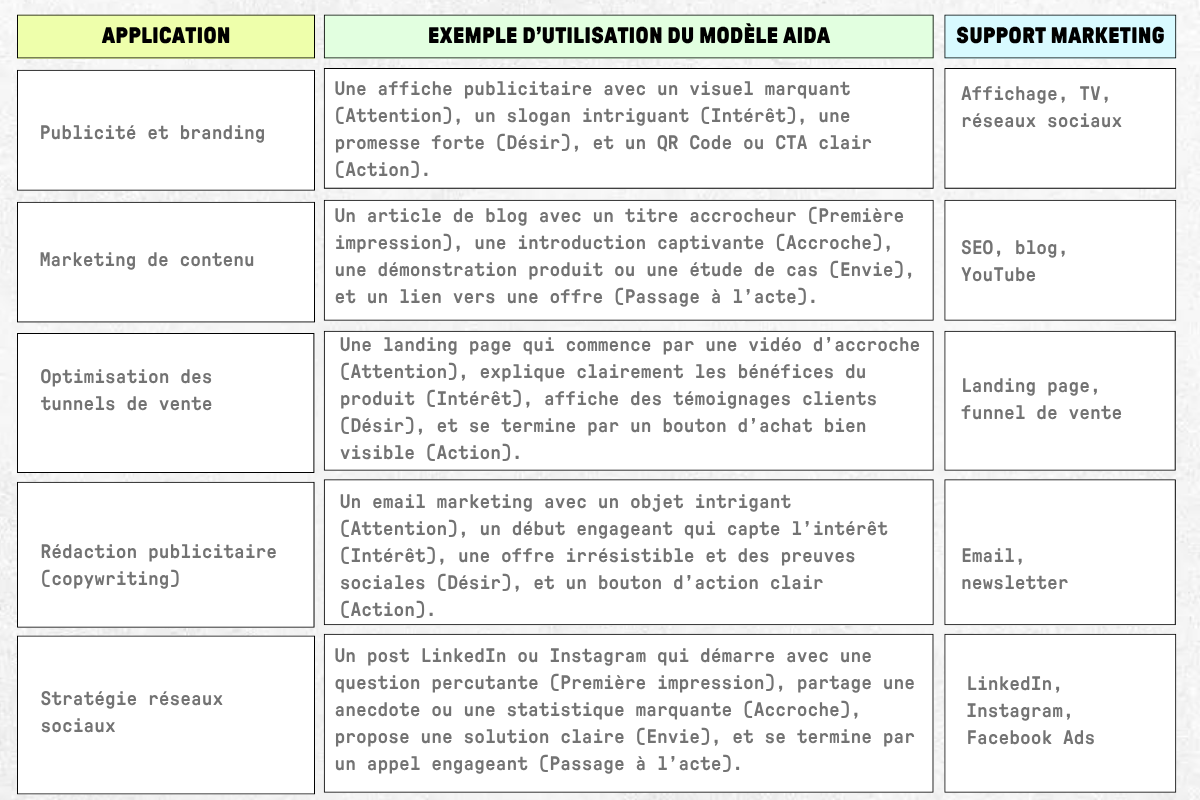
The AIDA model is everywhere in content strategies, and once you spot it, you can't unsee it. Advertising, social post, sales email, or a B2B nurturing sequence: it structures content to maximize impact. Five concrete examples to spot AIDA in action, each with a copy-paste template ready to adapt to your brand.
Attention: black stage, white logo, one line of text fades in slowly. Interest: Tim Cook names a problem everyone recognizes (battery, camera, screen). Desire: hands-on demo, side-by-side comparison with the previous generation, a filmed customer story. Action: "Available Friday. Pre-order today." One line, one button.
Copy-paste template — product launch.
Attention: a hand-drawn cartoon completely out of step with the tech register of the era. Interest: it shows a guy fighting with USB sticks and email attachments. Desire: in two minutes, it demos a magic folder synced everywhere. Action: "Get your free account." The video took Dropbox's waiting list from 5,000 to 75,000 signups overnight (source: Drew Houston).
Copy-paste template — SaaS explainer video.
Attention: a personalized notification you can't miss once a year. Interest: unique stats about your listening ("you're in the top 0.1% of fans of…"). Desire: shareable cards with polished design, built to be seen. Action: share on Instagram, invite friends to try Spotify Premium.
Copy-paste template — personalized campaign (Wrapped-style).
Attention: the subject line repeats the exact name of the product left in the cart. Interest: a reminder of the main benefit and a five-star review. Desire: product photo and a stock indicator ("Only 3 left"). Action: one button, "Complete your order". Abandoned cart emails consistently post the highest open and click rates in B2C marketing automation (benchmarks: Klaviyo, Omnisend).
Copy-paste template — abandoned cart email.
Attention: a contrarian hook on line one ("We cut 60% of our paid budget this year. On purpose."). Interest: the CEO explains why in three sentences, CAC numbers in hand. Desire: three concrete lessons a peer can test on Monday morning. Action: "DM me for the full playbook." This kind of post pulls in the right prospects instead of casting a wide net. It's one of the key levers of a modern account-based marketing (ABM) strategy.
Copy-paste template — contrarian B2B LinkedIn post.
AIDA isn't the only copywriting framework. Three other grids circulate in the industry, each calibrated for a precise reading context. The right choice depends on what your reader is already going through when they land on your message.
Historical note. AIDA was formalized in 1898 by Elias St. Elmo Lewis, nearly a century before PAS, FAB, and BAB. Its edge comes from structure: 4 steps cover the full chain of cold advertising, where PAS, FAB, and BAB each cover a slice. When in doubt for a new channel, start with AIDA; switch to PAS, FAB, or BAB once you know exactly where your reader sits in their journey.
[rta-block=folder-cta][rta-title=h3]Want to sharpen your copywriting and conversion strategy?[rta-title=h3][rta-btn=regular href="/prendre-rendez-vous-typeform" target=_blank]Get a free audit[rta-btn=regular][rta-block=folder-cta]
Applying the AIDA model is good. Knowing whether it's working is even better. Several indicators let you verify whether your content is creating genuine attention, stimulating engagement, sparking real desire, and provoking a response. It's also the basis for a growth loop: measure, learn, adjust each stage. Same logic on the long-term acquisition side, where the AARRR model (pirate funnel) takes over to steer retention and monetization.
If your audience doesn't even notice your content, everything else falls apart. To measure this first phase of the AIDA framework, track these indicators:
Once you've caught the eye, you need to maintain engagement and trigger a genuine motivation to act. For this, monitor:
This is the ultimate stage of the AIDA model, where the prospect becomes a client or qualified lead. Key KPIs here are:
The tools to track all this. GA4 for visitor behavior on your site, Meta Ads Manager for your Facebook and Instagram campaigns, Mailchimp, Brevo, or HubSpot for email open and click rates, Hotjar for visualizing behavior via heatmaps and session recordings, Google Search Console for organic CTR. To centralize the read across acquisition, content, and conversion in a single proprietary cockpit, Bulldozer OS and AI uses in marketing connect the dots between these tools.
Good copywriting isn't just judged by its style: it's measured. If your numbers aren't where you want them, test different approaches: change your hook, optimize your message, reposition your CTA. Sometimes a simple tweak can boost conversions.
What's the difference between AIDA method, AIDA model, and AIDA framework?
None. The three terms refer to the same four-step copywriting grid (Attention, Interest, Desire, Action). "Method" emphasizes how to use it, "model" the structure, "framework" the business application. It's the same concept.
Does the AIDA method still work in 2026?
Yes. It's 128 years old, but the logic is intact: catch, interest, convince, drive to act. Today it structures the best Meta ads, Apple keynotes, cold email sequences, and B2B LinkedIn posts. The channels change, the mechanics of the human brain don't.
Which channels does AIDA work best in?
Anywhere a stranger has to decide in under 2 minutes: display and video ads, cold emails, acquisition landing pages, short organic posts. For a reader already aware of their problem, PAS (Problem, Agitate, Solution) is more direct. For a visible transformation, BAB (Before, After, Bridge) is stronger.
Can you combine AIDA with other frameworks?
Yes, often. A LinkedIn post can open in PAS (agitated problem) then switch to AIDA for the close (proof, benefit, CTA). A nurture email can use BAB for the intro and AIDA across the full sequence. The rule: one single framework per visual block, so the reader follows without friction.
How do you adapt the AIDA method to B2B?
Three tweaks. 1) Stretch the Desire phase: B2B buys in a committee, so proof matters (ROI, quantified case study, benchmark). 2) Multiply micro-CTAs: demo, audit, calculator, rather than one "Buy now". 3) Plan an AIDCA variant (with a Conviction step) for long cycles where doubt, not interest, is the real brake.
The AIDA model remains a simple, formidable grid for turning a reader into a customer, provided you measure it and adjust in continuous. Ad, email, landing page, or B2B LinkedIn post: applied properly, the AIDA framework always finds its place.

Writer at Bulldozer, he covers web scraping, UGC and no-code, mixing data, storytelling and SEO.
Can't find what you're looking for ? Contact us here
jordan@bulldozer-collective.comGet access to playbooks and feedback from those who are shaping the next wave of marketing and AI.




 ChatGPT
 Perplexity
 Claude